Investors: 30–45 Minute Walkthrough for Rehab Cost Per Square Foot
Use rehab cost per square foot to screen deals, then convert it into a contractor verified line item budget with a 30–45 minute walkthrough. Photo AI...
By DealAnalyzerAI Editorial Team
Real estate investing education and deal-analysis research from DealAnalyzerAI.
Investors: 30–45 Minute Walkthrough for Rehab Cost Per Square Foot
Light cosmetic rehabs typically run in a range consistent with national averages per square foot, moderate rehabs cost noticeably more, and full gut jobs represent the highest tier of rehab expenses. Multiply your target square footage by a qualifier that matches the scope to obtain a rough screening number for a deal. That number is only a starting point — the next move is scheduling a contractor walkthrough to convert it into a real line-item budget before you commit an offer.
TL;DR:
- Contractor walkthroughs are essential to refine initial screening estimates and avoid underfunding projects with high-cost rooms like kitchens and bathrooms.
- Local labor markets can make actual rehab costs 20% to 30% higher than national averages, requiring region-specific multipliers for accuracy.
- Small rooms such as bathrooms often deviate significantly from per-square-foot averages due to fixed costs and scale inefficiencies.
- Contingency budgets should be 10% to 15% for cosmetic rehabs, 15% to 20% for moderate, and 20% to 30% for full gut projects to cover hidden system issues.
- AI photo-based tools provide quick initial estimates, but thorough contractor verification remains crucial before finalizing deals and budgets.
Table of Contents
- Rehab Cost Per Square Foot Ranges By Scope
- Where Per-Square-Foot Estimates Break Down
- How to Turn a Quick Estimate Into a Real Budget
- Worked Math: 1,200 and 1,500 Square Foot Examples
- Adjusting National Ranges for Your Local Market
- What’s Actually Inside a Rehab Budget
- Your Walkthrough Checklist Before You Sign Anything
- Speeding Up Screening Without Skipping Verification
- An Investor’s Take On Speed Versus Certainty
- Get an Instant Rehab Estimate Before You Make an Offer
- Sources
- FAQ
Rehab Cost Per Square Foot Ranges By Scope
Every experienced flipper keeps a mental version of this table. It’s the fastest way to sort a stack of leads into “worth a second look” and “pass,” and it works because rehab scope, more than anything else, dictates where a project lands on the cost spectrum.
Here’s how the three main scopes break down, based on national investor guides and remodeling cost data:
| Scope | Cost per sq ft | What’s typically included |
|---|---|---|
| Light cosmetic | $25–$40 | Paint, flooring, fixtures, light landscaping, minor repairs |
| Moderate rehab | $45 | Kitchen and bath updates, some layout tweaks, new mechanicals in spots |
| Full gut rehab | $90 | Structural work, full systems replacement, layout changes, permits |
These figures come from current investor guides that track rehab cost trends, and they line up with broader remodeling data showing whole-house projects landing anywhere from $15 to $60 per square foot depending on finish level and scope, with kitchen and bath work running $100 to $250 per square foot on its own.
A light cosmetic scope typically involves the house being fundamentally sound, with updates like flooring replacement, fixture swaps, and fresh paint. No permits beyond maybe an electrical panel touch-up. A moderate rehab generally includes significant kitchen and bathroom updates, along with potential repairs such as drywall patching or furnace replacement. A full gut rehab involves extensive work including stripping to studs, plumbing reroutes, and obtaining necessary permits for structural and electrical renovations.
Three things matter when you pick a rate from this table:
- These are national baselines. Metro labor markets can push actual costs 20% to 30% higher or lower.
- The ranges assume there are no major surprises behind walls or under floors.
- A property that straddles two scopes (mostly cosmetic with one gutted bathroom) needs a blended rate, not a single category.
Treat this table as your first filter on a lead, not your final answer on price.
Where Per-Square-Foot Estimates Break Down
Per-square-foot math is fast, and that speed is exactly why it’s dangerous when investors trust it too far. The formula assumes cost is spread evenly across every square foot of a house. It never is.
Kitchen and bathroom remodels commonly run $100 to $250 per square foot on their own, which is three to six times the cost of the cosmetic work surrounding them. Apply a blended $45 per square foot rate across the whole house and you’ll likely underfund the two rooms that actually determine resale appeal.
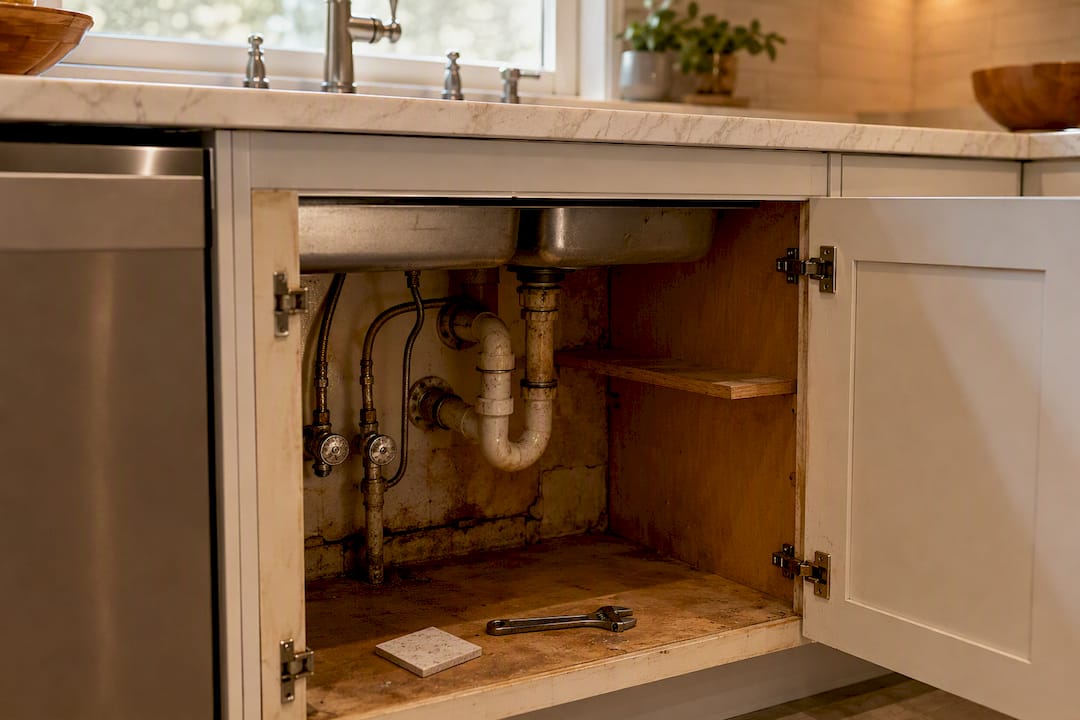
Small rooms skew the math even harder. A 40 square foot bathroom with a full gut (new tub, tile, vanity, plumbing rough-in) might cost $8,000. Divide that by 40 square feet and you get $200 per square foot, a number that looks absurd next to a whole-house average but is completely normal for that room. Project-level data on cost per square foot shows this volatility clearly: labor and materials don’t scale down proportionally in small spaces, because a plumber charges close to the same amount whether the room is 40 square feet or 100.
Hidden systems are the real budget killer. Per-square-foot rates generally assume you can see what you’re paying for. They don’t account for:
- Knob-and-tube wiring behind newer drywall
- Foundation settling that isn’t visible until you pull flooring
- Galvanized pipe that’s corroding from the inside
- Mold behind a bathroom wall you can’t inspect until demo starts
None of these show up on a drive-by or even most walkthroughs. They show up once demo starts, which is exactly why contingency exists.
Pro Tip: If a property has any kitchen or bathroom older than 25 years, budget those rooms separately at $100 to $250 per square foot before you apply a blended rate to the rest of the house. It’s the single fastest fix for per-SF math that runs low.
Labor is the variable that moves the needle most inside any of these ranges. Material costs are relatively standardized nationwide, but labor rates for licensed trades, electricians, plumbers, and HVAC techs can swing 30% or more between markets, and that swing shows up almost entirely in your moderate and full-gut numbers, where skilled trade work dominates the budget.
How to Turn a Quick Estimate Into a Real Budget
A per-square-foot number gets you in the door. It should never be the number you use to calculate your maximum allowable offer. Here’s the workflow that converts a screening estimate into something you can actually take to a lender or a seller.
- Pick your scope and calculate the screening range. Multiply square footage by the lower and upper estimates for the identified scope to get a broad starting cost range. For example, a 1,400 square foot moderate rehab yields a rough range consistent with moderate renovation costs.
- Add soft costs on top of the hard cost range. Permits, dumpster rental, portable toilets, temporary utilities, and a construction loan’s carrying costs typically add another 8% to 15% to the hard cost total, depending on project length and financing structure.
- Layer in contingency based on scope. Cosmetic rehabs need 10% to 15% held in reserve. Moderate rehabs need 15% to 20%. Full gut projects, where hidden systems are more likely to surface, need 20% to 30% held back.
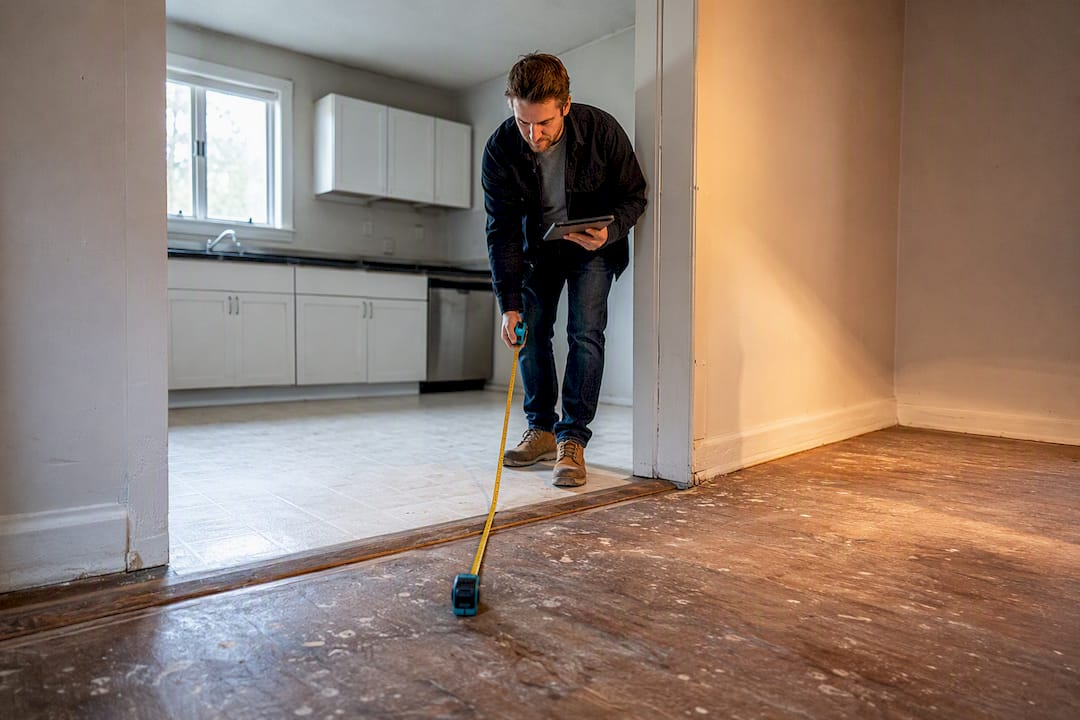
- Schedule a contractor walkthrough before you finalize anything. This is non-negotiable. A 30 to 45 minute walkthrough with a licensed contractor turns your screening number into a real quote with unit rates attached to actual conditions.
- Record line-item unit rates during the walkthrough. Ask for a rate per square foot of flooring, a rate per linear foot of cabinets, a flat rate for the HVAC swap. These numbers become your reconciliation check against the original per-SF estimate.
- Reconcile the contractor’s line items against your screening number. If the walkthrough total comes in more than 15% over your screening estimate, something was missed in scope, or the property has more deferred maintenance than it looked like on paper.
The reconciliation step catches the mistakes that per-square-foot math can’t. A structured investor workflow built around this exact sequence, screen, walkthrough, quote, reconcile, is standard practice among investors who don’t get burned on rehab budgets repeatedly.
Contingency deserves its own line of thought here, because too many investors treat it as an afterthought instead of a real budget category. On a cosmetic flip, 10% to 15% covers minor surprises like unexpected subfloor rot under old carpet. On a moderate rehab, 15% to 20% accounts for the chance that “update the kitchen” turns into “replumb the kitchen” once the sink cabinet comes out.
A rehab budget checklist built around line-item scope of work helps standardize this process so you’re not reinventing your walkthrough template on every deal.
Worked Math: 1,200 and 1,500 Square Foot Examples
Numbers make this concrete faster than any explanation. Here’s how the screening ranges play out on two common house sizes.
1,200 square feet:
| Scope | Rate range | Screening total |
|---|---|---|
| Light cosmetic | $25–$40/sq ft | $30,000–$48,000 |
| Moderate | $45/sq ft | $60,000–$90,000 |
| Full gut | $90 | $108,000–$162,000 |
1,500 square feet:
That’s the whole appeal of per-SF math: it scales cleanly for the parts of a house that really are proportional, like flooring, paint, and drywall.
But it also shows why the kitchen and bath problem matters more on the smaller house. On a 1,200 square foot property, a $25,000 kitchen and bath overhaul represents a much bigger share of total budget than it does on a 1,500 square foot property with the same two rooms. Smaller homes generally have less room for the fixed-cost items (one kitchen, one or two bathrooms) to get diluted across square footage.
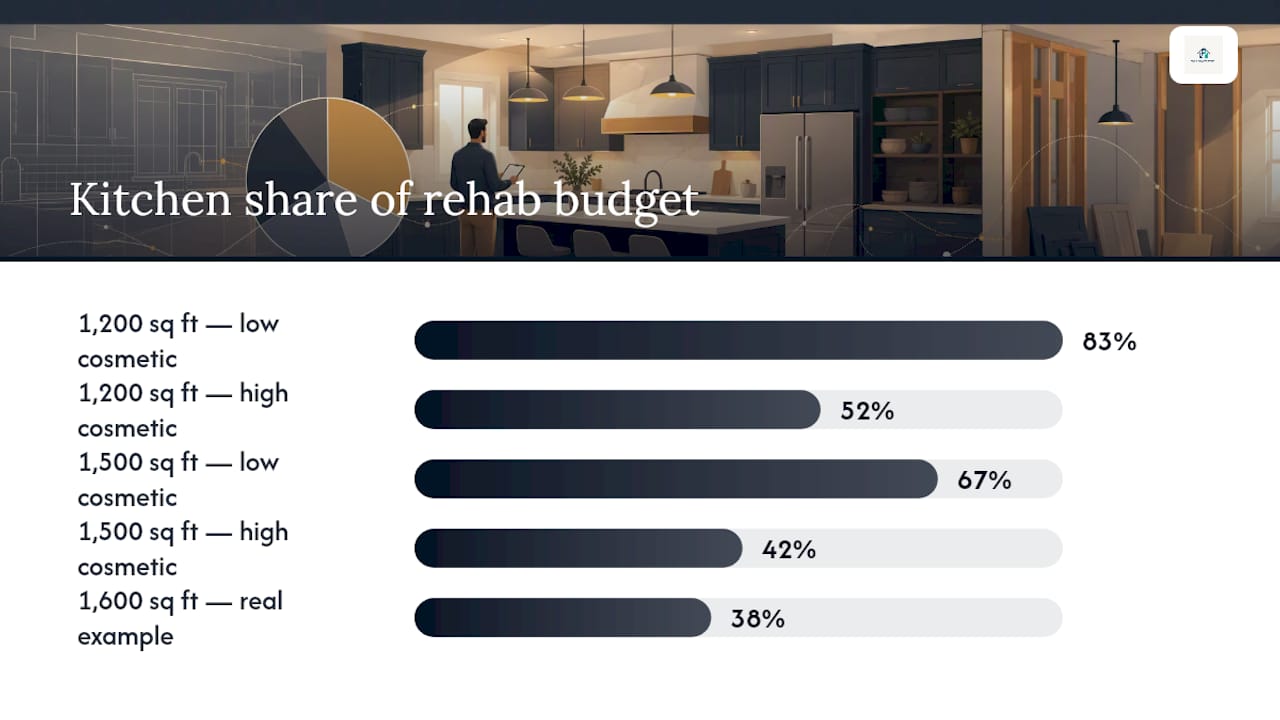
A real-world example from investor cost calculators shows this in practice: a mid-grade cosmetic rehab on a 1,600 square foot property totaled $65,090 in combined hard costs and 15% contingency, which works out to about $41 per square foot once everything is added up. That’s slightly above the low end of the cosmetic range and shows how contingency alone can push a screening number up by several dollars per square foot once you’re being honest about risk.
Adjusting National Ranges for Your Local Market
National ranges are a starting point, not a local answer. Two houses with identical scope and square footage can cost $30,000 apart depending on whether they sit in a low-cost labor market or a high-demand metro.
Build a regional multiplier by comparing three or four recent contractor bids you’ve received in your target area against the national midpoint for that scope. If your moderate rehab bids are consistently coming in at $85 per square foot against a national midpoint of $62.50, your local multiplier is roughly 1.36. Apply that multiplier to every future screening estimate in that market until your bid history tells you otherwise.
Finish level matters just as much as geography:
- Budget finishes (builder-grade cabinets, laminate counters, vinyl flooring) sit at or below the low end of each range.
- Mid-grade finishes (semi-custom cabinets, quartz counters, luxury vinyl plank) sit at the midpoint.
- Premium finishes (custom cabinetry, natural stone, hardwood) can push 30% or more above the high end, even on an otherwise cosmetic scope.
If every contractor in your market quotes higher than the national range predicts, that’s not a fluke; it’s local labor scarcity or high permit costs, and it’ll show up on every deal you screen in that zip code going forward.
What’s Actually Inside a Rehab Budget
A contractor quote that just shows one lump number is a quote you should push back on. A real budget breaks into categories, and knowing the typical split helps you catch what’s missing before you sign anything.
On a full gut, labor’s share climbs because structural and mechanical trades charge more per hour than cosmetic finish work.
Soft costs are where investors most often underbudget:
- Permit fees, which vary widely by municipality and scope of work
- Dumpster rental, typically needed for the full project duration on anything beyond light cosmetic
- Construction loan carrying costs (interest during the rehab period)
- Post-renovation cleaning before listing, which runs a predictable rate per square foot that’s easy to forget until closing week
- Utility costs during vacancy while work is underway
- Insurance adjustments for a vacant property under renovation
When a contractor hands you a quote, check for four things before you accept it: a written warranty period on labor, clearly stated allowances for items like fixtures and flooring (not just “TBD”), a defined change-order process with pricing for scope additions, and a payment schedule tied to project milestones rather than a lump sum upfront. A quote missing any of these four is a quote that’s going to generate disputes mid-project.
Your Walkthrough Checklist Before You Sign Anything
A single walkthrough, done right, catches most of the surprises that blow up a rehab budget later. Work through it in this order:
- Roof and attic first. Look for water stains, sagging, and daylight through the decking. A roof replacement can add $8,000 to $15,000 that a per-SF estimate never anticipated.
- Moisture signs everywhere. Basement walls, under sinks, around window frames. Moisture means mold risk and possible structural rot.
- HVAC age and condition. Anything past 15 years is a likely replacement, not a repair line.
- Electrical panel and visible wiring. Look for outdated panel brands, aluminum wiring, or any sign of DIY work.
- Plumbing material and water pressure. Ask what the supply lines are made of; galvanized pipe is a full re-pipe waiting to happen.
- Ask the contractor to state exclusions in writing. What’s not in this quote matters as much as what is.
Pro Tip: If a contractor hesitates to give you a per-unit rate for flooring, cabinets, or fixtures and only wants to quote a lump sum, that’s a red flag. Unit rates are how you catch scope creep before it becomes a change order.
Any red flag from roof, moisture, or electrical should trigger either a specialist inspection or an automatic bump to the high end of your contingency band. Don’t split the difference to make the deal work on paper.
Speeding Up Screening Without Skipping Verification
Photo-based AI tools have changed how fast the first pass on a deal can happen. Instead of eyeballing a listing and guessing a scope category, software that reads uploaded property photos can flag likely rehab categories and rough cost ranges before you’ve even scheduled a showing.
That speed matters when you’re screening a dozen leads a week and can’t put a contractor on every single one. An AI estimate gives you a fast second opinion on scope classification, kitchen and bath condition, and visible red flags like roofline sag or exterior water damage, all without leaving your desk.
The right way to use this kind of tool is as a first-pass filter, not a final number. Run the photos and get an ARV range and a rehab estimate, use that to decide whether the deal clears your minimum margin, and then bring in a contractor to verify the properties that pass the first screen. That’s the same screen-then-verify sequence covered in the walkthrough section above, just compressed into minutes instead of days.
A free rehab cost estimator works this way: upload property photos, get an instant rehab cost range alongside an ARV estimate and maximum allowable offer, and use that output to prioritize which leads earn a contractor visit this week instead of next month. It won’t replace the walkthrough. It will tell you which properties deserve one first.
An Investor’s Take On Speed Versus Certainty
Every flipper wants a faster way to screen deals, and per-square-foot math earns its place because it genuinely works as a first filter. The mistake isn’t using it. The mistake is treating a screening number like a closing number.
I’d rather lose a few hours on a walkthrough than lose several thousand dollars discovering a re-pipe mid-demo. Contingency isn’t a formality you check off, it’s the number that keeps a tight timeline from turning into a financial hole. My rule of thumb: if a property has anything beyond light cosmetic work, I don’t finalize an offer until a contractor has walked it and given me unit rates I can reconcile against my screening math.
Speed gets you to more deals. Verification is what keeps you in business long enough to close them.
— Sam
Get an Instant Rehab Estimate Before You Make an Offer
Running the math by hand works, but it takes time you don’t always have when a lead needs an answer today. DealAnalyzerAI gives you an ARV range, a maximum allowable offer, and a rehab cost estimate pulled from uploaded property photos, all in minutes instead of the hour or more it takes to build a screening budget from scratch.

The estimator flags likely scope categories and cost ranges automatically, so you can compare its output against your own per-square-foot math and see where the two agree or diverge. That comparison alone tells you which leads deserve a contractor call this week. Try the free rehab cost estimator on one active lead right now, and once you have a rehab number, run it through the fix and flip calculator to see your projected profit before you write an offer.
Sources
The ranges and examples in this guide come from investor-focused cost guides and remodeling cost trackers rather than a single source. The 2026 investor rehab cost guide supplied the core screening ranges and the screen-then-verify methodology. The rehab cost calculator resource provided the worked $41-per-square-foot example. HomeGuide’s remodeling cost data supported kitchen and bath figures, and cost-per-project-type data explained room-level volatility.
- Estimating Rehab Costs: The 2026 Investor’s Guide (+ Free Checklist)
- Rehab Cost Estimator: The Checklist That Catches Omissions | Real Estate Investing Edge
- House remodeling cost (HomeGuide)
- Cost Per Square Foot by Project Type: The Complete Reference
FAQ
How much does it cost to rehab a 1,200 square foot house?
A 1,200 square foot house typically costs $30,000 to $48,000 for a light cosmetic rehab, $60,000 to $90,000 for a moderate rehab, and $108,000 to $162,000 for a full gut, before soft costs and contingency.
Is rehabbing a house worth it?
Rehabbing can be worth it when the after-repair value comfortably covers the purchase price, rehab cost, financing carry, and a built-in profit margin, which is why a contractor-verified budget matters more than a quick screening number before you commit.
What’s the fastest way to get a rehab cost estimate before a walkthrough?
Tools like A free rehab cost estimator analyze uploaded property photos to generate an instant ARV range and rehab cost estimate, letting you prioritize which leads deserve a contractor visit.
Recommended
Analyze Your Next Deal with AI
Get an instant ARV estimate, rehab cost analysis, and deal score — free for 7 days.
Get Free Deal Breakdown