Why Accurate Comps Protect BRRRR Investors' Margins
Discover why accurate comps protect BRRRR investors. Learn how they secure profits, reduce refinancing risks, and free up capital for your next investment.
By DealAnalyzerAI Editorial Team
Real estate investing education and deal-analysis research from DealAnalyzerAI.

Why Accurate Comps Protect BRRRR Investors’ Margins
TL;DR:
- Accurate comps are crucial for setting correct ARV and MAO, which protect BRRRR investors from overpaying and refinancing risks. Misjudged comps can inflate property value projections, shrinking margins and trapping capital, ultimately causing deal failure. Using thorough, conservative analysis ensures dependable refinancing and ongoing real estate success.
Accurate comparable sales (comps) are the single most important safeguard BRRRR investors have. They determine your After-Repair Value (ARV), set your Maximum Allowable Offer (MAO), and decide whether your refinance closes at the LTV you need. Get them wrong, and you don’t just lose margin — you trap capital that should be funding your next deal.
Here’s what accurate comps do for you in practice:
- Defend your MAO math. A reliable ARV produces a MAO that leaves real profit after purchase, rehab, and closing costs — not a number that looks good on paper until the appraisal comes in.
- Reduce appraisal and refinance risk. Lenders typically cap cash-out refinances at 75% LTV, and DSCR lenders require 1.2–1.25 coverage. Both thresholds depend directly on a supportable ARV and verified rent comps.
- Prevent capital from getting trapped. When the appraisal falls short of your projected ARV, you either inject more cash or walk away from the refinance — neither outcome repeats the BRRRR cycle.
Tools like Dealanalyzerai give investors AI-filtered comp sets and instant ARV ranges so you can verify numbers before you bid, not after you close.
Table of Contents
- Why accurate comps protect BRRRR investors from the first number forward
- Which deal metrics break when your comps are wrong?
- Common comp mistakes that sink BRRRR deals
- How to choose and adjust comps to produce a reliable ARV
- How to stress-test deals with conservative ARV scenarios
- What lenders and appraisers actually check at refinance
- Quick formulas and a pre-offer checklist
- Key Takeaways
- The comp habit that separates repeatable BRRRR investors
- Dealanalyzerai gives you defensible comps before you bid
- Useful sources and further reading
- FAQ
Why accurate comps protect BRRRR investors from the first number forward
Every BRRRR deal starts with a comp. Specifically, it starts with a comparable sale — a recently closed property that is similar in size, condition, location, and features to your target after renovation. Appraisers use the sales comparison approach to reconcile several adjusted comps into a single indicated value: the ARV. That ARV is not a guess. It is a weighted conclusion drawn from real market evidence, and it is the number your lender will use when they order their own appraisal.
The chain of dependency runs like this: comps feed ARV, ARV sets MAO, MAO determines whether you overpay, and the appraisal at refinance either confirms your ARV or exposes the gap. Miss any link, and the whole deal structure breaks.
The standard MAO formula keeps the chain intact:
MAO = (ARV × 70%) − Estimated Rehab Costs
In tighter 2026 markets, disciplined investors are targeting 55–65% of ARV rather than the traditional 70%, building in room for appraisal variance, timeline slippage, and higher debt service.
Here’s a short worked example:
| Variable | Conservative Scenario |
|---|---|
| Projected ARV (from comps) | $200,000 |
| MAO at 60% rule | $120,000 − rehab |
| Estimated rehab | $35,000 |
| MAO (net) | $85,000 |
| Refinance at 75% LTV | $150,000 cash-out |
| Equity left in deal | $65,000 |
If your comps are solid and the appraisal confirms $200,000, you pull $150,000 at refinance, cover your purchase and rehab, and repeat. If your comps were optimistic and the appraisal comes in at $175,000, your cash-out drops to $131,250 — and you may not recover your full rehab investment.
Which deal metrics break when your comps are wrong?
Bad comps don’t just inflate ARV. They distort every downstream metric you use to evaluate a deal. Understanding how comps affect property value across your full underwriting model is what separates disciplined investors from ones who get burned at the refinance table.
ARV is the most direct casualty. An optimistic comp set pushes ARV up, which makes every percentage-based metric look better than it is.

MAO rises with ARV, so you bid more than the deal can support. You win the deal and lose the margin.
Rehab margin shrinks because you’ve already overpaid at acquisition. Any cost overrun — and rehab budgets routinely run over — eats directly into what little buffer remains.
Cap rate looks attractive when projected rents are high and ARV is inflated, but both inputs are suspect when comps are weak. A cap rate built on bad data is not a cap rate — it’s a guess dressed up as math.
DSCR is where lenders catch you. If your rent comps are optimistic and your actual rent comes in below projection, your debt service coverage ratio falls below the 1.2–1.25 threshold most DSCR lenders require. The refinance fails, or the loan terms worsen.
Cash-on-cash return and projected cash flow both assume your ARV-driven purchase price was correct. When it wasn’t, your actual cash-on-cash is negative before you account for vacancy.
Refinance LTV is the final checkpoint. A lender offering 75% LTV on a $200,000 ARV gives you $150,000. On a $175,000 appraisal, that same lender gives you $131,250. A $25,000 ARV error costs you $18,750 in cash-out proceeds — and that’s before you factor in the equity you can’t recycle into the next deal.
Common comp mistakes that sink BRRRR deals
The most expensive comp errors are not exotic. They’re the same mistakes investors make repeatedly, often because the numbers looked close enough at the time.
Over-relying on automated valuations. Zillow’s Zestimate and similar AVM tools are built for speed, not appraisal accuracy. They can’t account for condition, recent updates, or micro-neighborhood differences. Using an AVM as your primary ARV source is underwriting on a guess.
Using comps that are too old or too far away. A sale from 18 months ago in a shifting market tells you very little about today’s value. A comp three miles away in a different school district tells you even less. Appraisers typically prefer sales within the past six months and within a one-mile radius in urban markets.
Cherry-picking the high end. Selecting only the top-performing sales in a neighborhood inflates your ARV and your confidence. The appraiser will pull the full range — and reconcile toward the middle.
Ignoring condition and feature adjustments. A three-bed, two-bath comp with a renovated kitchen is not equivalent to your three-bed, one-bath target with original 1970s finishes. Failing to adjust for bed/bath count, square footage, lot size, and condition produces an ARV that no appraiser will support.
Skipping rent comps entirely. Rent comps matter for refinance, not just cash flow. Weak rent support can lower appraisal outcomes in rental-heavy markets and kill DSCR qualification.
What a $30K ARV overestimate actually costs you
Consider a deal where your comp analysis projects an ARV of $215,000, but the appraiser’s reconciled value comes in at $185,000. At 75% LTV, your cash-out drops from $161,250 to $138,750 — a $22,500 shortfall. If your all-in cost was $155,000, you don’t just leave money on the table; you leave capital trapped in the deal that you cannot recycle. The BRRRR cycle stops.
When rent comps fail the DSCR test
Suppose you project $1,800/month rent based on a few active listings, but the actual leased comps in the area average $1,550. At a 6.5% DSCR loan rate on a $150,000 refinance, your monthly payment is roughly $948. At $1,800 rent, your DSCR is 1.90 — comfortable. At $1,550, it drops to 1.63 — still passing, but if your actual rent comes in at $1,400 due to vacancy or concessions, your DSCR falls to 1.48. Some lenders will still approve; others won’t. The margin for error disappears.
Pro Tip: Always run rent comps from leased transactions, not active listings. Active listings are asking prices. Leased comps are what tenants actually paid — and that’s what your lender’s underwriter will use.
How to choose and adjust comps to produce a reliable ARV
Pulling defensible comps is a repeatable process. Follow these steps every time before you make an offer.
-
Define your search radius and timeframe. Start within 0.5–1 mile for urban or suburban markets; expand to 2–3 miles only if the market is thin. Prioritize sales from the past six months; go to 12 months only when recent sales are scarce, and note the timeframe in your documentation.
-
Require at least three closed sales. Three closed sales is the standard minimum for a URAR appraisal report, but in thin markets appraisers may expand parameters and explain their choices. Pull five or more when you can — more data reduces the risk of one outlier skewing your ARV.
-
Filter out non-arm’s-length and distressed sales. REO sales, foreclosures, estate sales, and transactions between related parties do not reflect market value. Remove them before you run your analysis.
-
Apply adjustments for key differences. Common adjustment benchmarks: +$8,000–$12,000 for an additional full bath, +$5,000–$8,000 per 200 square feet of finished space, −$8,000–$15,000 for inferior condition, and +$5,000–$10,000 for a significant update (new kitchen, HVAC). Keep adjustments proportionate — Fannie Mae guidance historically flags net adjustments over 15% and gross adjustments over 25% as reliability concerns.
-
Record every source with screenshots. Save MLS printouts, county recorder records, and photos. When the appraiser asks for your comp rationale — and some will — you hand them a documented file, not a verbal explanation.
For rental refinance comps, add rent-roll documentation and leased-transaction printouts from your local MLS or property manager. Pull at least five actively leased comps within 0.5 miles.
Pro Tip: Package your comp file the same way an appraiser would: MLS data sheet, county record, exterior photo, and a one-line adjustment note for each difference. Lenders and appraisers respond to documentation that mirrors their own workflow.
How to stress-test deals with conservative ARV scenarios
Running one ARV number and calling it underwriting is how investors get surprised at the appraisal. The right approach is three scenarios — optimistic, base, and conservative — with the conservative case driving your offer decision.
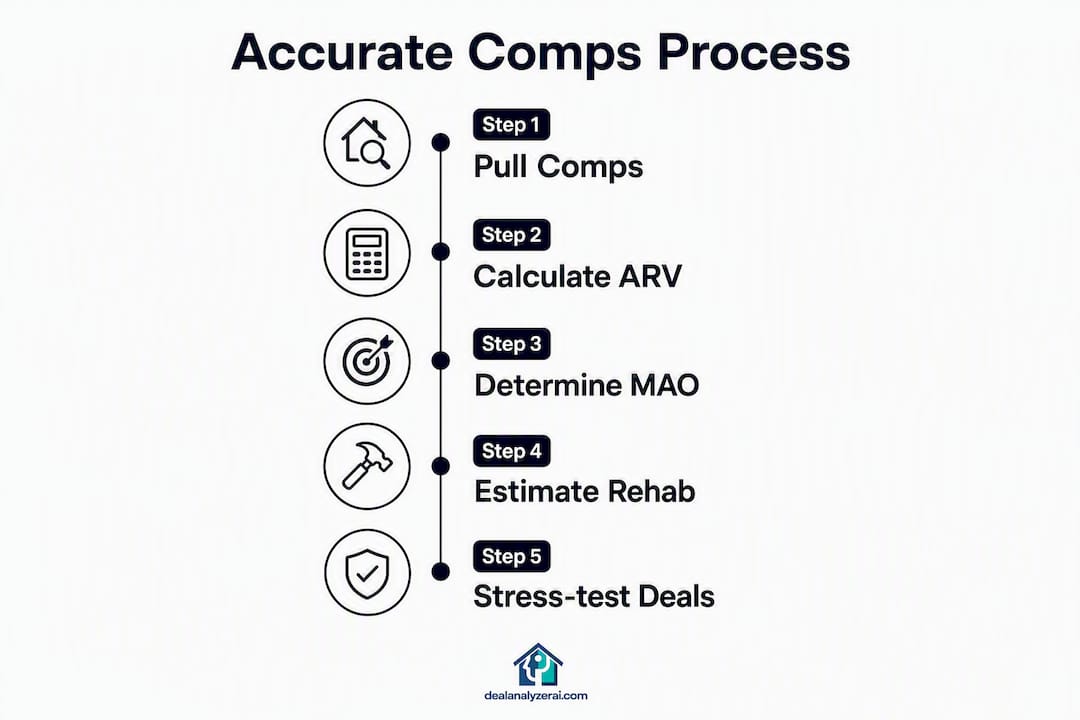
The standard conservative rule: run your deal at 90% of your average comp-derived ARV. That 10% buffer absorbs appraisal variance, market softening between contract and close, and the appraiser’s tendency to weight adjusted comps conservatively when adjustments are large.
Here’s what that looks like across three scenarios on a deal with an average comp-derived ARV of $200,000:
| Scenario | ARV | MAO (70%) − $35K Rehab | Refinance at 75% LTV | Capital Recovered |
|---|---|---|---|---|
| Optimistic | $210,000 | $112,000 | $157,500 | Full + buffer |
| Base | $200,000 | $105,000 | $150,000 | Full recovery |
| Conservative (90%) | $180,000 | $91,000 | $135,000 | Partial; $20K trapped |
If the conservative scenario still works — meaning you can acquire at or below $91,000 and the refinance covers your costs — the deal has real margin. If it only works at the optimistic ARV, you’re underwriting on hope.
Run these stress-test steps on every deal before you bid:
- Recalculate ARV at 90% of your comp average and rerun MAO at that number.
- Run DSCR using lower-quartile rent comps, not median projections.
- Add a 10–15% contingency to your rehab estimate for cost overruns and holding time.
- Model a worst-case appraisal outcome and confirm you can still service the debt or exit cleanly.
Pro Tip: For DSCR qualification, use the bottom quartile of your leased rent comps. Use the median for your cash-flow planning. The gap between those two numbers tells you how much cushion you actually have.

What lenders and appraisers actually check at refinance
When you submit for a cash-out refinance, the lender orders an independent appraisal. That appraiser does not use your comp file — they build their own. But if your underwriting comps were defensible, the two analyses will land close to each other. If yours were optimistic, the gap shows up as a lower-than-expected appraisal.
Here’s what the lender and appraiser are actually evaluating:
- Sales comparison grid. The appraiser selects three or more closed sales, adjusts each for differences, and reconciles them into an indicated value. Large adjustments reduce a comp’s weight in that reconciliation.
- LTV limits. Most conventional cash-out refinance programs cap at 75% LTV. DSCR loan programs vary, but 70–75% is common. Every dollar of ARV shortfall reduces your cash-out by 70–75 cents.
- DSCR targets. Lenders require 1.2–1.25 DSCR on rental properties. If your rent comps were optimistic, actual rent may not support the loan amount you need.
- Seasoning requirements. Many lenders require a 6–12 month seasoning period before they’ll allow a cash-out refinance. That’s 6–12 months of holding costs on top of your rehab budget — another reason conservative ARV buffers matter.
- Verified closed sales only. Appraisers use closed, arm’s-length transactions. Pending sales, active listings, and off-market deals do not count.
When the appraisal comes in below your projected ARV, you face three options: bring cash to close the gap, accept a smaller cash-out and leave equity trapped, or walk away from the refinance entirely. None of those outcomes repeats the BRRRR cycle on schedule.
For a deeper look at why BRRRR deals fail at refinance, the patterns are consistent — and almost all of them trace back to ARV assumptions that the appraisal couldn’t support.
Quick formulas and a pre-offer checklist
These are the four calculations every BRRRR investor should run before submitting an offer.
ARV = Weighted average of adjusted comparable closed sales (minimum three comps, adjusted for condition, size, and features)
MAO = (ARV × 55–65%) − Estimated Rehab − Closing/Contingency Costs
Refinance Proceeds = ARV × Lender LTV (typically 75%)
DSCR = Gross Annual Rent ÷ Annual Debt Service (target: ≥ 1.25)
Here’s a filled example you can copy directly into Dealanalyzerai or your own spreadsheet:
| Input | Value |
|---|---|
| Average comp-derived ARV | $200,000 |
| Conservative ARV (90%) | $180,000 |
| Estimated rehab | $35,000 |
| Net MAO | $73,000 |
| Projected refinance (75% LTV) | $135,000 |
| Projected monthly rent | $1,550 |
Before you make an offer, verify each of these:
- At least three closed, arm’s-length comps within 0.5–1 mile and six months
- ARV stress-tested at 90% of your comp average
- MAO calculated at conservative ARV, not optimistic
- Rehab estimate includes a 10–15% contingency
- Rent comps from leased transactions, not active listings
- DSCR confirmed at lower-quartile rent projection
- Comp documentation saved and ready for the appraiser
The free BRRRR calculator from Dealanalyzerai runs MAO, ARV, and cash-flow scenarios in one place, so you’re not doing this math across three separate spreadsheets.
Key Takeaways
Accurate comps are the foundation of every BRRRR deal — without them, your ARV, MAO, and refinance math are all built on assumptions that the appraisal will expose.
| Point | Details |
|---|---|
| Run comps yourself | Never rely solely on AVMs; pull closed, arm’s-length sales and adjust for real differences. |
| Underwrite at 90% ARV | Apply a 10% buffer to your average comp-derived ARV before calculating MAO and refinance proceeds. |
| Use leased rent comps for DSCR | Project rent at the bottom quartile of leased comps for lender qualification; use the median for cash-flow planning. |
| Document comp sources | Save MLS printouts, county records, and photos so your comp file mirrors what the appraiser will build. |
| Dealanalyzerai automates the process | Dealanalyzerai’s AI comp analysis, ARV calculator, and stress-test exports reduce human error and speed up deal screening. |
The comp habit that separates repeatable BRRRR investors
Most investors who struggle with BRRRR don’t have a deal-finding problem. They have an underwriting discipline problem. The deals are there. The issue is that optimistic ARV assumptions feel reasonable in the moment — especially when you’ve spent weeks finding a property and you want it to work.
Experienced investors treat comps as a constraint, not a starting point. They pull their own comp set independently, run the conservative scenario first, and only move to the base case if the conservative deal still pencils. They keep a local team — a property manager for rent comps, a lender contact for current LTV and DSCR requirements, and an inspector who knows the rehab cost reality in that market. When a deal only works at the optimistic ARV, they walk. Not reluctantly. Automatically.
The 90% ARV rule and a 10–15% rehab contingency are not pessimistic. They are the minimum buffer that keeps the BRRRR cycle repeatable. A deal that fails the conservative scenario is not a deal you’re passing on — it’s a loss you’re avoiding. The investors who scale to 10, 20, or 30 units are the ones who internalized that distinction early.
Dealanalyzerai gives you defensible comps before you bid
Accurate comp analysis takes time when done manually — pulling MLS data, filtering distressed sales, applying adjustments, and building a scenario table. Dealanalyzerai compresses that process into minutes.
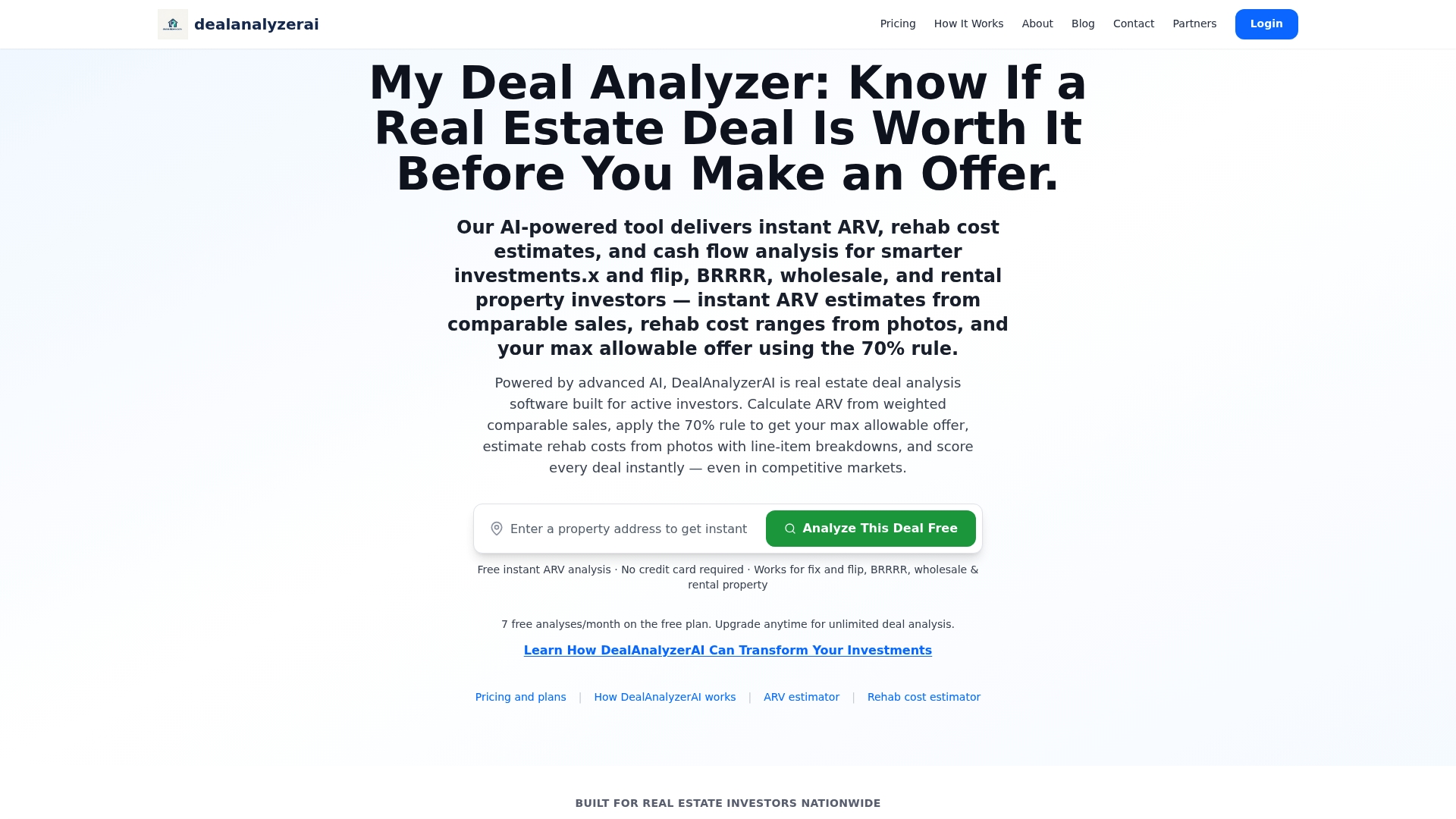
The platform’s AI comp engine evaluates comparable sales, produces an ARV range, and flags deals where the numbers don’t hold up under conservative assumptions. The built-in rehab cost estimator uses uploaded property photos to generate cost projections, so your MAO calculation reflects real scope, not a ballpark. Stress-test exports store your comp documentation in a format lenders and appraisers recognize — the same structured file this article recommends you build manually.
For investors screening multiple properties each week, that speed and consistency is the difference between catching a bad deal before you bid and discovering the problem at the appraisal table. Run your next deal through the free ARV analysis tool and see where your comp-derived ARV actually lands before you commit.
Useful sources and further reading
These are the authoritative sources for pulling comps, understanding appraisal methodology, and reading lender guidelines:
- Comparables: What They Are, How They Work — Investopedia: A clear explanation of how comps establish fair market value; useful for understanding the selection criteria appraisers apply.
- How Appraisers Use Comps: The Sales Comparison Approach — Madison & Park Appraisal: The clearest public explanation of how appraisers weight and reconcile adjusted comps, including adjustment magnitude guidance. Use this to understand what your appraiser will do with your comp file.
- Dos and Don’ts of Selecting Appraisal Comps — McKissock Learning: Appraiser-education guidance on comp selection, including when to expand search radius or timeframe in thin markets.
- BRRRR in 2021 Is Not BRRRR in 2026 — Cornerstone CPA: Market-context analysis on why tighter 2026 conditions require deeper buy-in discounts and conservative ARV buffers.
- IRS Publication 527 — Residential Rental Property: The primary IRS reference for tax treatment of rental income, depreciation, and expenses — relevant when modeling after-tax cash flow on BRRRR holds.
FAQ
What is the 70% rule for BRRRR?
The 70% rule historically set your MAO at 70% of the property’s ARV minus estimated rehab costs: MAO = (ARV × 70%) − Rehab. In tighter 2026 markets, disciplined investors target 55–65% of ARV to account for appraisal variance and higher debt service.
What is the rule of three comparables in real estate?
Three closed, arm’s-length sales is the standard minimum for a URAR appraisal report. In thin markets, appraisers may expand the search radius or timeframe and use fewer comps, but they must document their reasoning — which is why pulling five or more comps when possible gives your ARV more support.
What is the 2% rule in rental property?
The 2% rule suggests that monthly rent should equal at least 2% of the purchase price. It’s a quick screening heuristic, not a substitute for DSCR analysis — most DSCR lenders require 1.2–1.25 coverage regardless of whether a property passes the 2% threshold.
What is the 3-3-3 rule in real estate?
The 3-3-3 rule is a readiness heuristic: maintain three months of emergency reserves, three months of mortgage coverage, and complete at least three property evaluations before buying. It’s a due-diligence and reserve check, not an underwriting formula, but it reinforces the conservative buffer approach that protects BRRRR investors at every stage.
How do inaccurate comps affect a BRRRR refinance?
When your comp-derived ARV is overstated and the lender’s appraisal comes in lower, your cash-out proceeds drop proportionally — at 75% LTV, a $25,000 ARV shortfall costs you roughly $18,750 in recoverable capital. That gap either traps equity in the deal or forces you to inject additional cash, both of which break the BRRRR cycle.
Recommended
Analyze Your Next Deal with AI
Get an instant ARV estimate, rehab cost analysis, and deal score — free for 7 days.
Get Free Deal Breakdown