Keep $10,000 at Closing: Repair Credit vs Price Cut for Homebuyers
Homebuyers: a math driven comparison of repair credits versus price cuts. See $10,000 examples, lender concession caps, and a clear decision checklist to...
By DealAnalyzerAI Editorial Team
Real estate investing education and deal-analysis research from DealAnalyzerAI.

Keep $10,000 at Closing: Repair Credit vs Price Cut for Homebuyers
For most buyers, a repair credit beats a price cut because it hands you cash at closing instead of shaving a few dollars off your monthly payment. A $10,000 credit covers costs today; a $10,000 price reduction might only trim your mortgage payment by roughly $50 a month. Before you ask for either, check your loan’s remaining concession cap with your lender. That number decides whether a credit is even possible.
TL;DR:
- Repair credits provide immediate cash at closing, covering costs like repairs or prepaid items, while price cuts reduce the loan principal and lower monthly payments by about $50 per $10,000 saved.
- Lenders cap concession amounts based on the loan type, limiting credits to a percentage of the purchase price, and any prior negotiated concessions count against this cap.
- Credits cannot be used for the down payment, and they must be itemized on the Closing Disclosure, with repair-specific wording potentially triggering additional review.
- Buyers who are cash-constrained or dealing with appraisal risks benefit most from requesting a repair credit, especially before inspection results are known.
- Using a property-specific model helps compare the long-term affordability of a price cut versus a repair credit, factoring in loan terms, rehab costs, appraisal risks, and maximum allowable offer.
Table of Contents
- Repair Credit vs Price Cut: How the Math Actually Splits
- How Seller Concession Caps Limit Your Credit Request
- When Should You Ask for a Credit Instead of a Price Cut?
- Decision Checklist: Credit, Price Cut, or Both?
- Three Numbers-Based Scenarios Buyers Actually Face
- Modeling This Tradeoff Before You Negotiate
- What I’d Tell a Buyer Sitting Across the Table From This Decision
- Run Your Own Numbers Before You Send the Counteroffer
- Sources
- FAQ
Repair Credit vs Price Cut: How the Math Actually Splits
The seller writes the same check either way. What changes is who benefits and when. A seller credit shows up as cash applied to your closing costs, prepaid escrows, or discount points at the settlement table. A price cut lowers the purchase price itself, which lowers your loan principal and stretches savings out over 360 monthly payments, instead of handing you anything today.
That distinction is the whole ballgame. Opendoor’s breakdown of seller credits confirms that a credit reduces your cash-to-close immediately, while a price cut reduces principal and payment but leaves your wallet untouched on closing day. Sellers often don’t care which structure you pick, because their net proceeds land in the same place regardless. Your outcome, though, depends entirely on which lever you pull.
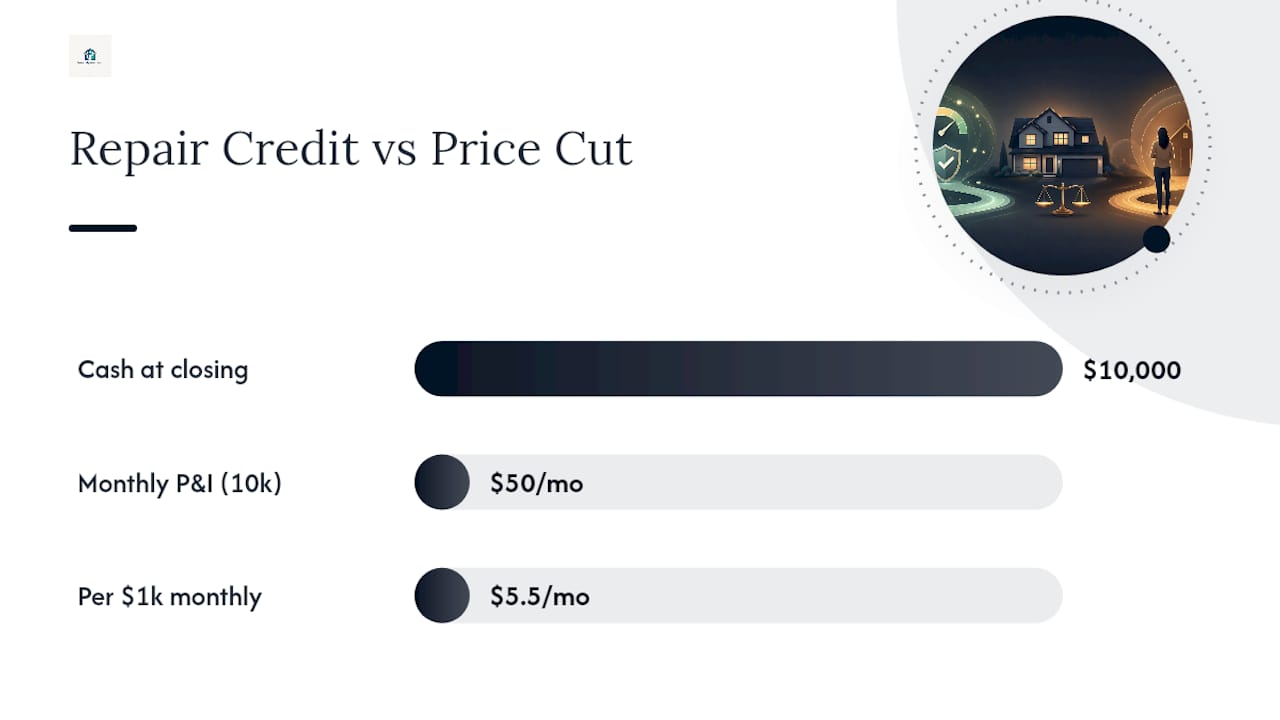
Here’s how a $10,000 concession behaves under each structure, assuming a $400,000 purchase price and a 6.5% rate on a 30-year fixed loan:
| Factor | $10,000 Repair Credit | $10,000 Price Cut |
|---|---|---|
| Buyer cash at closing | $10,000 available immediately | $0 (no cash impact) |
| Monthly payment change (P&I) | No direct change (unless applied to a rate buydown) | Roughly $50 lower per month |
| Effect on loan principal / tax basis | No change to principal; tax basis unaffected | Loan principal drops by $10,000; tax basis on the home lowers accordingly |
| Eligible uses | Closing costs, prepaid items, discount points | Not applicable, built into price |
| Limited by lender/program caps | Yes, counts against IPC limits | No, price is negotiated freely |
| Best when | Buyer is cash-constrained or wants to fund repairs/buydown | Buyer prioritizes long-term payment and has closing cash covered |
The $50-per-month figure on that $10,000 reduction is the detail most buyers underestimate. A price cut sounds satisfying on paper, but at current rates it barely moves your monthly obligation. A credit of the same size, by contrast, can wipe out your entire closing cost bill or fund a chunk of that new roof the inspector flagged.
There’s a nuance worth flagging on the tax side. A price cut lowers your basis in the property, which can matter years later when you sell and calculate capital gains. The IRS guidance on home sales explains how basis adjustments work and why keeping documentation on any price changes protects you at tax time. A credit, by comparison, doesn’t touch your basis at all since it’s a cash transfer rather than a price adjustment.
Statistic callout: Expect roughly $5 to $6 in monthly P&I savings for every $1,000 shaved off the purchase price at a 6.5% rate on a 30-year loan. Scale that math to your own price cut request and you’ll see quickly how small the monthly difference really is compared to the same amount delivered as cash.
Real estate professionals who work through these negotiations regularly point out that the seller’s net proceeds stay identical no matter which structure you choose, so the decision should hinge on what you actually need. If you need liquidity now, a credit wins. If your priority is a lower payment over 30 years and closing cash isn’t tight, a price cut has real value too.
How Seller Concession Caps Limit Your Credit Request
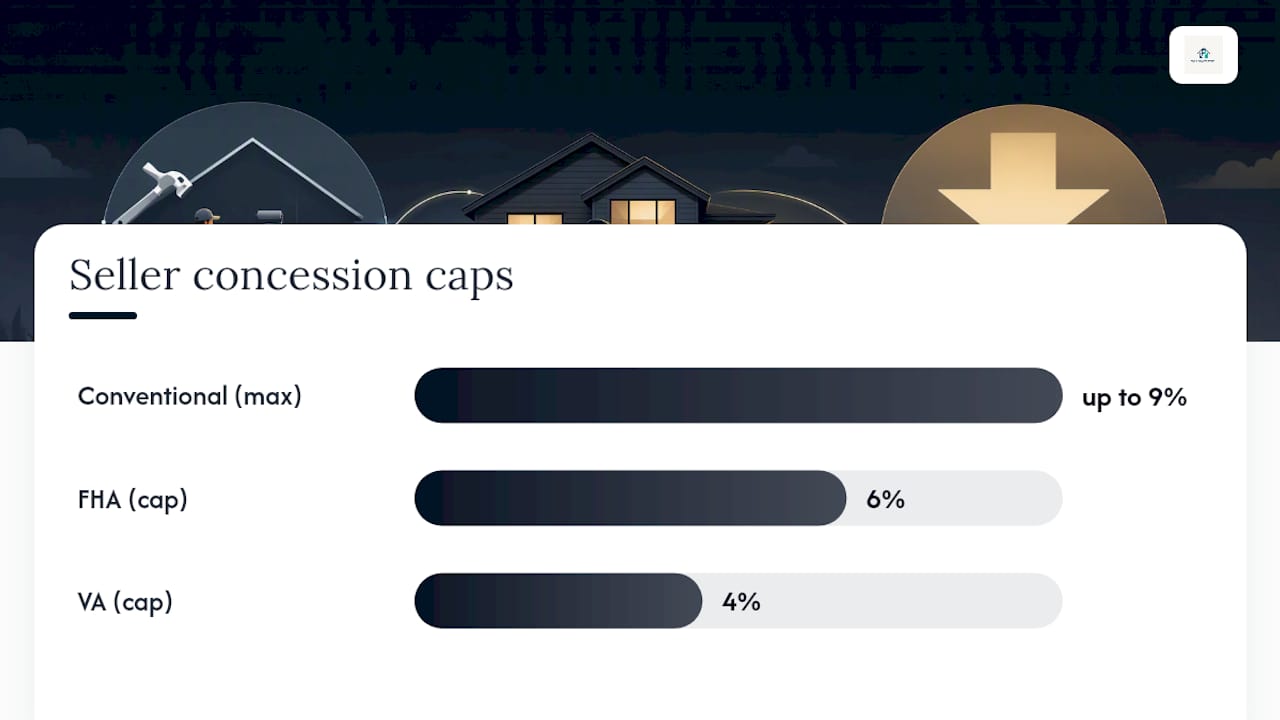
Lenders don’t let sellers hand over unlimited cash. Every loan program sets an interested-party contribution (IPC) cap, and that cap determines the ceiling on your credit request regardless of what the seller is willing to offer.
Conventional loans typically allow IPCs somewhere between 3% and 9% of the purchase price, with the exact percentage tied to your down payment size, according to GoMortgage’s IPC guide. FHA loans cap contributions at 6%, and VA loans cap them at 4%. Exceed the cap and the lender simply won’t process the excess. The unused portion doesn’t roll over or convert into something else; it’s forfeited.
| Loan program | Typical IPC cap |
|---|---|
| Conventional | 3% to 9%, based on down payment |
| FHA | 6% |
| VA | 4% |
A detail that trips up a lot of buyers: if you already negotiated a smaller concession in your initial offer, that amount counts against your total cap. Ask for $8,000 upfront, and you’ve already used most of a $10,000 limit on a low down payment conventional loan before repairs even come up in the inspection period. HUD’s own underwriting handbook lays out the FHA-specific contribution rules in detail, and VA guidelines follow a similarly strict structure.
Credits can pay for a defined set of costs. Eligible uses generally include:
- Closing costs like title fees, recording fees, and lender charges
- Prepaid items such as property tax and insurance escrows
- Discount points to buy down your interest rate
- Home warranty premiums in many markets
What credits absolutely cannot touch is your required down payment. That’s a universal rule across every major loan program, and it’s worth understanding through the lens of down payment assistance resources like this down payment assistance program guide, which lays out how down payment funding works separately from seller concessions.
Here’s where the paperwork gets specific. Every credit has to appear on your Closing Disclosure, the standardized form the Consumer Financial Protection Bureau requires lenders to issue at least three business days before closing. Credits get itemized as specific line entries, and your lender confirms in advance exactly which costs the credit will offset. If your addendum labels the credit as “repair funds” rather than a generic closing cost credit, some underwriters flag it for additional review, since repair-specific language can suggest unresolved property condition issues that affect appraisal risk. That’s a detail worth understanding before you draft the request, which the next section covers directly.
When Should You Ask for a Credit Instead of a Price Cut?
Timing changes your leverage. Ask for a credit in your initial offer, and you’re negotiating from a position where the seller hasn’t yet invested emotional energy in a signed contract. Ask after inspection, and you’re negotiating with specific, documented defects in hand, which tends to produce a more responsive seller because they’re weighing your request against relisting the property and disclosing those same defects to the next buyer.
Negotiating early keeps things simple but limits your ammunition, since you haven’t seen the inspection report yet. Negotiating post-inspection gives you concrete leverage but eats into your timeline and can spook a seller who assumed the deal was settled.
- Confirm remaining IPC capacity with your lender first. If you already used part of your cap in the initial offer, find out what’s left before drafting any addendum.
- Confirm which closing costs are eligible for the credit. Not every fee on your Closing Disclosure qualifies, so ask your lender to map the credit against actual line items.
- Check appraisal risk before requesting a credit tied to repairs. If the defect is severe enough to affect appraised value, a credit doesn’t solve the underlying problem.
Pro Tip: Skip repair-specific wording entirely. A clean addendum that reads “Seller to provide $X toward buyer’s closing costs at closing” moves through underwriting faster than language that mentions specific repairs, because it avoids triggering condition-related scrutiny.
Decision Checklist: Credit, Price Cut, or Both?
Run these questions with your lender and agent before you draft any counteroffer.
- Are you cash-constrained at closing? If yes, a credit is almost always the better fit since it puts money in your pocket exactly when you need it.
- Do the inspection items affect appraised value? Structural issues, foundation problems, or major system failures can suppress an appraisal regardless of any credit offered, which makes a price cut the more honest fix.
- Have you already used concession capacity in your initial offer? If your cap is nearly maxed out, you may need to combine a smaller credit with a price adjustment to get full value.
- Is lowering your monthly payment the real priority? If your debt-to-income ratio is tight or you’re planning to hold the loan for decades, a price cut’s principal reduction compounds in ways a one-time credit never will.
A useful statistic to keep in mind here: buyers can typically expect only about $5 to $6 in monthly savings per $1,000 of price reduction at current rates, which means a price cut needs to be fairly large before it meaningfully changes your monthly budget.
Red flags that should push you toward a price cut instead of a credit include confirmed structural damage, a low appraisal that’s already come in under contract price, or a seller who’s already extended the maximum concession their loan program and your lender will allow. In any of those situations, pushing harder for a bigger credit just isn’t realistic. A price adjustment becomes the only lever left on the table, and it’s worth reading up on how underwriters evaluate deal structure if you want to understand why lenders draw that line where they do.
Three Numbers-Based Scenarios Buyers Actually Face
-
The cash-tight first-time buyer. You’re closing with $12,000 in reserves and a $10,000 repair bill from the inspection. A $10,000 credit covers the repairs directly and leaves your reserves intact. A $10,000 price cut instead saves you around $50 a month, but you still have to pay for repairs out of pocket, draining your cash cushion right after closing.
-
The rate-sensitive buyer using a 2-1 buydown. Instead of taking a flat credit, you apply $10,000 toward a temporary rate buydown. In Year 1, your effective rate drops two points below your note rate, which on a $400,000 loan can save several hundred dollars a month, according to buydown mechanics GTG Financial outlines. That’s a bigger short-term payment win than a straight price cut delivers.
-
The appraisal-risk buyer facing a foundation issue. The inspection reveals foundation cracking that an appraiser is likely to flag. A credit doesn’t change the appraised value, and if the appraisal comes in low, your loan amount shrinks regardless of any credit negotiated. A price cut here is the more defensible move, since it aligns the contract price with what the property will actually appraise for.
Modeling This Tradeoff Before You Negotiate
Running these numbers by hand works for a back-of-envelope estimate, but a property-specific model catches details spreadsheets miss, especially rehab cost variance and how a credit or price cut shifts your maximum allowable offer.
To model the tradeoff properly, you need a handful of inputs: the property address or nearby comparable sales, your proposed purchase price, the credit amount under discussion, your loan terms, and the scope of any repair work. From there, the outputs worth inspecting are your projected cash-to-close, your maximum allowable offer, your revised monthly P&I, and how sensitive your numbers are to rehab cost estimates that come in higher or lower than expected.
- Address or comps, purchase price, and proposed credit amount
- Loan terms (rate, term, down payment)
- Rehab scope and photos for cost estimation
- Outputs: cash-to-close, MAO, monthly P&I, contingency sensitivity
A model that flags appraisal risk before you submit an offer is worth more than one that only crunches numbers after the fact. Rehab cost variance in particular tends to swing wider than buyers expect, which directly affects whether a credit or a price cut makes more sense for a given property’s condition.
Pro Tip: Print or screenshot your model’s output before you send a counteroffer. Sellers and their agents respond better to a specific number backed by data than to a vague repair request, and it gives your lender something concrete to check against the concession cap.
Even with a solid model in hand, confirm your lender’s actual rules before finalizing anything. Software estimates the math; your loan officer confirms what’s actually allowed.
What I’d Tell a Buyer Sitting Across the Table From This Decision
If you’re cash-tight, take the credit almost every time, unless the property has a defect serious enough to threaten the appraisal, in which case the price cut protects your loan amount in ways no credit can. That’s the judgment call in one sentence, and it holds up across most of the deals I’ve seen negotiated.
When you present the request to the listing agent, keep the tone contractual rather than adversarial. Frame it as “here’s what the inspection identified, here’s the dollar figure, here’s how we’d like to structure it,” not as a complaint about the property. Sellers and their agents respond to specificity, not emotion. A clean number tied to a clear reason moves faster through negotiation than a long explanation of everything that’s wrong with the house.
— Sam
Run Your Own Numbers Before You Send the Counteroffer
Every scenario above assumes round numbers on a hypothetical property. Your actual deal won’t be that clean, and that’s exactly where a purpose-built model earns its place in your negotiation prep.

This tool can provide property-specific estimates such as ARV and rehab costs based on comparable sales and uploaded photos, calculate a maximum allowable offer, and flag appraisal risks before contract commitment. Instead of guessing whether a $10,000 credit or a $10,000 price cut serves you better, you can run your actual address, your actual repair scope, and your actual loan terms and get a number you can hand directly to your lender or agent. Start with the free real estate deal analyzer to test the numbers on your own property, or check the pricing page if you want ongoing access to the full deal-screening toolkit for every offer you make this year.
Sources
Verifying lender-specific rules matters more than trusting general advice, since concession caps and disclosure rules shift by program and by individual lender policy.
- Seller Credits: How Sellers Help Buyers with Closing Costs — Opendoor
- Closing Disclosure — Consumer Financial Protection Bureau
- Repair Credits vs Price Reduction: The Buyer’s Math — Own Luxury Homes
Confirm with your own lender before finalizing any request. Caps and eligible uses can vary based on your specific loan product, even within the same program.
FAQ
What’s the Difference Between a Credit and a Price Reduction?
A credit gives you cash at closing to cover costs like closing fees, prepaids, or discount points. A price reduction lowers your loan principal and monthly payment instead, without putting any cash in your hand on closing day.
How Does a Repair Credit Work at Closing?
The seller agrees to a dollar amount that gets applied against your closing costs on the Closing Disclosure rather than paid out directly. It has to stay within your loan program’s interested-party contribution cap, and it cannot be used toward your required down payment.
What Is the Fastest Way to Improve Your Finances Before Buying a House?
Paying down revolving credit card balances and correcting errors on your credit report tend to move your score fastest, since utilization and reporting accuracy carry heavy weight in most scoring models. Beyond that, keeping accounts open and avoiding new credit inquiries in the months before you apply for a mortgage protects the score you’ve already built.
What Is the 3-3-3 Rule for Buying a House?
Treat it as a rough budgeting heuristic rather than a strict lending rule, since actual loan qualification depends on your lender’s specific underwriting standards.
Can Dealanalyzerai Help Me Decide Between a Credit and a Price Cut?
Yes. Running your property’s address, purchase price, and repair scope through Dealanalyzerai’s deal analyzer produces ARV estimates, rehab cost projections, and a maximum allowable offer you can use to compare both options numerically before you negotiate.
Recommended
Analyze Your Next Deal with AI
Get an instant ARV estimate, rehab cost analysis, and deal score — free for 7 days.
Get Free Deal Breakdown