How Property Class Affects ARV and Refinance for BRRRR Investors
Discover how property class affects refinance ARV for BRRRR investors. Learn the key factors that impact your investment success.
By DealAnalyzerAI Editorial Team
Real estate investing education and deal-analysis research from DealAnalyzerAI.

How Property Class Affects ARV and Refinance for BRRRR Investors
TL;DR:
- Property class influences appraisal sources, loan limits, and refinancing options, significantly affecting capital recovery. Understanding and modeling class-specific ARV ranges and LTV caps helps investors avoid capital traps during BRRRR exits. Using tools like Dealanalyzerai enables accurate scenario planning tailored to property type and market conditions.
Property class changes everything about how an appraiser values your deal and what a lender will let you borrow against it. A single-family rental, a condo, a duplex, and a manufactured home can all sit on the same street and produce wildly different ARV estimates, LTV caps, and eligible refinance programs. The practical consequence: if you model your BRRRR exit using the wrong class assumptions, you can close a deal that looks profitable on paper and then watch capital get trapped at the refinance stage.
Three mechanisms drive this:
- Comp pool differences. Each property class draws from a separate comp set. Fewer recent sales mean wider appraisal variance and a higher chance the appraiser’s number lands below yours.
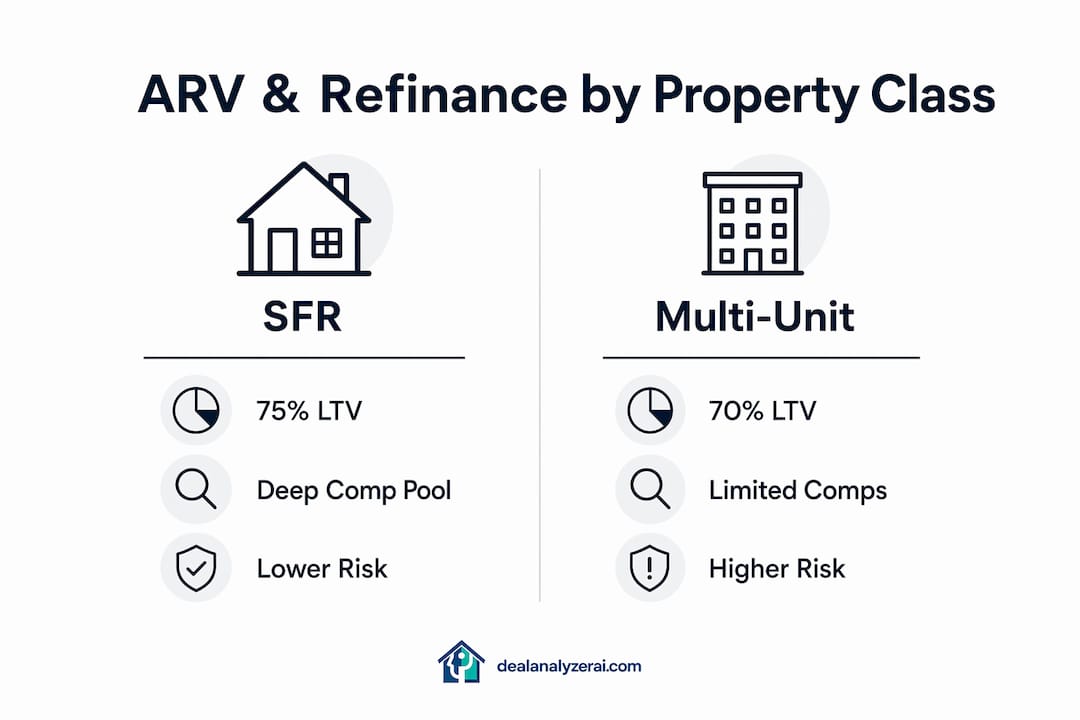
- LTV haircuts by class. Conventional cash-out refinances limit LTV lower for 2–4 unit investment properties than for single-unit ones. Condos, non-warrantable condos, and short-term rentals often face further LTV reductions relative to standard investment properties.
- Appraisal conservatism. Appraisers follow USPAP standards and must support every adjustment with market data. They will not credit your renovation at full cost if comparable finished properties don’t support that value.
Immediate action items: Model your ARV at the conservative end of your comp range. Plan your BRRRR exit at the LTV cap for your specific property class, not the maximum possible. Assemble class-specific documentation before you order the appraisal.
Table of Contents
- How property class changes your ARV estimate
- Why an appraiser’s ARV often differs from yours
- How lenders treat different property classes at refinance
- How the BRRRR 65–75% rule shifts by property class
- Red flags that cut ARV or block refinancing by class
- Practical steps to raise ARV and qualify for better refi terms
- A quick ARV worksheet to stress-test your refinance
- How Dealanalyzerai helps you model ARV and refinance scenarios by class
- Key Takeaways
- What most investors get wrong about property class and ARV
- Run your ARV and refinance scenarios with Dealanalyzerai
- Useful sources
- FAQ
How property class changes your ARV estimate
The comp pool is the foundation of every ARV calculation, and property class defines which sales an appraiser can legally use. An SFR appraiser pulls detached single-family sales. A condo appraiser pulls only condo sales within the same project or comparable projects. A 2-unit appraiser uses duplex sales. When those pools are thin, the appraiser has to reach further in time or distance, and every concession widens the margin of error.
SFR has the deepest comp pools in most U.S. markets. That depth keeps appraisal variance tighter. With sufficient recent, nearby comps, investor ARV estimates generally align closely with appraised values, though sparse comps can cause larger discrepancies.
Condos introduce two layers of complexity. First, the unit itself must comp against similar units in comparable projects. Second, the project as a whole gets reviewed: owner-occupancy ratios, HOA financial health, pending litigation, and delinquency rates all affect whether the project is “warrantable.” A non-warrantable condo project can reduce the eligible lender pool to portfolio lenders only, which typically means tighter LTVs and higher rates.
2–4 unit properties are valued using the sales comparison approach for residential loans, but appraisers must find duplex or triplex comps specifically. In many markets those comps are sparse. Appraisers also adjust for unit mix, gross rent multiplier, and condition of individual units. A well-renovated duplex in a thin market may still appraise below your investor ARV because the appraiser can’t find recent sales to support the finish-quality premium you paid for.
Manufactured homes face the most restrictive comp requirements. The appraiser must use other manufactured home sales, not site-built homes, even if site-built comps are abundant. That constraint often produces lower ARVs in markets where manufactured homes trade at a discount to site-built properties. Title type (real property vs. personal property) and foundation type further affect both appraised value and lender eligibility.
Short-term rentals (STRs) present a different problem. Most appraisers value STRs on the sales comparison approach using long-term rental comps, not STR income. If your ARV model assumes an income-based premium from Airbnb revenue, the appraiser will likely not credit it. Some DSCR lenders will underwrite STR income using platforms like AirDNA, but that is a lender-specific accommodation, not a standard appraisal practice.
Key appraisal adjustments to expect by class:
- SFR: Adjustments for square footage, bedroom/bath count, garage, lot size, and condition. Finish-quality ratings (C1–C6 on Fannie Mae’s scale) directly affect value.
- Condo: Adjustments for floor level, view, HOA fees, storage, and parking. Project-level issues can override unit-level quality entirely.
- 2–4 unit: Adjustments for unit count, unit size, gross rent multiplier, and income potential. Vacant units at appraisal time can reduce value.
- Manufactured home: Adjustments for age, size, foundation type, and land ownership. HUD certification status matters.
- Mixed-use: Appraisers may blend income and sales approaches, creating more variability and requiring a more experienced appraiser.
Why an appraiser’s ARV often differs from yours
An ARV estimate is a planning tool. The refinance succeeds only when the appraiser’s number aligns with yours. That alignment is not automatic, and the gap is often larger than investors expect.
Appraisers work under USPAP (Uniform Standards of Professional Appraisal Practice), which requires them to support every value conclusion with market evidence. They cannot simply accept your renovation budget as added value. They must find sold comps that demonstrate buyers actually paid for those improvements. If your market doesn’t have recent sales of fully renovated properties in your price range, the appraiser will adjust downward.
Common reasons appraisals come in lower than investor projections:
- Different comp selection. The appraiser may weight a lower-priced sale you excluded because it was distressed or older.
- Conservative finish ratings. A C3 (average) finish rating produces a lower value than a C2 (good) rating. Appraisers rate condition based on what they see, not what you spent.
- Thin or dated comps. In slow markets or for less common property classes, the appraiser may use sales from 6–12 months ago, which may not reflect your current renovation premium.
- Seasonal timing. An appraisal ordered in January in a seasonal market may use fall comps that don’t reflect spring pricing.
Worked example. You buy a duplex for $140,000 and spend $45,000 on rehab. Your investor ARV is $240,000, based on three renovated duplex sales at $235,000–$250,000. The appraiser finds only two of those sales usable (one was a related-party transaction) and adds a third sale at $215,000 from eight months ago. Weighted conservatively, the appraiser arrives at $225,000. At a 70% LTV cap for a 2-unit, your maximum loan is $157,500. Your all-in cost was $185,000 (including $5,000 in holding costs). You’re short by $27,500.
Pro Tip: Before the appraisal, prepare a comp packet: a one-page summary of your three best comps with photos, price-per-square-foot analysis, and a brief renovation summary with before/after photos and contractor invoices. Hand it to the appraiser at the inspection. Appraisers are not required to use your comps, but they must consider them — and a well-organized packet reduces the chance they miss a favorable sale.
The role of appraisal in mortgage underwriting is to protect the lender, not to validate your business plan. Understanding that distinction changes how you prepare.
How lenders treat different property classes at refinance
Property class doesn’t just affect ARV. It determines which loan programs you can access, what LTV the lender will approve, and what rate you’ll pay. These three variables together set your actual refinance proceeds.

LTV caps by class and program:
| Property Class | Conventional Cash-Out | DSCR Cash-Out | Notes |
|---|---|---|---|
| SFR (1-unit investment) | 75% LTV | 75% LTV | Standard investment property cap |
| 2–4 unit investment | 70% LTV | 70% LTV | Lower cap reflects income risk |
| Warrantable condo | 70–75% LTV | 70–75% LTV | Project review required |
| Non-warrantable condo | Portfolio only | 60–70% LTV | Fewer lenders, tighter terms |
| Manufactured home | 65–70% LTV | Limited availability | Foundation/title requirements apply |
| Short-term rental | 70–75% LTV | 70–75% LTV | STR income may not be credited |
| Mixed-use | Portfolio/commercial | Varies | Residential rules may not apply |
Investment property mortgage rates tend to carry a premium above primary residence rates. That premium reflects lender risk: owners prioritize their primary residence payment when finances tighten. The premium applies across all investment property classes, but non-warrantable condos, manufactured homes, and STRs often carry an additional rate adjustment on top of the base investment premium.
Extra lender steps triggered by property class:
- Condo project review. Fannie Mae and Freddie Mac require a full project review for most condo refinances. The lender checks owner-occupancy (typically must be above 50%), HOA delinquency rates (must be below 15%), pending litigation, and reserve funding. A project that fails review pushes the loan to portfolio or non-QM, with tighter LTVs.
- Manufactured home requirements. The home must be titled as real property (not personal property), permanently affixed to a foundation, and HUD-certified. Lenders also require a foundation certification from a licensed engineer.
- STR underwriting. Conventional lenders underwrite STRs using long-term rental income or market rent, not actual STR revenue. Some DSCR lenders will use STR income from platforms like AirDNA, but they typically apply a haircut and require 12 months of operating history.
- 2–4 unit income documentation. Lenders require leases and rent rolls. Vacant units at application time reduce qualifying income and can push DSCR below the 1.20x floor.
DSCR loans qualify on property income rather than personal income, which makes them the default refinance vehicle for many BRRRR investors. They typically allow LLC vesting, have shorter seasoning requirements (often 3–6 months vs. 6–12 months for conventional), and are available for most residential investment classes. The tradeoff is a higher rate and, for some classes, a tighter LTV.
For mortgage eligibility by property type, lender requirements vary more than most investors realize. Confirming program availability before you close on a property is not optional.
How the BRRRR 65–75% rule shifts by property class
The BRRRR guideline recommends keeping your all-in cost (purchase + rehab + holding costs) at or below a threshold percentage of ARV to ensure capital recovery. The logic is that a lender’s 75% LTV cap on a 1-unit investment property should return most or all of your capital. But that math breaks down fast when property class triggers a lower LTV cap or an appraisal shortfall.
BRRRR investors who model at a typical all-in percentage but refinance a 2-unit at a lower LTV cap may encounter a capital shortfall, which can worsen if the appraisal comes in lower than expected.
Worked example with class-specific adjustments:
- Investor ARV: $250,000 (2-unit duplex, fully renovated)
- All-in cost: $175,000 (70% of ARV — looks fine at first glance)
- Appraiser’s value: $237,500 (5% below investor ARV)
- Lender LTV cap: 70% (2-unit investment property)
- Maximum loan: $237,500 × 70% = $166,250
- Capital trapped: $175,000 − $166,250 = $8,750
That $8,750 stays in the deal. It’s not catastrophic, but it stops the “repeat” cycle. If the appraisal had come in at $225,000 instead (a 10% shortfall, which is within the range for thin comp markets), the maximum loan drops to $157,500 and the trapped capital grows to $17,500.
Rule-of-thumb targets by class:
- SFR: Target all-in at or below 70% of ARV to absorb a 5% appraisal variance and still recover capital at a 75% LTV cap.
- 2–4 unit: Target all-in at or below 65% of ARV. The 70% LTV cap leaves less room for appraisal variance.
- Condo (warrantable): Target 65–70% all-in. Project review risk adds uncertainty beyond the unit-level ARV.
- Non-warrantable condo or manufactured home: Target 60% or lower. LTV caps can drop to 60–70% and lender options narrow significantly.
- STR: Model using long-term rental income for the DSCR calculation, not STR revenue. If the property doesn’t cash-flow at long-term rents, the DSCR refinance may not qualify.
For a deeper look at why BRRRR deals fail at refinance, the most common cause is an ARV modeled at the optimistic end of the comp range combined with a property class that carries a tighter LTV cap.
Red flags that cut ARV or block refinancing by class
Some issues don’t just reduce your ARV. They stop the refinance entirely. Running a quick triage before you close or start rehab saves you from discovering these problems after you’ve spent the money.
Universal red flags (apply to all classes):
- Unpermitted additions or conversions. Appraisers must note them; lenders may require removal or correction before funding.
- Deferred maintenance that affects habitability (roof, HVAC, plumbing, electrical). Lenders require properties to be in “average” or better condition.
- Zoning nonconformity. A property used as a 3-unit in a zone that allows only 2-unit use may appraise as a 2-unit.
- Title defects or survey problems. These can delay or kill a refinance regardless of ARV.
- Thin or volatile comp sample. Fewer than three recent, similar sales within a reasonable radius is a warning sign.
Class-specific red flags:
- Condo: HOA litigation, reserve fund below 10% of annual budget, owner-occupancy below 50%, single entity owning more than 10% of units. Any of these can make the project non-warrantable.
- Manufactured home: Personal property title (not real property), missing HUD certification plate, non-permanent foundation. These block conventional and most DSCR financing entirely.
- 2–4 unit: Vacant units at appraisal time, below-market leases that reduce DSCR, unpermitted unit additions.
- STR: Local ordinance restrictions on short-term rentals, missing business license, occupancy caps that limit income. These affect DSCR qualification and resale value.
- Mixed-use: Commercial tenant leases that complicate residential underwriting, zoning that limits residential use above ground floor.
Quick pre-close red-flag checklist:
- [ ] Confirm zoning matches actual use
- [ ] Pull permit history and verify all additions are permitted
- [ ] Order a preliminary title report
- [ ] For condos: request HOA financials, litigation status, and owner-occupancy data
- [ ] For manufactured homes: confirm real property title and HUD certification
- [ ] For 2–4 units: review existing leases and confirm all units are legal
- [ ] For STRs: check local ordinances and licensing requirements
Practical steps to raise ARV and qualify for better refi terms
The highest-value rehab improvements vary by property class. Spending $30,000 on a kitchen in a duplex may not move the needle the same way it would in an SFR, because duplex buyers weight income potential more than finish quality.
Prioritized rehab by class:
- SFR: Kitchen and primary bath updates return the most in appraisal finish-quality ratings. Curb appeal (paint, landscaping, front door) affects the appraiser’s first impression and condition rating. Roof and HVAC replacement removes lender condition flags.
- Condo: Focus on unit-level finishes (flooring, kitchen, bath) since you can’t improve common areas. Confirm HOA is current on dues before applying for refinance.
- 2–4 unit: Prioritize habitability and rent-readiness for all units. Occupied, market-rate units at appraisal time support both the income approach and the DSCR calculation. Separate utility metering adds value.
- Manufactured home: Foundation upgrades to meet HUD permanent foundation standards are often the prerequisite for any conventional financing. After that, kitchen and bath updates follow.
- STR: Furnishings and amenities don’t add appraised value, but they affect income. Focus structural rehab on items that affect long-term rental income for DSCR qualification.
Documentation pack for appraisers and lenders:
- Contractor invoices and scope of work for all renovations
- Before/after photos organized by room
- Copies of all permits and certificate of occupancy
- Rent rolls and current leases (for income properties)
- Your comp analysis: three to five recent sales with price-per-square-foot breakdown
- For condos: HOA financials, meeting minutes, and project questionnaire
- For manufactured homes: title documents, HUD certification, and foundation engineer’s report
Seasoning and timing. Conventional lenders typically require 6–12 months of seasoning before a cash-out refinance. DSCR and some portfolio lenders may allow 3–6 months with full documentation. Plan your rehab timeline and refinance application date around the seasoning requirement for your target program. Applying too early forces you into a shorter-seasoning DSCR product, which may carry a higher rate.
Pro Tip: A condition rating upgrade from C3 (average) to C2 (good) on Fannie Mae’s scale can add meaningful value without a full gut renovation. Appraisers look at flooring, fixtures, paint, and trim. Replacing worn carpet with LVP, updating light fixtures, and painting throughout often costs $8,000–$15,000 on an SFR and can shift the condition rating — which affects every comp adjustment in the appraisal.

For guidance on avoiding over-improvement, match your rehab scope to what the comp market actually supports, not what you’d want in your own home.
A quick ARV worksheet to stress-test your refinance
Before you order an appraisal, run this worksheet. It converts your optimistic investor ARV into a conservative, appraiser-ready number and shows you the cash you can realistically recover.
Step-by-step inputs:
- Pull three to five recent sold comps (within 1 mile, within 6 months, same property class).
- Calculate price per square foot for each comp. Average them.
- Multiply average price per square foot by your subject property’s finished square footage. This is your baseline ARV.
- Apply a condition adjustment: subtract 3–5% if your finish quality is average (C3), add 3–5% if it’s above average (C2).
- Apply a class-specific risk discount: subtract 5% for thin comp markets, 5–10% for non-warrantable condo or manufactured home risk.
- This is your conservative ARV.
- Multiply conservative ARV by your class-specific LTV cap to get your maximum loan amount.
- Subtract your all-in cost from the maximum loan amount. Positive = capital recovered. Negative = capital trapped.
Sample calculation table:
| Input | Optimistic Scenario | Conservative Scenario |
|---|---|---|
| Investor ARV | $250,000 | $237,500 (5% haircut) |
| Property class | 2-unit | 2-unit |
| LTV cap | 70% | 70% |
| Maximum loan | $175,000 | $166,250 |
| All-in cost | $175,000 | $175,000 |
| Capital recovered | — | ($8,750) trapped |
Running both scenarios before you close tells you whether the deal has a margin of safety. If the conservative scenario traps more than $10,000–$15,000, consider reducing rehab scope, negotiating a lower purchase price, or targeting a different property class.
Use the BRRRR calculator to run these sensitivity checks interactively, adjusting ARV, LTV, and rehab cost in real time.
Sensitivity checks to run:
- What happens if the appraisal comes in 5% low? 10% low?
- What if the lender applies a 5-point LTV haircut for a project issue?
- What do closing costs (typically 2–3% of the loan amount) do to your net proceeds?
- If capital is trapped, how many months of cash flow does it take to recover it?
How Dealanalyzerai helps you model ARV and refinance scenarios by class
Dealanalyzerai is built for exactly this kind of scenario modeling. Instead of building spreadsheets from scratch for every deal, you get AI-generated ARV ranges, rehab cost estimates from uploaded property photos, and maximum allowable offer calculations in one place.
Key features relevant to property class and refinance planning:
- AI ARV ranges generated from comparable sales, with adjustments for condition and market depth
- Rehab cost estimator using uploaded photos to flag deferred maintenance and estimate scope
- MAO calculator that incorporates your target LTV cap and all-in cost threshold
- Risk flags for property class issues: thin comp pools, non-warrantable condo signals, manufactured home title concerns
- Refinance scenario modeling that lets you test conservative vs. optimistic ARV against class-specific LTV caps
Mini case example. An investor is evaluating a 2-unit in a mid-size Midwest market. The purchase price is $130,000 and the estimated rehab is $40,000. Running the deal through Dealanalyzerai, the AI ARV range comes back at $195,000–$210,000 based on available duplex comps. The tool flags that the comp pool has only two sales in the past six months, which increases appraisal variance risk. At a 70% LTV cap and a conservative ARV of $195,000, the maximum loan is $136,500. All-in cost is $170,000 (including $5,000 holding costs). The tool surfaces a $33,500 gap and recommends either reducing rehab scope or renegotiating the purchase price to $105,000. That’s the kind of decision-support that prevents a deal from trapping capital.
Dealanalyzerai is a modeling aid, not a licensed appraisal. The numbers it generates help you plan and negotiate. The appraiser’s number is what the lender uses.
Key Takeaways
Property class is one of the most underestimated variables in BRRRR refinance planning: it changes your comp pool, your LTV cap, and your eligible loan programs simultaneously.
| Point | Details |
|---|---|
| Model conservatively by class | Use the LTV cap for your specific property class (70% for 2–4 unit, 75% for SFR) as your planning ceiling. |
| Appraisal variance is real | Strong comps keep the gap to 3–5%; thin comp markets can produce a 10%+ shortfall that traps capital. |
| BRRRR all-in target shifts by class | SFR: target 70% all-in; 2–4 unit: 65%; non-warrantable condo or manufactured home: 60% or lower. |
| Document before the appraisal | A comp packet, contractor invoices, and before/after photos reduce appraisal variance and lender friction. |
| Dealanalyzerai for scenario testing | Run conservative ARV-to-refi models by property class to surface capital gaps before you close. |
What most investors get wrong about property class and ARV
The most common mistake is treating ARV as a single number rather than a range with class-specific risk attached to it. An investor who models a condo ARV the same way they model an SFR ARV is ignoring a layer of project-level risk that the appraiser and lender will not ignore.
The second mistake is assuming the BRRRR 75% rule is a universal ceiling. It’s a starting point. For a 2-unit, the relevant ceiling is 65% all-in because the LTV cap is 70% and you need room for appraisal variance. For a non-warrantable condo, the ceiling drops further. The rule is a framework; the property class fills in the actual numbers.
There’s also a documentation gap that costs investors money. Appraisers work from what they can see and verify. An investor who spent $45,000 on a renovation but can’t produce permits, invoices, or before photos gives the appraiser no basis to credit the work at full value. The appraiser rates what they observe, not what you tell them you spent. Assembling a clean documentation pack before the appraisal appointment is one of the highest-return habits an investor can build.
Finally, the rate premium on investment properties matters more than most investors budget for. At 1.0%–2.0% above primary residence rates, the cost of capital on a BRRRR refinance is higher than a homeowner’s refi. That premium affects your cash-on-cash return and your DSCR calculation. Model it in from the start, not as an afterthought.
Run your ARV and refinance scenarios with Dealanalyzerai
Knowing how property class affects your refinance ARV is one thing. Seeing the numbers play out for your specific deal is another. Dealanalyzerai gives you AI-powered ARV ranges, rehab cost estimates from property photos, and refinance scenario modeling that accounts for class-specific LTV caps and appraisal variance — all before you make an offer.

If you’re evaluating a duplex, a condo, or a manufactured home and need to know whether the BRRRR math works at a conservative ARV, the ARV analysis tool gives you that answer in minutes. You can also use the free ARV calculator to stress-test your comp assumptions and see how a 5–10% appraisal variance changes your cash recovery. Start your analysis at dealanalyzerai.com and know your numbers before you close.
Useful sources
These are the primary references used in this article. Each covers a specific aspect of ARV estimation, BRRRR refinancing, or lender guidelines.
- After Repair Value (ARV): How to Estimate It — Covers ARV calculation methods, comp selection, and the BRRRR 65–75% all-in guideline. Start here for ARV fundamentals.
- BRRRR Refinance Calculator Guide — Explains how appraisal shortfalls and LTV caps trap capital at the refinance stage. Useful for stress-testing your BRRRR exit.
- Refinancing Rental Property FAQ | DoorVault — Covers LTV caps by property class, seasoning requirements, and the compounding effect of appraisal variance on cash-out proceeds.
- Cash-Out Refi for Real Estate Investors | OnPoint Mortgage — Compares DSCR and conventional programs, including LLC vesting, seasoning, and LTV availability.
- Investment Property Refinance Guidance | Asteris Lending — Details the 1.0%–2.0% rate premium on investment properties and program-level differences.
- After-Repair Value Discussion | Bright Bridge Realty Capital — Explains why investor ARV and appraiser ARV diverge and how to narrow the gap.
- Refinance Investment Property Guide | Avana Capital — Covers investor CRE refinance mechanics, DSCR underwriting, and LTV caps for multifamily and commercial classes.
- NMLS Consumer Access — Use to verify that any lender you work with is licensed in your state before submitting a refinance application.
FAQ
How does property class affect refinance ARV?
Property class determines which comparable sales an appraiser can use, what condition adjustments apply, and which loan programs are available. A 2-unit investment property, for example, draws from a smaller comp pool than an SFR and faces a 70% LTV cap versus 75% for a single-family rental, which directly reduces the cash you can extract at refinance.
What factors most influence ARV in real estate?
Comp recency and depth are the primary drivers. With four or more recent, nearby sales, investor ARV estimates typically land within 3–5% of the appraised value; thin comp markets can produce gaps of 10% or more. Condition rating, finish quality, and property class-specific adjustments (unit mix, HOA status, foundation type) also move the number significantly.
What is the BRRRR 65–75% rule and how does property class change it?
The rule says your all-in cost (purchase + rehab + holding) should stay at or below 65–75% of ARV so a lender’s LTV cap returns most of your capital. Property class tightens that target: for a 2-unit, plan for 65% all-in because the LTV cap is 70%; for non-warrantable condos or manufactured homes, target 60% or lower given the narrower lender options and tighter LTV caps.
What disqualifies a property from refinancing?
Common disqualifiers include unpermitted additions, title defects, habitability issues (failed roof, HVAC, or electrical), and property class-specific problems such as a non-warrantable condo project, a manufactured home on personal property title, or a short-term rental in a jurisdiction that restricts STR licensing. Any of these can either block the refinance entirely or push the loan to a portfolio lender with tighter terms.
Can Dealanalyzerai help me model refinance scenarios by property class?
Yes. Dealanalyzerai generates AI ARV ranges, flags thin comp pools and class-specific risk factors, and lets you test conservative vs. optimistic ARV against class-specific LTV caps. It’s a planning and modeling tool, not a licensed appraisal, but it surfaces capital gaps and risk flags before you close on a deal.
Recommended
Analyze Your Next Deal with AI
Get an instant ARV estimate, rehab cost analysis, and deal score — free for 7 days.
Get Free Deal Breakdown