Rental Property Leverage Explained for Investors
Discover how rental property leverage can boost your investment returns by using borrowed funds to increase asset control and amplify gains.
By DealAnalyzerAI Editorial Team
Real estate investing education and deal-analysis research from DealAnalyzerAI.

Rental Property Leverage Explained for Investors
Rental property leverage means using borrowed money to control a larger asset than your cash alone could buy, amplifying your return on invested equity. Put simply: you put $100,000 down on a $500,000 property, borrow $400,000, and when that property rises 10% in value to $550,000, your $50,000 gain represents a 50% return on your equity — not the 10% an all-cash buyer earns. That multiplier is the entire point of leverage in real estate.
Three things every investor must hold in mind from the start:
- The upside: You capture appreciation and rental cash flow on the full asset value while committing only your equity. Rent increases flow to you after a fixed debt payment, accelerating equity growth.
- The downside: The same multiplier works in reverse. A 10% drop on that $500,000 property wipes out 50% of your $100,000 equity. Leverage amplifies losses just as aggressively as gains.
- The first metric to check: Loan-to-Value (LTV). It tells you immediately how much of the asset is financed and how exposed you are if values fall.
Key Takeaways
Rental property leverage amplifies both gains and losses in direct proportion to your LTV, making DSCR the single most important gating metric before committing to any financed rental deal.
| Point | Details |
|---|---|
| Leverage amplifies both ways | A 10% value move produces a 50% return or loss on equity at 80% LTV. |
| DSCR is the gating metric | Keep DSCR at or above 1.20–1.25; below 1.20 leaves no margin for vacancies or repairs. |
| Positive leverage requires cap rate > loan constant | If the loan constant exceeds the cap rate, debt costs more than the asset earns from day one. |
| Total cash invested includes closing costs | Add 2–5% of the loan in closing costs plus rehab to your denominator when computing cash-on-cash. |
| Stress-test before every offer | Recompute DSCR and cash-on-cash with rates +1.5% and rents -10% to confirm the deal survives adversity. |
Table of Contents
- What is rental property leverage and how does the math work?
- How leverage magnifies gains and losses with real numbers
- What loan types and costs affect your leverage calculation?
- How do you decide whether leverage makes sense for a specific deal?
- What risks does leverage create and how do you manage them?
- A step-by-step worked example you can replicate
- What I’ve learned about avoiding the overleveraging trap
- Run your next deal through Dealanalyzerai
- Sources
- FAQ
What is rental property leverage and how does the math work?
Leverage converts a mortgage and rental income into measurable metrics. These five formulas are the ones lenders and experienced investors actually use.
- LTV (Loan-to-Value): Loan balance ÷ property value. On the $500k example: $400,000 ÷ $500,000 = 80% LTV. Conventional investment mortgages commonly cap LTV around 75%–80%, meaning a 20–25% down payment is the standard entry point.
- NOI (Net Operating Income): Gross rent minus vacancy and operating expenses (taxes, insurance, maintenance, management). NOI excludes debt service.
- Cap Rate: NOI ÷ property value. This is the asset’s unlevered return, independent of how you finance it.
- Cash-on-Cash Return: Annual pre-tax cash flow after debt service ÷ total cash invested. This is your levered return, the number that actually reflects your financing. Cap rate measures the asset; cash-on-cash measures the deal.
- DSCR (Debt Service Coverage Ratio): NOI ÷ annual debt service. A DSCR of 1.25 means the property is thought to generate $1.25 for every $1.00 of debt payment. Commercial and portfolio lenders commonly require a DSCR around 1.20–1.25 as a minimum, leaving a buffer for vacancies and repairs.
- Loan Constant: Annual debt service ÷ loan amount. This is the annual cost of your debt as a percentage. When the loan constant exceeds the cap rate, you have negative leverage — the debt costs more than the asset earns.
Key threshold: A DSCR below 1.20 is a red flag. It means one bad month or an unexpected repair can push you into negative cash flow.
Pro Tip: Always include closing costs, origination fees, and initial rehab in your total cash invested when calculating cash-on-cash return. Leaving them out inflates your apparent return and leads to bad decisions.
How leverage magnifies gains and losses with real numbers
The same $500,000 property with $100,000 equity tells two very different stories depending on which direction values move. Comparing a leveraged purchase to an all-cash buy makes the amplification concrete.
The dollar gain or loss is identical in both cases. Leverage changes the percentage return on your invested capital, not the absolute dollar move. Leverage allows you to control larger assets and spread capital across more properties, but it expands downside exposure proportionally.
The same logic applies to rental income. If rents rise $200/month after a fixed debt payment, that $2,400 annual increase flows entirely to your equity return. At 80% LTV, a modest rent increase produces a disproportionately large improvement in cash-on-cash. Conversely, a rent drop or vacancy hits your cash flow hard because the debt payment does not flex.
Think of LTV as a dial. As you increase it from 50% toward 90%, the equity volatility curve steepens sharply. At 50% LTV, a 10% value drop costs you 20% of equity. At 90% LTV, the same drop wipes out your entire equity position.
What loan types and costs affect your leverage calculation?
Understanding the financing options available in the US shapes how much leverage you can realistically use and what it costs.
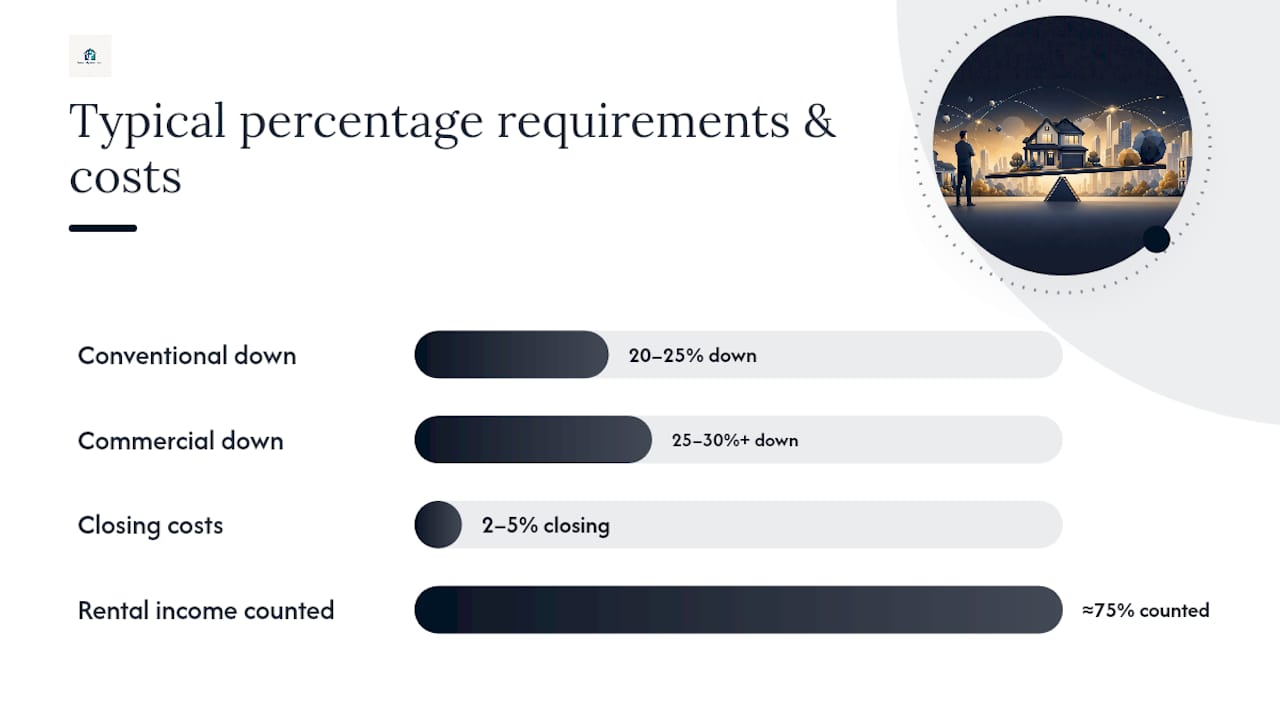
- Conventional investment mortgages: Typically require 20–25% down for 1–4 unit properties. Underwriting focuses on borrower credit, income, and debt-to-income ratio. Lenders often count approximately 75% of projected rental income toward qualifying income, which affects how large a loan you can obtain.
- Portfolio loans: Held by the lender rather than sold to Fannie Mae or Freddie Mac. More flexible underwriting, often DSCR-focused, and available for investors with multiple properties.
- Commercial mortgages (5+ units): Typically require 25–30%+ down. Underwriting centers on the property’s NOI and DSCR rather than personal income.
- HELOCs on existing equity: Allow you to tap equity in one property to fund the down payment on another, effectively stacking leverage across your portfolio.
Closing costs run 2–5% of the loan amount and include origination fees, title insurance, appraisal, prepaid taxes, and escrow setup. On a $400,000 loan, that is $8,000–$20,000 in additional cash out of pocket. Add initial rehab costs and your true cash invested can be significantly higher than the down payment alone.
Ongoing interest is your largest recurring cost. Mortgage interest on investment property is generally deductible against rental income under tax regulations, which reduces your taxable cash flow. That deductibility does not eliminate the cost, but it does improve after-tax returns.
Pro Tip: When you compute cash-on-cash return, your denominator is down payment + closing costs + initial rehab. A $100,000 down payment with $15,000 in closing costs and $10,000 in repairs means $125,000 invested, not $100,000.
How do you decide whether leverage makes sense for a specific deal?
Run this checklist before committing to any leveraged rental purchase.
- Check LTV. Is it at or below 80% for residential, 70–75% for commercial? Higher LTV means less margin if values fall.
- Compute DSCR. Is NOI ÷ annual debt service at or above 1.25? Below 1.20 is a hard stop for most disciplined investors.
- Compare cap rate to loan constant. If the cap rate is 6% and the loan constant is 7%, you have negative leverage from day one. Positive leverage requires cap rate > loan constant.
- Calculate cash-on-cash. Does it meet your target return after including all cash invested?
- Verify reserves. Do you have at least 3–6 months of mortgage payments in liquid reserves for a single-family rental, and 6+ months for a multifamily property?
- Define your exit. Can you refinance or sell at current values without a loss if you need to exit in 3–5 years?
Stress-test template: Recompute DSCR and cash-on-cash assuming interest rates rise 1.5% (if you have an adjustable-rate loan) and rents fall 10%. If DSCR drops below 1.20 or cash-on-cash turns negative under that scenario, the deal carries more risk than the base case suggests.
Pro Tip: Size reserves as a percentage of loan balance, not just a flat dollar amount. A 1% annual reserve fund on a $400,000 loan is $4,000/year set aside for capital expenditures, separate from your operating reserves.
What risks does leverage create and how do you manage them?
- Negative leverage: When the loan constant exceeds the cap rate, debt costs more than the asset earns. Mitigation: only proceed when cap rate > loan constant, or when strong appreciation prospects justify the short-term drag.
- Being underwater: If values fall and LTV exceeds 100%, you owe more than the property is worth. Excessive leverage caused severe losses in the 2008–2009 downturn when investors with 90%+ LTV had no equity cushion. Mitigation: keep LTV conservative and stress-test for a 15–20% value decline.
- Vacancy and rent-drop risk: Fixed debt service does not pause when a tenant leaves. Mitigation: thorough tenant screening, 6-month reserves, and conservative vacancy assumptions (10–15%) in your underwriting.
- Rate-reset risk: Adjustable-rate loans can push the loan constant above the cap rate after a reset. Mitigation: prefer fixed-rate terms for long holds, or ladder maturities so not all loans reset simultaneously.
- Forced selling: Over-leveraged investors who cannot cover debt service may be forced to sell at the worst time. Mitigation: never let debt service consume more than 70–75% of NOI at origination.
Pro Tip: Tenant quality and lease certainty directly affect how much leverage is appropriate. A property with a long-term, creditworthy tenant can support higher LTV than a short-term or month-to-month tenancy.
A step-by-step worked example you can replicate
Inputs:
- Purchase price: $350,000
- Down payment (25%): $87,500
- Loan amount: $262,500
- Interest rate: 7.0%, 30-year fixed
- Annual debt service: approximately $20,964
- Gross annual rent: $28,800 ($2,400/month)
- Vacancy (10%): $2,880
- Operating expenses (taxes, insurance, maintenance, management): $8,400
- Initial rehab: $10,000
- Closing costs (3% of loan): $7,875
Step 2: Compute the metrics
- NOI: $28,800 - $2,880 - $8,400 = $17,520
- Cap Rate: $17,520 ÷ $350,000 = 5.0%
- Annual Debt Service: $20,964
- DSCR: $17,520 ÷ $20,964 = 0.84 — Red flag: below 1.20
- Cash Flow: $17,520 - $20,964 = -$3,444/year
- Total Cash Invested: $87,500 + $7,875 + $10,000 = $105,375
- Cash-on-Cash: -$3,444 ÷ $105,375 = -3.3%
- Loan Constant: $20,964 ÷ $262,500 = 7.99% (exceeds cap rate of 5.0% — negative leverage)
Step 3: Stress variants
This deal fails every threshold at current pricing. The loan constant (8.0%) exceeds the cap rate (5.0%) by a wide margin. To make this work, you would need to either negotiate a lower purchase price, increase rents substantially, or wait for rates to fall. Use a rental cash flow calculator to iterate quickly on price and rate assumptions.
What I’ve learned about avoiding the overleveraging trap
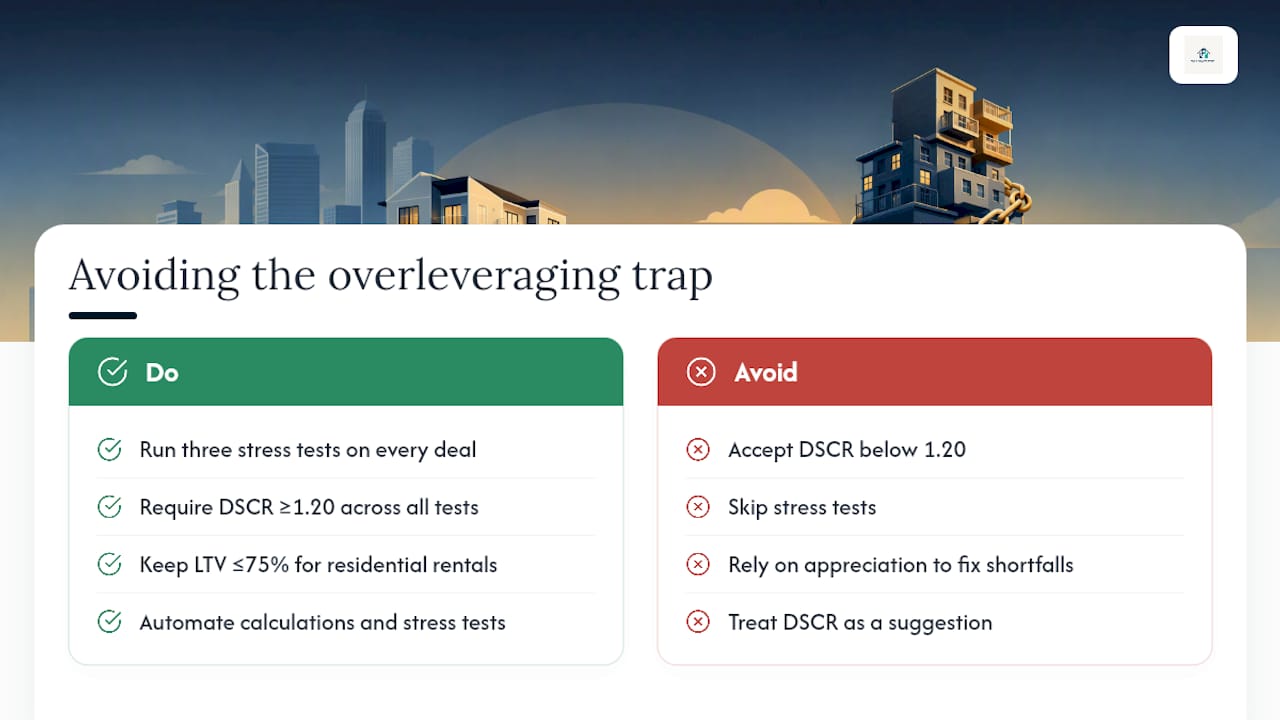
Most investors who get into trouble with leverage do not make one catastrophic decision. They make a series of small compromises: accepting a DSCR of 1.10 instead of 1.25, skipping the stress test because the base case looked fine, or counting on appreciation to bail out negative cash flow. Each compromise feels minor in isolation.
The discipline that actually protects you is mechanical, not intuitive. Run three stress tests on every deal before you make an offer: rates up 1.5%, rents down 10%, and both simultaneously. If the deal survives all three with DSCR above 1.20, you have a real margin of safety. If it only works in the base case, you are speculating, not investing.
Conservative LTV targets (75% or below for most residential rentals) and laddered debt maturities are not just risk management tactics. They are what keep you in the game long enough to benefit from compounding. Automation tools like Dealanalyzerai reduce the calculation errors that creep in when you are screening multiple deals per week, and they make it faster to run those stress tests consistently rather than selectively.
The investors who build durable portfolios treat DSCR as a gating metric, not a suggestion. If a deal does not clear 1.20 at origination, no amount of optimism about future rents changes the math today.
Run your next deal through Dealanalyzerai
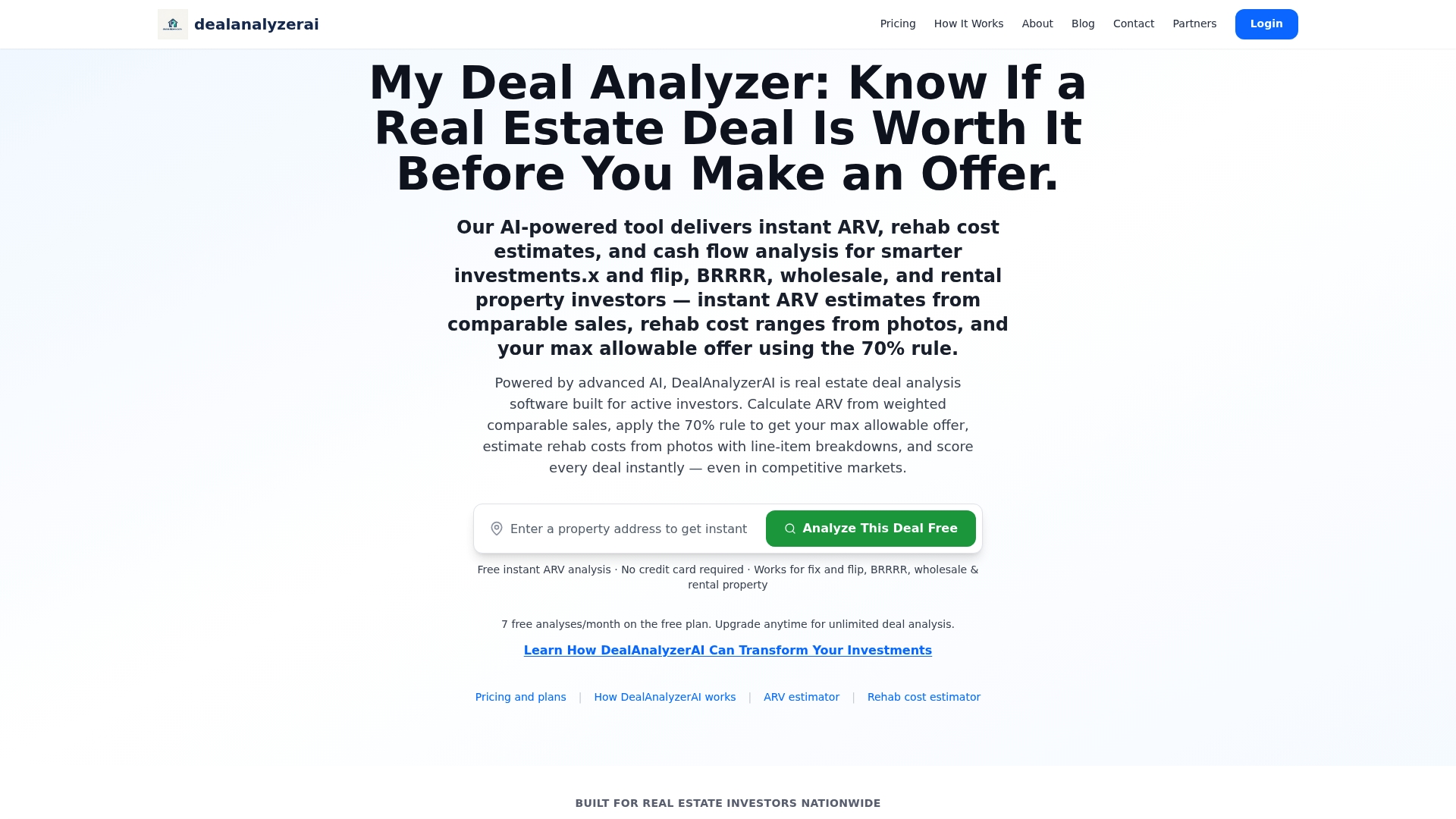
The worked example above takes 30–45 minutes to build manually. Dealanalyzerai computes NOI, cap rate, cash-on-cash, and DSCR automatically, flags negative leverage, and lets you run stress-test variants in seconds. Try the free deal analyzer to apply the exact framework from this article to your next rental property.
Sources
- Leverage in Real Estate: How It Works and Key Risks - LegalClarity
- Understanding leverage in real estate financing - CrowdStreet
- Increase your real estate net worth by using leverage - Investopedia
- How to buy a rental property - LendingTree
- Why Leverage Can Turn a Mediocre Rental Into a Great Investment — or a Disaster · Quanticed
- What is Leverage in Real Estate? (How to Calculate and More) - BiggerPockets
This article is general information, not a substitute for advice from a qualified financial advisor. Consult a qualified financial professional about your own circumstances before acting on anything here.
FAQ
What is rental property leverage in simple terms?
Leverage means using a mortgage to control a property worth more than your cash investment, so your equity return is amplified relative to the full asset’s performance. A $100,000 down payment on a $500,000 property captures gains and losses on the entire $500,000.
What DSCR do lenders require for rental property loans?
Most commercial and portfolio lenders require a DSCR of 1.20–1.25, meaning the property’s NOI must cover annual debt service by at least 20–25%. Below 1.20 is typically treated as high-risk.
What is negative leverage in real estate?
Negative leverage occurs when the loan constant (annual debt service ÷ loan amount) exceeds the cap rate (NOI ÷ property value). The debt costs more than the asset earns, so financing reduces your return rather than amplifying it.
How much do closing costs add to my total cash invested?
Closing costs typically run 2–5% of the loan amount, covering origination fees, title insurance, appraisal, and prepaid escrow items. On a $400,000 loan, that is $8,000–$20,000 on top of your down payment.
How do I stress-test a leveraged rental deal?
Recompute DSCR and cash-on-cash assuming interest rates rise 1.5% and rents fall 10%. If DSCR stays at or above 1.20 under both conditions, the deal has a real margin of safety.
Recommended
Analyze Your Next Deal with AI
Get an instant ARV estimate, rehab cost analysis, and deal score — free for 7 days.
Get Free Deal Breakdown