LTC vs LTV: The Investor's Guide to Both Ratios
Discover the key differences between LTC and LTV ratios. Understand their applications to secure the best financing for your investments.
By DealAnalyzerAI Editorial Team
Real estate investing education and deal-analysis research from DealAnalyzerAI.

LTC vs LTV: The Investor’s Guide to Both Ratios
LTC governs construction and value-add financing; LTV governs stabilized acquisitions and permanent loans. Knowing which ratio your lender is sizing to — and when each one binds — determines how much equity you need to bring to the table.
Quick reference before the full breakdown:
- LTC formula: Loan Amount ÷ Total Project Cost. Used for ground-up construction, major rehab, and bridge loans. Lenders typically cap it at 75–80%.
- LTV formula: Loan Balance ÷ Appraised Market Value. Used for acquisitions and permanent financing on stabilized assets. Caps commonly run 65–75% depending on property type and lender.
- When each applies: LTC during construction and lease-up; LTV at stabilization and takeout.
The worked examples in the calculation section below show exactly how the same deal looks under each metric.
Key Takeaways
LTC governs construction and value-add financing by measuring the loan against verified project costs, while LTV governs stabilized acquisitions by measuring the loan against appraised market value — and institutional lenders always size to whichever constraint is lower.
| Point | Details |
|---|---|
| LTC formula and benchmark | Loan ÷ Total Project Cost; lenders typically cap at 75–80% for construction and bridge loans. |
| LTV formula and benchmark | Loan ÷ Appraised Market Value; permanent lenders commonly cap at 65–75% by property type. |
| Four-constraint sizing rule | Institutional lenders size to the lowest of LTC, LTV, DSCR, and debt yield — run all four. |
| Model both ratios | Modeling only one metric leads to systematic errors in projected loan proceeds and required equity. |
| Dealanalyzerai | Computes LTC and LTV from verified cost and ARV inputs, with built-in sensitivity scenarios and exportable lender reports. |
This article is general information, not a substitute for advice from a qualified financial advisor. Consult a qualified financial professional about your own circumstances before acting on anything here.
Table of Contents
- What is loan-to-value (LTV) and how does it work?
- What is loan-to-cost (LTC) and what goes into total project cost?
- How do LTC and LTV compare side by side?
- How lenders apply LTC and LTV across loan types
- Worked examples: calculating LTV and LTC step by step
- Why LTC and LTV matter for your equity, financing, and exit
- Common mistakes investors make with LTC and LTV
- Practical strategies to improve your LTC and LTV
- How Dealanalyzerai approaches LTC and LTV in deal screening
- Dealanalyzerai calculates and stress-tests LTC and LTV for you
- Sources
- FAQ
What is loan-to-value (LTV) and how does it work?
LTV equals loan balance divided by appraised market value. It is the dominant constraint for acquisitions, permanent financing, and any loan where the asset already generates stable income.
Formula: LTV = Loan Amount ÷ Appraised Market Value
Short example: You buy a stabilized apartment building appraised at $2,000,000 and request a $1,400,000 loan.
Lenders choose the appraisal regime based on loan type:
- As-is value: Used for acquisitions of existing, income-producing properties. The appraiser values the asset in its current condition.
- As-stabilized (as-completed) value: Used when the property will be repositioned or constructed. The appraiser projects value at full occupancy and market rents, which feeds the loan-to-ARV calculation common in BRRRR and fix-and-flip underwriting.
- Income-based inputs: For commercial assets, lenders derive value from net operating income (NOI) divided by a market cap rate. A shift in the cap rate assumption directly moves the appraised value and therefore the LTV.
LTV is a forward-looking value test. It answers the question: if we had to sell this asset today (or at stabilization), does the loan stay covered? That makes it the primary lens for permanent lenders, life companies, agency programs, and HUD. Accurate ARV calculation methods are critical when an as-stabilized appraisal is the basis for LTV sizing.
What is loan-to-cost (LTC) and what goes into total project cost?
LTC equals the loan amount divided by total project cost (TDC) and is used when no stabilized appraisal exists yet. Construction lenders, bridge lenders at peak draw, and value-add debt funds all lead with LTC because an incomplete asset has no reliable income or market value to appraise.
Formula: LTC = Loan Amount ÷ Total Project Cost (TDC)
Short example: A ground-up development has a TDC of $3,000,000. The lender offers $2,250,000.
TDC is the denominator that matters most, and lenders scrutinize every line item. Standard components include:
- Land cost: Actual purchase price, not current market value (though some lenders will credit market value — more on that in the improvement strategies section).
- Hard costs: Materials, labor, general contractor fees, site work, utilities. These are the largest and most volatile component.
- Soft costs: Architecture, engineering, permits, legal, marketing, and developer overhead.
- Soft costs: Architecture, engineering, permits, legal, marketing, and developer overhead.
- Financing costs: Loan origination fees, interest reserves, and carry costs during construction.
- Contingency reserves: Typically 5–10% of hard costs, required by most lenders.
Common exclusions from TDC include equity-side developer fees (profit the sponsor pays themselves) and costs already reimbursed through other funding sources. Counting those inflates TDC, which lowers LTC and makes the deal look more conservative than it is — a mistake that can mislead both the sponsor and the lender.
Lenders insist on LTC for ground-up construction, major rehabilitation, and bridge loans during the transition period before a property stabilizes.
How do LTC and LTV compare side by side?
The table below captures the dimensions deal teams use to decide which metric will bind.
| Dimension | LTV | LTC |
|---|---|---|
| Denominator | Appraised market value | Total project cost (TDC) |
| Primary use case | Stabilized asset lending, acquisitions, permanent financing | Construction, major rehab, bridge at peak draw |
| Formula | Loan ÷ Appraised Value | Loan ÷ Total Project Cost |
| Typical lender cap | 65–75% (varies by property type and lender) | 75–80% (construction/bridge lenders) |
| Effect on required equity | Higher appraised value = less equity needed | Higher project cost = more equity needed |
| Primary underwriting inputs | Appraisal (as-is or as-stabilized), NOI, cap rate, comps | Hard costs, soft costs, land, financing costs, contingency |
| When ratio is measured | At acquisition or stabilization | During construction, at peak loan draw |
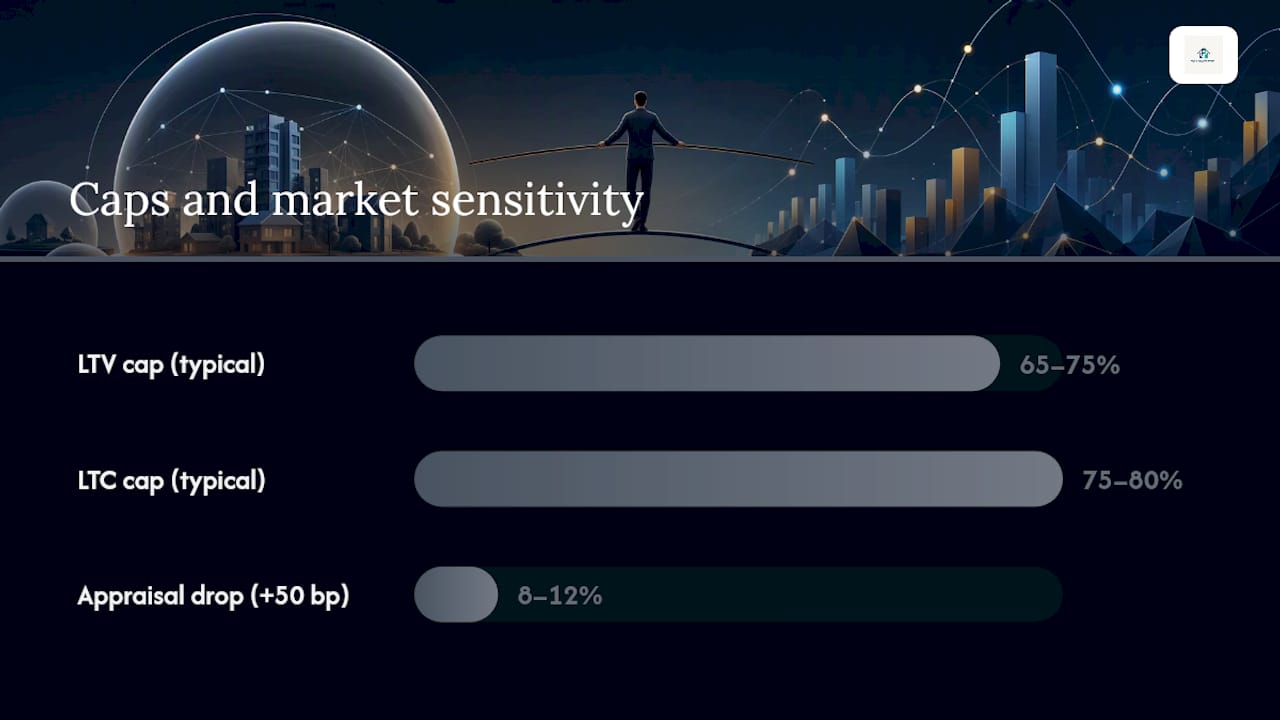
Institutional lenders size to the lowest of LTV, LTC, DSCR, and debt yield — LTV and LTC are the collateral-side pair in that four-constraint framework. Running only one of them gives you an incomplete picture of your maximum loan proceeds.
Practical implications for borrowers:
- LTC is more sensitive to cost overruns. Every dollar of hard-cost escalation shrinks your loan proceeds or forces more equity.
- LTV is more sensitive to market conditions. A cap rate expansion of 50 basis points on a commercial asset can cut appraised value by 8–12%, pulling the loan down with it.
- When LTC and LTV produce different loan amounts, the lender takes the lower number. Identifying which constraint binds in your base case lets you negotiate on the right lever.
How lenders apply LTC and LTV across loan types
Construction and bridge lenders lead with LTC; permanent lenders lead with LTV. The logic is straightforward: an incomplete asset cannot be reliably appraised, so cost is the only verifiable anchor.
By lender type:
- Banks and credit unions: Often use LTC for construction lines and switch to LTV at permanent conversion. Typical LTC caps run 75–80%; permanent LTV caps often land at 70–75% for residential and 65–70% for commercial.
- Debt funds and private lenders: More flexible on LTC (sometimes up to 85–90% for experienced sponsors), but price the risk in the rate. LTV at takeout is still the exit constraint.
- Life companies and agency (Fannie/Freddie): Almost exclusively LTV-based on stabilized multifamily. Caps are tighter, often 65–70%, but rates are lower.
- HUD/FHA programs: LTV-driven with specific caps by program type; underwriting is income-based.
Underwriting checks lenders run regardless of metric:
- Verified cost documentation (signed contracts, GC bids, permit budgets)
- Draw schedule and inspection protocol for construction loans
- Contingency reserve adequacy (5–10% of hard costs is a common floor)
- Appraisal regime selection (as-is vs. as-stabilized) and appraiser independence
- Sponsor track record and financial strength
Typical benchmark bands (these vary by capital source and market cycle):
- Construction/bridge LTC: 75–80% for most institutional lenders; up to 85% for experienced sponsors with strong guarantees
- Permanent LTV: 65–75% for most property types; tighter for hospitality and retail
Pro Tip: Pre-pack your lender submission with a detailed GMP (guaranteed maximum price) contract, GC resumes, and a preliminary appraisal or market memo. Deal teams that document both cost and value regimes close faster and face fewer covenant negotiations at takeout.
For a deeper look at how mortgage scenario analysis works from the lender’s side, the linked resource covers the underwriting checks that parallel what construction lenders run on LTC.
Worked examples: calculating LTV and LTC step by step
These two examples use the same sponsor to show how the same project looks under each metric.
Example A: ground-up development (LTC constraint)
- Land cost: $500,000
- Hard costs (construction): $1,800,000
- Soft costs (architecture, permits, legal): $200,000
- Financing costs (origination, interest reserve): $150,000
- Contingency (8% of hard costs): $144,000
- Total Project Cost (TDC): $2,794,000
- Lender offers 75% LTC: $2,794,000 × 0.75 = $2,095,500 maximum loan
- Required equity: $2,794,000 − $2,095,500 = $698,500
Example B: stabilized acquisition (LTV constraint)
- Purchase price: $2,500,000
- Appraised market value (as-is): $2,600,000
- Lender applies 70% LTV: $2,600,000 × 0.70 = $1.82 million maximum loan
- Required equity (down payment): $2,500,000 − $1.82 million = $680,000
| Input | Example A (LTC) | Example B (LTV) |
|---|---|---|
| Denominator | $2.79 million TDC | $2.6 million appraised value |
| Ratio applied | 75% LTC | 70% LTV |
| Maximum loan | $2,095,500 | $1.82 million |
| Required equity | $698,500 | $680,000 |
If the loan is fixed, the sponsor covers the gap from equity. Building-material price inflation has kept hard-cost pressure elevated, making this scenario realistic for active developers. Residential remodeling spending has also increased recently, which raises TDC for rehab projects and tightens LTC outcomes.
ARV assumptions should always be stress-tested against realistic comp and cap rate shifts.
Why LTC and LTV matter for your equity, financing, and exit
Both ratios directly control how much cash you bring to closing and how much flexibility you have at exit.
- Equity sizing: The lower your LTC or LTV, the more equity you contribute. A 5-point tightening in LTC (from 80% to 75%) on a $3,000,000 project forces an additional $150,000 in equity.
- Gap financing: When LTC and LTV produce different loan amounts, the gap between them often requires mezzanine debt or preferred equity. Identifying that gap early lets you price it into your returns model.
- Hold vs. sell decision: A project that stabilizes above projected ARV improves your refinance LTV, potentially allowing a cash-out refi that returns equity to investors. A project that stabilizes below ARV traps equity and may force a sale.
- Interest rate and pricing impact: Higher LTC or LTV loans carry higher rates. Debt funds charging 10–12% for 80% LTC construction loans versus 6–7% for 65% LTV permanent loans represent a meaningful carry cost difference.
- Financing gap from ARV mismatch: If your cash costs run $2,800,000 but the as-completed appraisal comes in at $3,000,000, your LTC loan proceeds may exceed what a 70% LTV permanent loan will cover at takeout. That gap requires a bridge or a capital event. Modeling both ratios from day one prevents that surprise.
Understanding how property class affects ARV and refinance outcomes is particularly relevant for BRRRR investors who depend on a strong as-stabilized LTV to pull equity back out.
Common mistakes investors make with LTC and LTV
These errors cost time, money, and sometimes the deal itself.
- Inflating TDC to lower LTC: Padding soft costs or double-counting line items makes LTC look more conservative. Lenders verify every budget line — discrepancies damage credibility and can trigger a re-underwrite.
- Counting equity-side fees as project cost: Developer profit or promoted interest is not a project cost. Including it in TDC inflates the denominator and misrepresents the deal to lenders.
- Relying on as-completed appraisals without contingency: An as-stabilized appraisal assumes the project completes on budget and on time. Without a contingency reserve in TDC, any overrun creates an immediate equity gap.
- Modeling only one metric: Developers who model only LTC or only LTV systematically over- or under-estimate loan proceeds. Run both in your base case and identify which one binds.
- Ignoring the four-constraint stack: LTC and LTV are the collateral-side pair. DSCR and debt yield are the income-side pair. A loan that clears 75% LTC and 70% LTV can still be cut by a DSCR constraint if projected income is thin.
- Using the wrong appraisal regime: Applying an as-is value to a value-add deal understates LTV proceeds. Applying an as-stabilized value to a deal with execution risk overstates them. Match the regime to the actual loan type.
Screening deals for these flags before you approach a lender is exactly what property investment risk assessment frameworks are designed to catch.
Practical strategies to improve your LTC and LTV
When ratios are tight, you have more levers than most investors realize.
- Value-engineer the scope: Reducing hard costs by 5–8% through material substitutions or phased construction directly improves LTC without changing the loan amount. Get the GC involved early.
- Pre-sell units or secure anchor leases: Executed leases or pre-sales improve the as-stabilized appraisal, which lifts LTV at takeout and can justify a higher construction loan from day one.
- Bring in mezzanine or preferred equity: If LTC caps your senior loan at 75%, a mezzanine lender can fill the gap to 85–90% of cost. You pay a higher blended rate, but you preserve your equity for other deals.
- Negotiate a market-value land credit: Some lenders will credit the current market value of land rather than its original cost, especially when the sponsor purchased land well below market or has held it through entitlement. This lowers effective LTC and reduces required equity. It requires documentation — entitlement progress reports, a current appraisal, and evidence of value realization during the hold period.
- Stage the project or use phased financing: Breaking a large development into phases lets you demonstrate execution on Phase 1 before drawing on Phase 2 financing. Lenders often offer better LTC terms on later phases when track record is established.
- Improve your cost documentation: A detailed, contractor-signed budget with unit costs, a GMP contract, and lien waiver protocols signals cost credibility. Lenders who trust your budget are more likely to approve higher LTC.
Pro Tip: Timing matters when requesting a land value credit. Present the request at initial term sheet negotiation, not after the loan is structured. Bring a current appraisal, a summary of entitlement milestones achieved, and comparable land sales. Lenders who see documented value uplift are far more likely to treat land at market value rather than cost.
How Dealanalyzerai approaches LTC and LTV in deal screening
Running LTC and LTV manually across a pipeline of deals is slow and error-prone. Dealanalyzerai computes both ratios from verified inputs: itemized cost line items that feed TDC for LTC, and AI-estimated ARV ranges drawn from comparable sales for LTV. When you upload property photos, the platform’s rehab cost analysis generates a detailed cost breakdown that maps directly to the hard and soft cost components lenders require.

The platform also runs sensitivity scenarios automatically. Those outputs are exportable as professional reports you can hand directly to a lender or equity partner.
For investors screening multiple properties weekly, having both ratios calculated and stress-tested in one place means fewer surprises at the term sheet stage. Run your numbers at Dealanalyzerai.
Dealanalyzerai calculates and stress-tests LTC and LTV for you
Modeling LTC and LTV by hand across multiple deals creates room for costly errors. Dealanalyzerai eliminates that friction.

The platform gives active investors and developers the specific tools these ratios require:
- AI-powered ARV estimation using comparable sales, feeding accurate as-stabilized LTV inputs
- Rehab cost estimator that generates itemized hard and soft cost breakdowns for TDC and LTC
- Scenario stress tests that show how cost overruns or comp shifts move each ratio
- Exportable deal reports formatted for lender submissions and equity partner presentations
- Maximum allowable offer (MAO) calculator that ties ARV and cost assumptions together
Run your LTC and LTV calculations now at Dealanalyzerai — free to start, no commitment required.
Sources
FAQ
Are LTC and LTV the same thing?
No. LTC divides the loan by total project cost and applies during construction or rehab. LTV divides the loan by appraised market value and applies to stabilized assets and permanent financing.
What does 80% LTC mean?
On a $2 million project, the maximum loan depends on the applicable LTV or LTC ratio, affecting how much equity is required.
What does 70% LTC mean?
On a $2 million project, the maximum loan amount and required equity vary depending on the loan-to-value or loan-to-cost ratio used.
What is LTC in mortgages?
LTC is less common in standard residential mortgages and more common in construction loans and commercial bridge financing. When used in a construction mortgage, it caps the loan at a percentage of the verified build budget rather than the property’s future value.
Which ratio should you calculate first when evaluating a deal?
Run both simultaneously. Identify which constraint binds in your base case — LTC during construction, LTV at stabilization — then stress-test each against realistic cost overruns and comp shifts before approaching a lender.
Recommended
Analyze Your Next Deal with AI
Get one free ARV range from comparable sales, then enter an email to reveal aggregate market insights. Full property analysis is available on paid plans.
See Your Free ARV Range