Flippers: Holding Costs Calculator to Avoid a $15,600 Six Month Hit
A practical workflow for flippers to calculate holding costs, add 1–2 months contingency, and cross check totals with DealAnalyzerAI.
By DealAnalyzerAI Editorial Team
Real estate investing education and deal-analysis research from DealAnalyzerAI.

Flippers: Holding Costs Calculator to Avoid a $15,600 Six Month Hit
Holding costs are the monthly expenses you pay to own a property while you rehab, market, or lease it: loan interest, property taxes, insurance, utilities, maintenance, and HOA dues. The formula is simple: total holding cost equals monthly carrying cost multiplied by the number of months you hold the property. On a financed flip, loan interest is usually the single largest line item, so budget conservative timelines before you ever submit an offer.
TL;DR:
- Hard-money loans for flips typically cost around $2,000 in interest per month on a $200,000 loan at 12%, significantly impacting total holding costs.
- Adding 1 to 2 months of contingency to your rehab timeline is essential, as delays from permits, subcontractors, or seasonal issues can easily double planned costs.
- Accurately calculating monthly holding costs requires careful input of loan interest, property taxes, insurance, utilities, maintenance, and HOA fees to avoid underestimating expenses.
- Comparing manual estimates with AI-driven tools like DealAnalyzerAI helps identify overly optimistic assumptions and ensures realistic maximum offer prices.
- Total holding costs can reach $15,600 for a six-month hold on a $200,000 loan, emphasizing the importance of conservative planning to protect profit margins.
Table of Contents
- How Do You Calculate Holding Costs Line By Line?
- What’s the Step-By-Step Formula for Total Holding Costs?
- How Long Should You Assume the Hold Will Take?
- What Do Two Real Holding Cost Examples Look Like?
- What Does Tying Up Capital in a Property Actually Cost You?
- How Do Holding Costs Affect Your Taxes?
- How DealAnalyzerAI Cross-Checks Your Holding Cost Math
- Run Your Numbers Before You Make the Offer
- Sources
- FAQ
How Do You Calculate Holding Costs Line By Line?
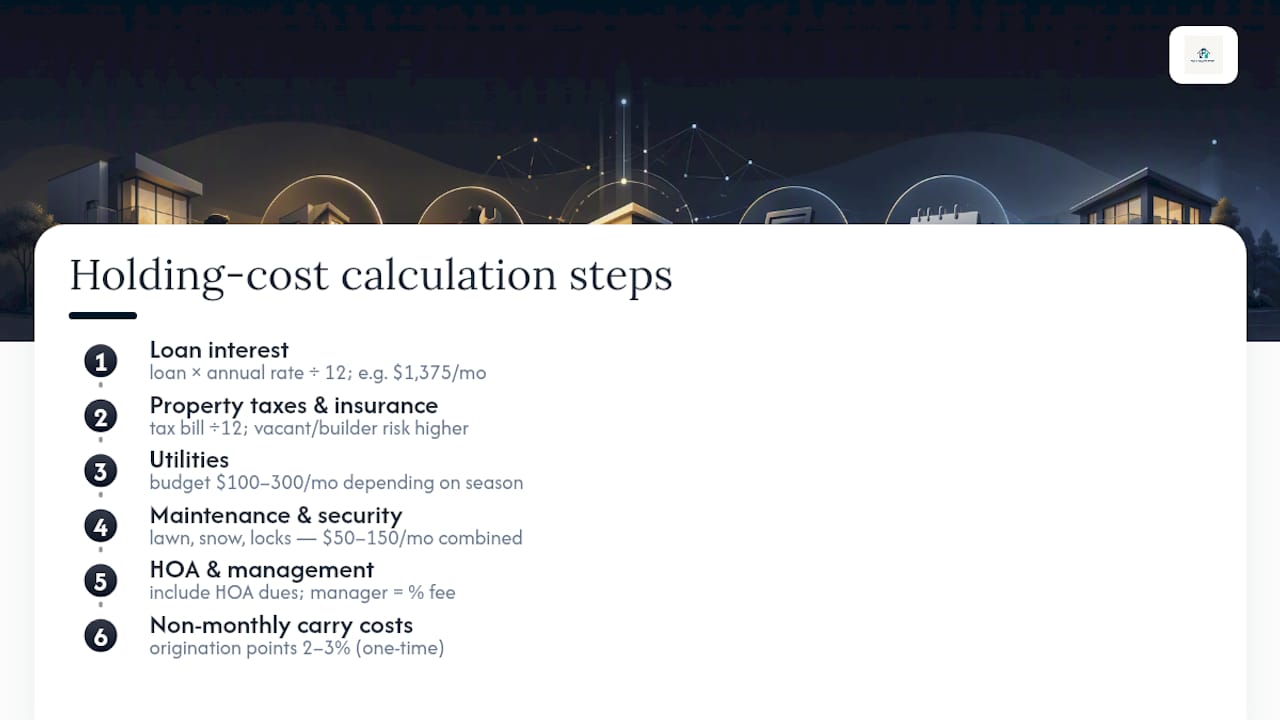
Every holding cost estimate starts with the same six or seven inputs. Get each one right and your monthly total will hold up under scrutiny when you’re negotiating an offer or defending your numbers to a partner.
Loan interest. Most fix-and-flip loans are interest-only, meaning you owe interest on the full balance every month with no principal paydown. The formula is loan amount multiplied by annual rate, divided by 12. Hard-money rates typically run 8% to 14%, so a $150,000 loan at 11% costs about $1,375 a month in interest alone.
Property taxes and insurance. Take the annual tax bill and divide by 12. Pull the actual number from county assessor records rather than guessing off the listing, since assessed value often lags market value after a sale. Insurance is trickier: a vacant or rehab property needs a vacant-property or builder’s risk policy, not a standard landlord policy, and those premiums often run higher than a normal homeowner policy.
Utilities. Budget conservatively, especially during rehab when contractors need power and water running daily. Plan for at least $100 to $300 a month depending on season and property size, with heating and cooling months pushing toward the higher end.
Maintenance and security. Lawn care, snow removal, and lock changes on a vacant property typically add $50 to $150 a month combined. Skip these and you risk code violations or a break-in that costs far more than the service fee.
HOA and property management. Include monthly HOA dues if the property has them, and factor in a management percentage only if you’re using a property manager during a rental hold.
Non-monthly carry costs. Hard-money loans often charge 2 to 3 origination points at closing. Treat points as a one-time cost added to your total deal expense, or spread them across your planned hold months if you want a single blended monthly figure.
Pro Tip: Call your insurance agent before you close, not after. Vacant-property coverage sometimes takes days to bind, and a gap in coverage during demolition is exactly when something goes wrong.
What’s the Step-By-Step Formula for Total Holding Costs?
Run the numbers in this order every time, and you’ll produce a monthly figure, a daily figure, and a total-period figure you can defend to a lender or a partner.
- Gather your inputs. Loan amount and interest rate, annual property taxes, annual insurance premium, estimated monthly utilities, monthly maintenance and security, and HOA or management fees if they apply.
- Calculate monthly interest. Loan amount times annual rate, divided by 12.
- Calculate monthly taxes and insurance. Annual tax divided by 12, plus annual insurance divided by 12.
- Add utilities, maintenance, and HOA. Sum every remaining monthly line.
- Total the monthly figure. Add every line from steps 2 through 4 into one monthly holding cost number.
- Convert to daily cost. Divide the monthly total by 30. This is the number that should make you move faster on contractor scheduling.
- Multiply by your planned hold months. That gives you the total holding cost for the deal.
- Fold the total into your offer math. Maximum allowable offer equals ARV minus rehab costs minus closing costs minus total holding costs minus your desired profit.
A $200,000 hard-money loan at 12% interest generates roughly $2,000 a month in interest and about $66 a day, before you’ve added a single dollar of taxes, insurance, or utilities.
That statistic alone explains why so many flippers get their loan sizing wrong on the front end. If your monthly total including everything else lands at $2,600, a six-month hold costs $15,600 before rehab even starts.
How Long Should You Assume the Hold Will Take?
Optimistic timelines are the single most common way flippers underestimate their carrying costs. Add 1 to 2 months of contingency on top of whatever timeline your contractor gives you, because permits, subcontractor scheduling conflicts, and seasonal slowdowns hit far more often than beginners expect.
- Permitting delays: inspectors backed up, plan revisions requested, or missing documentation.
- Subcontractor scheduling: your electrician or plumber double-books and pushes your job back two weeks.
- Seasonal slowdowns: winter weather stalls exterior work. Summer heat slows interior painting and flooring cure times.
- Buyer financing delays once you list, adding weeks even after the rehab is done.
Run the math on a single overrun: at $2,600 a month in carrying costs, one extra month erases $2,600 of profit before you account for anything else going wrong.
Pro Tip: Order permits and materials before closing when you can. Overlapping tasks, like painting one floor while flooring goes down on another, shaves real days off the calendar without cutting corners. A fast cosmetic-upgrade approach on doors, closets, and other high-visibility items can also compress your timeline without touching the structural scope of the rehab.
What Do Two Real Holding Cost Examples Look Like?
Numbers make the formula real. Here are two scenarios flippers run constantly: a financed rehab and a rental sitting vacant between tenants.
Example A assumes an interest-only hard-money loan with no principal paydown, so the $2,000 monthly interest stays flat across the whole hold. Example B swaps rehab-specific costs for a simpler vacancy scenario: no vacant-property insurance surcharge, but you’re also losing rental income the whole time, so the real cost of that vacancy is holding costs plus lost rent, not holding costs alone.
Scale either example up or down by adjusting the loan amount and rate.
What Does Tying Up Capital in a Property Actually Cost You?
Every dollar sitting in a rehab is a dollar not working somewhere else, and that opportunity cost rarely makes it onto a flipper’s spreadsheet even though it’s real money. If your down payment and rehab cash could otherwise earn a return in another deal, a rental, or even a conservative investment, that forgone return belongs in your evaluation of whether this specific deal is worth doing.
The math gets particularly relevant when you’re comparing all-cash purchases against financed ones. Paying cash eliminates loan interest, but it also locks up capital that could fund a second or third deal running simultaneously. Many active investors use hard money specifically to preserve cash for multiple projects, accepting the interest cost as the price of keeping capital in motion rather than parked in a single property.
Opportunity cost also shows up in decision speed. A property sitting on the market for an extra 60 days doesn’t just add $90 a day in direct holding costs from the table above. It also delays the capital’s return to you, pushing back your next acquisition and compounding the lost opportunity across your whole portfolio for the year. Treat that delay as a real cost, even though no invoice ever arrives for it, and you’ll size your offers more conservatively where it counts.

How Do Holding Costs Affect Your Taxes?
Holding costs carry real tax consequences, and how they’re treated depends heavily on whether the property is inventory (a flip) or a long-term rental. For flips held as inventory, holding costs including interest, taxes, and insurance are generally added to the property’s cost basis and deducted when the property sells, rather than expensed monthly as they’re paid.
Rental properties work differently. Mortgage interest, property taxes, insurance, and operating expenses during a vacancy are typically deductible in the year they’re incurred, and the property itself depreciates over its useful life, creating a separate paper loss that can offset rental income. That depreciation schedule is a distinct calculation from your holding-cost carrying total, but the two interact directly on your tax return.
None of this is a substitute for advice from a tax professional who knows your entity structure and state rules, since flip income, rental income, and short-term rental income can all be taxed and depreciated differently. What matters for your holding-cost calculation is keeping clean records of every dollar spent monthly, because those records determine whether an expense reduces this year’s tax bill or gets added to basis and recovered at sale.
How DealAnalyzerAI Cross-Checks Your Holding Cost Math
The manual formula in this article works, and every active investor should know it cold. But running it property by property, week after week, is where errors creep in, usually from an optimistic timeline or an underestimated insurance line.
Some deal analysis tools build holding-cost assumptions directly into their ARV and rehab estimation workflows, so once you’ve run your own numbers by hand, you can cross-check them against a second, independent calculation before you commit to an offer. The suggested workflow: calculate manually first using the steps above, run the same property through Dealanalyzerai’s estimators, then compare the two and adjust your hold-month assumption if the gap is wide. A gap usually means either your timeline or your line-item estimates need a second look, and catching that before you sign a purchase agreement is far cheaper than catching it three months into a rehab.
— Sam
Run Your Numbers Before You Make the Offer
Manual math gets you close, but a second set of eyes on your ARV, rehab budget, and holding-cost assumptions catches the errors that eat into margin. Some deal analysis software provides a second check, pairing AI-driven ARV ranges with rehab cost estimates from uploaded photos so your maximum allowable offer reflects reality, not optimism.

The fix-and-flip calculator combines your holding-cost inputs with ARV and rehab data to output a complete profit picture in minutes instead of a spreadsheet you rebuild for every deal. Three things it does that a manual worksheet doesn’t: it flags risk before you submit an offer, it pulls comparable sales automatically instead of you searching manually, and it lets you screen multiple properties in the time it used to take to underwrite one. Start with the free deal analyzer and run your next property through it before your offer deadline.
Sources
- Hard money loan rates 2026 (Crestmont Capital blog)
- What is a Holding Cost in Real Estate? (The Land Method)
FAQ
What Is the Formula for Holding Costs Calculation?
Total holding cost equals monthly carrying cost (loan interest plus taxes, insurance, utilities, maintenance, and HOA) multiplied by the number of months you hold the property.
How Much Are Holding Costs on a Typical Flip?
It varies by loan size and market, but a $200,000 hard-money loan at 12% interest alone runs about $2,000 a month, before taxes, insurance, and utilities add another few hundred dollars monthly.
How Do I Include Holding Costs in My Offer Price?
Subtract total holding costs, along with rehab costs, closing costs, and your desired profit, from the ARV to arrive at your maximum allowable offer.
How Much Contingency Should I Add to My Flip Timeline?
Add 1 to 2 months of contingency beyond your contractor’s estimate to account for permitting delays, subcontractor scheduling conflicts, and seasonal slowdowns.
Can DealAnalyzerAI Help Verify My Holding Cost Estimates?
Yes. Dealanalyzerai’s calculators let you cross-check a manual holding-cost calculation against an independent ARV and rehab estimate, which helps catch optimistic timeline or cost assumptions before you make an offer.
Recommended
Analyze Your Next Deal with AI
Get an instant ARV estimate, rehab cost analysis, and deal score — free for 7 days.
Get Free Deal Breakdown