Investors' Weekly Playbook to Prioritize Real Estate Deals With AI
Investors' weekly playbook for prioritizing real estate deals. Use a written buy box, weighted scoring, and AI for Gates 1–2; humans verify the shortlist.
By DealAnalyzerAI Editorial Team
Real estate investing education and deal-analysis research from DealAnalyzerAI.

Investors’ Weekly Playbook to Prioritize Real Estate Deals With AI
Rank those survivors with a calibrated weighted scoring model, not gut feel. Your immediate move: apply your written buy box to today’s top 10 inbound deals and see how many die at Gate 1 before you waste an hour underwriting them.
TL;DR:
- Most deals are eliminated at Gate 1 based on strict buy box criteria, saving time for only the most promising opportunities.
- Screening numbers like cap rate, NOI, and DSCR must meet predefined thresholds to qualify deals for further review, with adjustments based on strategy.
- Non-numeric factors such as sponsor credibility, environmental risks, and document responsiveness influence deal priority and may lower pursuit scores.
- A weighted scoring model calibrated with past deals improves consistency and predicts which opportunities align with long-term goals.
- Automating Gates 1 and 2 with tools like DealAnalyzerAI accelerates screening and frees investors to focus on cases that pass initial filters.
Table of Contents
- The Three-Stage Screening Funnel That Kills Bad Deals Fast
- Which Numbers Actually Tell You a Deal Is Worth Pursuing?
- What Non-Numeric Factors Should Change a Deal’s Priority?
- How Do You Build a Scoring Model That Actually Predicts Good Deals?
- How to Run Weekly Deal Screening Without Drowning Your Team
- Liquidity and Exit Strategy Considerations During Prioritization
- How to Balance Short-Term Wins Against Long-Term Portfolio Goals
- How to Handle Missing or Unreliable Data When Ranking Deals
- Author Perspective: Process Discipline Beats Chasing the Perfect Deal
- Let DealAnalyzerAI Handle Gates 1 and 2 While You Focus on the Deals That Matter
- Sources
- FAQ
The Three-Stage Screening Funnel That Kills Bad Deals Fast
Most investors drown in deal flow because they underwrite everything with the same intensity. A better system kills weak deals at the cheapest possible gate and saves detailed analysis for the handful that deserve it. A three-stage funnel built on structural knockouts, economic screening, and human review typically pushes only a small, select portion of deals through to full underwriting, according to BiggerPockets.
Gate 1: structural knockouts. This is your written buy box, and it should read like a checklist, not a vibe. Define it once, then apply it mechanically to every inbound deal:
- Asset class fit (multifamily, industrial, single-family flip, etc.)
- Deal size range (minimum and maximum purchase price)
- Geography (specific submarkets or metro boundaries)
- Hard exclusions: flood zone designation, unacceptable ground lease terms, environmental red flags, or ownership structures you won’t touch
A deal that fails any single line item dies immediately. No spreadsheet, no phone call.
Gate 2: economics screen. Deals that survive Gate 1 get run through quick math: cap rate, rough NOI, cash-on-cash, and debt service coverage. You’re not underwriting yet. You’re pulling four or five numbers and comparing them to thresholds you set in advance. Label each surviving deal Kill, Watch, or Pursue based on where it lands against those thresholds.

Gate 3: human review. Only the Pursue and strong Watch deals reach a person. Here the questions shift from “does this pencil” to “do I trust the story.” Sponsor credibility, underwriting assumptions, and strategic fit with your current portfolio all get evaluated by a human who has time to think, because Gates 1 and 2 already did the sorting.
A written, cheapest-first framework like this keeps meetings decision-focused instead of exploratory, according to SFAI Labs. Most deals die at Gate 1, which is exactly the point: it’s the cheapest gate to run, so it should absorb the most casualties.
Three operational rules make this work in practice. First, always kill at the cheapest gate available. Don’t run a DSCR calculation on a deal that’s already outside your geography. Second, log the reason every deal dies. A rejection log with dates and reasons becomes your data set for refining the buy box later. Third, use three tiers, not two. A binary pass/fail throws away deals that might work if one assumption shifts. Kill/Watch/Pursue keeps optionality alive without cluttering your pipeline.
Pro Tip: Set a hard rule that no deal skips Gate 1, even ones referred by a broker you trust. Relationship pressure is the number one reason bad deals sneak past screening.
Which Numbers Actually Tell You a Deal Is Worth Pursuing?
Gate 2 lives or dies on a handful of formulas. You don’t need a full underwriting model here. You need fast, directional numbers that separate obvious no’s from deals worth a closer look.
Cap rate = Net Operating Income ÷ Purchase Price. This is your first filter for income-producing assets. A cap rate below your market’s going rate usually signals you’re overpaying relative to comparable stabilized assets.
NOI (Net Operating Income) = Gross rental income minus operating expenses, excluding debt service. Every other metric depends on getting this number roughly right, even at the screening stage.
Cash-on-cash return = Annual pre-tax cash flow ÷ total cash invested. This matters more than cap rate for leveraged deals, because it accounts for your actual capital outlay, not the full purchase price.
DSCR (Debt Service Coverage Ratio) = NOI ÷ annual debt service. Most lenders want to see 1.20 to 1.25 or higher. A deal that can’t clear 1.0 at the screening stage isn’t financeable as structured, full stop.
GRM (Gross Rent Multiplier) = Purchase price ÷ gross annual rent. Rough and fast, useful for a first-pass comparison across a batch of similar properties before you dig into expense detail.
IRR (Internal Rate of Return) deserves a caveat at the screening stage: it’s a ranking tool, not a decision tool. IRR requires assumptions about hold period, exit cap rate, and future rent growth that you haven’t verified yet. Use it to compare deals against each other, never as a standalone green light.
Different strategies lean on different metrics. Value-add investors should weight cash-on-cash and a projected stabilized cap rate heavier than day-one cap rate, since the entire thesis depends on what the asset becomes, not what it is today. Core buyers should prioritize current cap rate and DSCR, because the whole appeal is stability, not upside. Flippers care almost exclusively about the spread between all-in cost and ARV, with cash-on-cash and cap rate barely relevant since there’s no hold period.
A simple screening-sheet row might look like this: property address, asking price, quick NOI estimate, cap rate, DSCR, cash-on-cash, and a single Kill/Watch/Pursue flag. Five columns of math, one column of judgment. That’s the entire Gate 2 output for one property.
Experienced investors don’t rely on a single valuation lens. Combining absolute valuation (discounted NOI) with relative approaches like comparable sales and GRM cross-checks value from two directions and protects against market shifts that a single formula would miss, according to Investopedia.
For a deeper walkthrough of how these numbers feed a full underwriting model once a deal clears screening, see this guide to real estate deal underwriting.
What Non-Numeric Factors Should Change a Deal’s Priority?
Numbers get a deal to the table. They rarely tell you whether to sign the contract. A useful mental model here is the “real estate diamond,” which evaluates four interconnected factors: the product itself, the people involved, the external environment, and capital markets conditions. This framework gives a fuller picture of an opportunity than financial calculations alone, according to HBS Online.
Each factor should adjust your score up or down, not override the economics entirely. A sponsor with a strong track record in the exact asset class you’re evaluating deserves a bump. A first-time sponsor underwriting a complex value-add deal in an unfamiliar submarket deserves a discount, even if the spreadsheet looks clean.
Watch for these red flags during Gate 3, any one of which should drop a deal from Pursue to Watch or kill it outright:
- Missing or incomplete rent roll (you can’t verify income you can’t see)
- Unknown or unverifiable sponsor history on deals of similar size and complexity
- Ground lease terms that limit financing options or resale flexibility
- Deferred maintenance that exceeds your pre-set capital reserve threshold
- Environmental concerns without a Phase I report on file
For deals sitting in Watch, don’t just wait passively. Send the broker a specific request list: trailing twelve months of financials (T-12), a current rent roll, copies of service contracts, and any existing environmental reports. A deal that produces these documents quickly and cleanly signals a well-run asset. A deal where the broker stalls on basic paperwork is telling you something too.
Pro Tip: Treat document responsiveness as a screening signal in itself. Sponsors and brokers who take two weeks to produce a T-12 rarely improve once you’re under contract.
If you want an outside framework for sequencing these requests, this due diligence guide from SzopaLabs walks through a standard verification order that pairs well with Gate 3.
How Do You Build a Scoring Model That Actually Predicts Good Deals?
A weighted scoring model turns Gate 3 judgment calls into a repeatable, comparable number. Without one, you’re ranking deals by memory and mood, which doesn’t scale past a handful of opportunities a week.
Start with five scoring categories, each contributing to a composite score:
- Financial attractiveness (cap rate, cash-on-cash, IRR relative to your target)
- Value-creation potential (renovation upside, lease-up opportunity, repositioning angle)
- Market fundamentals (population growth, employment diversity, supply pipeline)
- Risk profile (sponsor experience, structural condition, environmental exposure)
- Strategic fit (does this match your current portfolio concentration and hold-period goals)
Starting weights vary by investor type. A core, income-focused buyer would likely flip that, weighting financial attractiveness and risk profile heaviest since stability matters more than upside.
These starting weights are a guess, and that’s fine as a first draft. Calibration is what makes the model useful. Score 20 to 30 of your past deals, both the ones you pursued and the ones you passed on, using your new weighted model. If not, adjust the weights until it does. A custom scoring model calibrated against historical decisions consistently outperforms generic scoring tools, because it encodes what you actually value rather than a template built for someone else’s strategy, according to The AI Consulting Network. Calibration is arguably the single most impactful step in adopting any scoring model. Skip it, and your scores may simply reflect a stranger’s priorities dressed up as math.
Once calibrated, convert composite scores into tiers. Set thresholds so that, say, scores above 80 become Pursue, 60 to 80 become Watch, and anything below 60 becomes Kill. For more detail on structuring categories and weights, this guide to real estate deal scoring covers common variations investors use.
How to Run Weekly Deal Screening Without Drowning Your Team
Turning this into a repeatable weekly habit is where most investors fall apart. The funnel and scoring model are only useful if someone actually runs them on every deal, every week, without exception.
A practical cadence looks like this: deals get ingested from broker emails, listing platforms, and off-market sources into one place. A completeness gate checks whether each deal has the minimum viable data (address, price, basic financials) before it enters Gate 1. Deals that pass Gate 1’s structural knockouts move to Gate 2, where automated scoring runs the economic tests. Only a small percentage get presented for Gate 3 human review, and typically only one or two deals per week receive a full underwrite.
Structured completeness checks matter more than they sound. A 26-point intake checklist used in some playbooks prevents half-documented deals from clogging the pipeline and improves the accuracy of anything you extract automatically later, according to NextAutomation. Garbage in, garbage out applies with particular force to automated screening.
AI-driven workflows can now process well over a hundred deals a day, automating extraction from broker packages, first-pass rent comp checks, and initial scoring, according to The AI Consulting Network. That throughput is the whole point: automation clears Gates 1 and 2 fast so a human only sees deals worth their time.
But automation has firm limits. AI can draft comp sets, re-estimate NOI from uploaded financials, and populate a first-pass scoring sheet. Humans must still verify comp selection, confirm sponsor background, and scope out capex assumptions in person or through a trusted inspector. AI excels at extraction and consistency, but people must own the underwriting model itself and the final numbers that go into an offer.
A tool like DealAnalyzerAI fits squarely into Gates 1 and 2 of this workflow. It generates ARV ranges and rehab cost estimates from uploaded property photos, calculates a maximum allowable offer, and flags risk factors before you draft an LOI. That output becomes the data package your analyst uses in Gate 3, rather than a starting point they have to build from scratch.
| Workflow stage | What gets automated | What a human must verify |
|---|---|---|
| Intake / completeness | Document parsing, missing-field flags | Confirming the deal actually matches your target profile |
| Gate 1 (structural) | Rule-based filtering against buy box | Edge cases the rules didn’t anticipate |
| Gate 2 (economics) | Cap rate, NOI, DSCR calculations | Comp selection and NOI assumption sanity checks |
| Gate 3 (human review) | Draft memo, risk flag summary | Sponsor background, capex scope, final go/no-go |
Pro Tip: Never let an automated tool own your underwriting model’s core formulas. Let it populate inputs and draft the first pass; keep the model structure and final numbers under human control.
For a broader look at wiring these pieces together, this weekly AI screening workflow guide walks through the integration points in more detail.
Liquidity and Exit Strategy Considerations During Prioritization
A deal that looks strong on paper can still rank low once you account for how hard it will be to exit. Liquidity should factor into Gate 3, not just your final underwriting.
Ask three questions before ranking any Watch or Pursue deal. First, who is the realistic buyer pool at exit? A niche asset type in a thin market might take twice as long to sell as a standard multifamily property in a liquid submarket. Second, does the deal’s structure limit your exit options? A restrictive ground lease or an unusual ownership arrangement can shrink your buyer pool significantly, even if the underlying asset is solid. Third, what’s your actual hold-period flexibility? If your fund or partnership agreement forces an exit within a fixed window, deals with longer stabilization timelines should score lower regardless of their eventual upside.
Deals with strong current cash flow but weak exit liquidity deserve a different score than deals with modest cash flow but strong resale demand. Neither is automatically better. The right weighting depends on whether your capital needs to recycle quickly or can sit patiently. Build this into your scoring model’s risk profile category rather than treating it as a separate afterthought, since exit liquidity is fundamentally a risk factor wearing a different hat.
How to Balance Short-Term Wins Against Long-Term Portfolio Goals
A deal that scores well today can still be the wrong deal if it pulls resources away from a better long-term position. This tension shows up constantly in weekly screening, and most investors resolve it by instinct rather than rule.
The fix is to make strategic fit a real category in your scoring model, not a tiebreaker you consult only when two deals look identical. If your five-year plan concentrates on build-to-rent development, a well-priced but unrelated retail flip should score lower on strategic fit even if its financial attractiveness score is excellent. The composite score should reflect that trade-off automatically rather than requiring a separate gut check.
Set explicit rules for how much short-term opportunity can override long-term strategy. Some investors cap the percentage of quarterly capital that can go toward opportunistic, off-thesis deals, regardless of how attractive the numbers look. Others simply raise the financial-attractiveness bar for off-thesis deals so only exceptional opportunities clear the threshold.
The danger runs both directions. Chasing every attractive short-term deal fragments your portfolio and dilutes your expertise in any one asset class. But rigid long-term discipline can also mean passing on genuinely rare opportunities that don’t fit last year’s thesis. Review your strategic fit weighting quarterly, the same way you review your buy box, so it evolves with your actual capital position instead of freezing in place.
How to Handle Missing or Unreliable Data When Ranking Deals
Screening runs on data that’s frequently incomplete, outdated, or simply wrong. A broker’s pro forma NOI is often optimistic by design. A rent roll might be six months stale. Comparable sales data can lag the actual market by a full quarter in fast-moving submarkets.
The instinct to wait for perfect data before scoring a deal is the wrong instinct. It kills your throughput and lets faster-moving competitors win deals you never got around to properly evaluating. The better approach is to score with the data you have, flag your confidence level explicitly, and let uncertainty push a deal toward Watch rather than an automatic Pursue or Kill.
Build a simple confidence flag into your Gate 2 output: high confidence when you have verified T-12 financials and a current rent roll, medium when you’re working from a broker pro forma with partial verification, and low when you’re estimating from public records and comparable listings alone. A deal scoring 85 on high-confidence data deserves more trust than a deal scoring 90 on low-confidence estimates.
Cross-check whenever possible. Combining absolute and relative valuation methods, as covered earlier, is itself a data-quality safeguard, since two independent estimates that land close together give you more confidence than either alone. When they diverge sharply, that gap is information. It usually means one of your inputs, often the NOI estimate or the comparable set, needs a second look before the deal moves any further through the funnel.
Author Perspective: Process Discipline Beats Chasing the Perfect Deal
Most investors want to talk about the deal that got away or the unicorn find nobody else saw coming. Fewer want to talk about process, because process sounds boring next to a great story. But a repeatable screening system beats hunting for the occasional perfect deal, because it compounds. Every week you run it, you get faster and more accurate.
Keep a kill-reason log and actually review it every quarter. The patterns in why deals died will tell you more about your real buy box than the one you wrote on day one. You’ll usually find you’re rejecting more deals for one or two recurring reasons, and that’s your signal to tighten Gate 1 criteria and stop wasting time on that category entirely.
Stay conservative on assumptions, especially in scoring models. Test any model against your own history before trusting it going forward. A model that hasn’t been checked against real outcomes is just an opinion wearing a spreadsheet.
— Sam
Let DealAnalyzerAI Handle Gates 1 and 2 While You Focus on the Deals That Matter
This tool is built for investors who screen multiple properties a week and can’t afford to underwrite every single one by hand. It generates ARV ranges and rehab cost estimates directly from uploaded property photos, calculates a maximum allowable offer, and surfaces risk flags before you draft an offer.
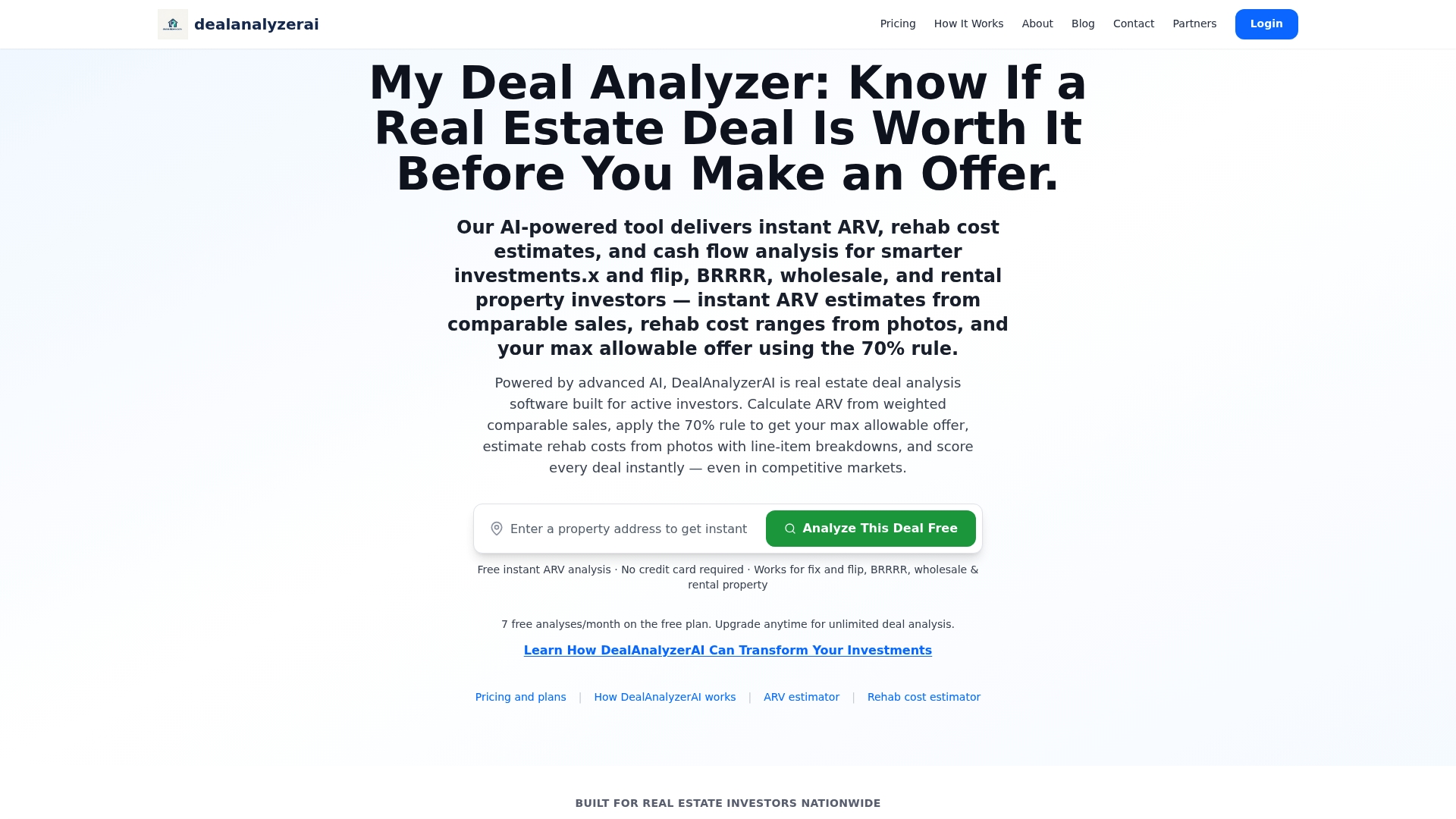
That combination automates early screening steps including sales validation, rough economics, and risk scoring, and provides a ranked shortlist with supporting data for further analysis. It also includes tools for off-market and Facebook Marketplace search for sourcing deals, plus structured, shareable reports with market-adjusted buyer pay ceilings.
If you’re currently running screening manually across a spreadsheet and a dozen browser tabs, start with the free property analysis tool to see how ARV and MAO output compares to your own numbers on a live deal. Teams ready to run this at scale across multiple analysts can review plan and pricing details, including the Premium tier at $97 per month and White-Label options for firms that want to present reports under their own brand.
Sources
- Six-step process needed to find unlimited real estate deals | BiggerPockets
- The Deal Screening Framework: kill deals in minutes, not meetings | SFAI Labs
- Real estate investment analysis — HBS Online
FAQ
What Is the 7% Rule in Real Estate?
It’s a fast Gate 2 style filter, not a substitute for calculating actual NOI, cap rate, and cash-on-cash return on a specific property.
What Is the 3-3-3 Rule for Buying a House?
It’s aimed at personal home buyers rather than investment deal screening, but the underlying discipline of setting hard financial thresholds before you shop applies directly to buy-box criteria.
What Creates 90% of Millionaires, and How Does That Apply to Deal Screening?
Real estate has historically been cited as a major wealth-building vehicle for a large share of self-made millionaires, largely through consistent, disciplined acquisition over time rather than one exceptional deal. That supports the core argument for building a repeatable screening funnel: process discipline applied consistently across many deals compounds faster than waiting for a single perfect opportunity.
What Is the Hardest Month to Sell a House?
Winter months, particularly December and January, are generally considered the slowest for residential resale in most U.S. markets, since buyer activity typically drops around the holidays and in colder weather. For investors weighing exit strategy during deal prioritization, factoring seasonal listing timing into your projected hold period can meaningfully affect your exit liquidity score.
How Much Does DealAnalyzerAI Cost?
DealAnalyzerAI’s Premium plan is priced at $97 per month or $931 per year, with a White-Label Upgrade available at $149 per month or $1430 per year for firms that want branded reports. Add-ons including Off-Market Property Search, Renovation Estimator, and Facebook Marketplace Search are priced separately, and a free tier is available for investors who want to test the tool before subscribing.
Recommended
Analyze Your Next Deal with AI
Get an instant ARV estimate, rehab cost analysis, and deal score — free for 7 days.
Get Free Deal Breakdown