Investors: Screen 40 Leads/Week, Verify AI Risk Flags in 10 Minutes
A weekly workflow for investors to screen high-volume leads. Use AI risk flags with ARV/MAO filters, verify flags in under 10 minutes, and gate deals fast.
By DealAnalyzerAI Editorial Team
Real estate investing education and deal-analysis research from DealAnalyzerAI.

Investors: Screen 40 Leads/Week, Verify AI Risk Flags in 10 Minutes
AI property-level risk flags exist to do one job: catch the valuation, rehab, title, or distress problems that would otherwise surface after you’ve already made an offer. The correct move when a flag appears is simple. Verify the linked evidence, then prioritize or pass. Tools like AI-powered real estate analysis software generate ARV ranges, maximum allowable offers, rehab estimates, and source-linked flags in the same pass, which is what turns a stack of listings into a ranked pipeline instead of a guessing game.
TL;DR:
- AI risk flags are most impactful when they identify significant ARV outliers, visible rehab issues, environmental risks, or title problems that alter deal economics or timelines.
- Verifying flags quickly involves confirming their source documents, checking public records, and making targeted calls or inspections to assess validity.
- Different strategies require setting customized thresholds for flags, tightening criteria in slow markets, and regularly reviewing these settings to prevent either missed opportunities or risky deals.
- AI flags serve as filters to prioritize traditional due diligence efforts but cannot replace it entirely, especially for confirming title issues or physical conditions.
- Maintaining a disciplined workflow with clear flag statuses, thresholds, and regular data updates helps manage high-volume lead screening effectively.
Table of Contents
- What Are AI Risk Flags in Real Estate?
- What Flags Should You Actually Watch For?
- How Do You Verify a Flagged Finding Fast?
- How Do You Build a Weekly Screening Workflow?
- Where Do AI Flags Get It Wrong?
- How Often Should You Update Your Risk Flag Datasets?
- How Should You Set Risk Flag Thresholds for Your Strategy?
- How Do AI Flags Fit With Traditional Due Diligence?
- A Practical Note on Trusting the Flags
- How DealAnalyzerAI Puts Risk Flags to Work
- Sources
- FAQ
What Are AI Risk Flags in Real Estate?
An AI risk flag is a property-level warning: something in the valuation, rehab estimate, title, condition, or distress profile that doesn’t line up with what a clean deal should look like. Good systems pull from automated valuation models and comps, uploaded photos, public records, rent rolls, and inspection reports to generate these flags.
They also fail in predictable ways. Data goes stale between refresh cycles, rural and low-transaction markets have thin comp coverage, and records get mismatched to the wrong parcel more often than most software vendors admit. AI screening compresses the time it takes to extract critical fields and calculate derived metrics, but it still leans on human judgment for anything involving tenant credit, lease nuance, or neighborhood context machines can’t see. Treat every flag as a lead worth checking, not a verdict.
What Flags Should You Actually Watch For?
Not every flag deserves your attention. Some change your offer by thousands of dollars; others are noise. Here’s the compact list that actually moves deal economics:
- ARV range outliers. When a property’s after-repair value estimate sits far outside the comp cluster, it usually means the comps are mismatched, not that you found a hidden gem.
- Photo-detected rehab issues that contradict the listing. Foundation cracking, roofline sag, or water staining visible in uploaded photos but absent from the seller’s description is one of the highest-value flags because it changes your rehab budget directly.
- Environmental and oil-tank indicators. Older homes in former heating-oil markets carry buried tank risk that can turn a $15,000 rehab into a $60,000 remediation.
- Title and lien flags. Tax delinquency, a lien filed in the last 90 days, or an HOA judgment attached to the parcel changes your closing timeline and your leverage in negotiation.
- Distress signals. A composite score built from foreclosure filings, probate records, and other life-event data helps rank which distressed leads to call first. PropertyRadar’s Distress Score aggregates more than 30 public-record and life-event signals into a 0 to 100 score, with scores above 80 marking the highest-priority tier. A high score ranks urgency; it doesn’t prove the seller is ready to negotiate.
- Listing anomalies. Duplicate listings across platforms or a rapid price drop inside two weeks often signals a deal that already fell through financing once.
- Tenant concentration and lease rollover risk. A multifamily deal where 60% of leases expire in the same quarter carries vacancy risk that a cap rate alone won’t show you.
Each of these earns a spot on your checklist because it changes either your number or your timeline, not because it sounds alarming in a report.
How Do You Verify a Flagged Finding Fast?
Every flag needs the same three-part read before you act on it: what was detected, so what it means for your numbers, and now what you do about it. That structure, borrowed from structured findings modules that classify severity and quantify exposure, keeps you from either dismissing something real or freezing on something trivial.
Run these checks before you decide anything:
- Confirm the source citation. Refuse to treat a flag as confirmed until it links to the exact document sentence, photo region, or map location it came from. Systems that read dense diligence documents and cite the exact paragraph behind a finding let you verify in minutes instead of re-reading the whole file.
- Pull the public record. County tax and recorder sites confirm liens, delinquency, and ownership in five minutes or less.
- Order a quick title summary. Not a full title commitment, just enough to flag anything the county site missed.
- Call with a script, not a pitch. Ask the seller or listing broker one direct question tied to the flag: “Is there an oil tank on the property?” gets a cleaner answer than “Tell me about the property’s history.”
- Get a targeted contractor opinion. A 15-minute walk-through beats a full inspection when you’re screening, not closing.
Sort every flag into a severity tier and act accordingly:
| Severity | Example | Typical action |
|---|---|---|
| High | Active tax lien, confirmed oil tank | Escrow holdback or pass |
| Medium | ARV outlier, roof age uncertain | Negotiate price, order inspection |
| Low | Minor cosmetic photo flag | Proceed, note in file |
Pro Tip: Never let a flag sit in your notes without a status tag. Mark it pending, reviewed, mitigated, or dismissed the moment you check it, so you’re not re-verifying the same lien three weeks from now.
How Do You Build a Weekly Screening Workflow?
If you’re only looking at one property at a time, flags are a convenience. If you’re running 40 leads a week, they’re the only thing that keeps your pipeline from collapsing into chaos. Here’s a workflow that scales:
- Set your thresholds first. Decide your maximum acceptable ARV spread, your rehab-cost ceiling by property type, your minimum distress-score band for outreach, and your minimum MAO gap before you touch a single lead. Thresholds set in advance stop you from rationalizing a bad deal mid-week.
- Ingest and auto-flag. Feed your list through your analysis tool and let it generate ARV ranges, rehab estimates, and flags in bulk rather than one at a time.
- Triage into three queues. Queue A is clean, high-priority deals ready for a call today. Queue B needs one verification step before you commit time. Queue C gets parked or passed.
- Run rapid verification on Queue B only. This is where your call scripts, photo requests, and title/tax checklists earn their keep. Don’t waste verification time on Queue A or C.
- Decide: pursue, keep in the pipe, or pass. Every property gets a decision before the week ends. Nothing sits in limbo.
Two things make this workflow repeatable instead of a one-time exercise:
- The affordability gate. Run ARV range, MAO, and rehab estimate together as a single filter. If the gap between MAO and asking price can’t clear your target margin even at the low end of the ARV range, the deal gets cut automatically, no further review needed.
- Recordkeeping with status tags. Every finding gets marked pending, reviewed, mitigated, or dismissed, with a short rationale attached for the audit trail. Six months from now, when a similar property crosses your desk, you’ll have a record of why you passed or pursued the last one.
Wholesalers running high lead volume benefit most from this structure because it turns “check every property carefully” (impossible at scale) into “check the properties that already failed a threshold” (entirely doable in an evening).
Where Do AI Flags Get It Wrong?
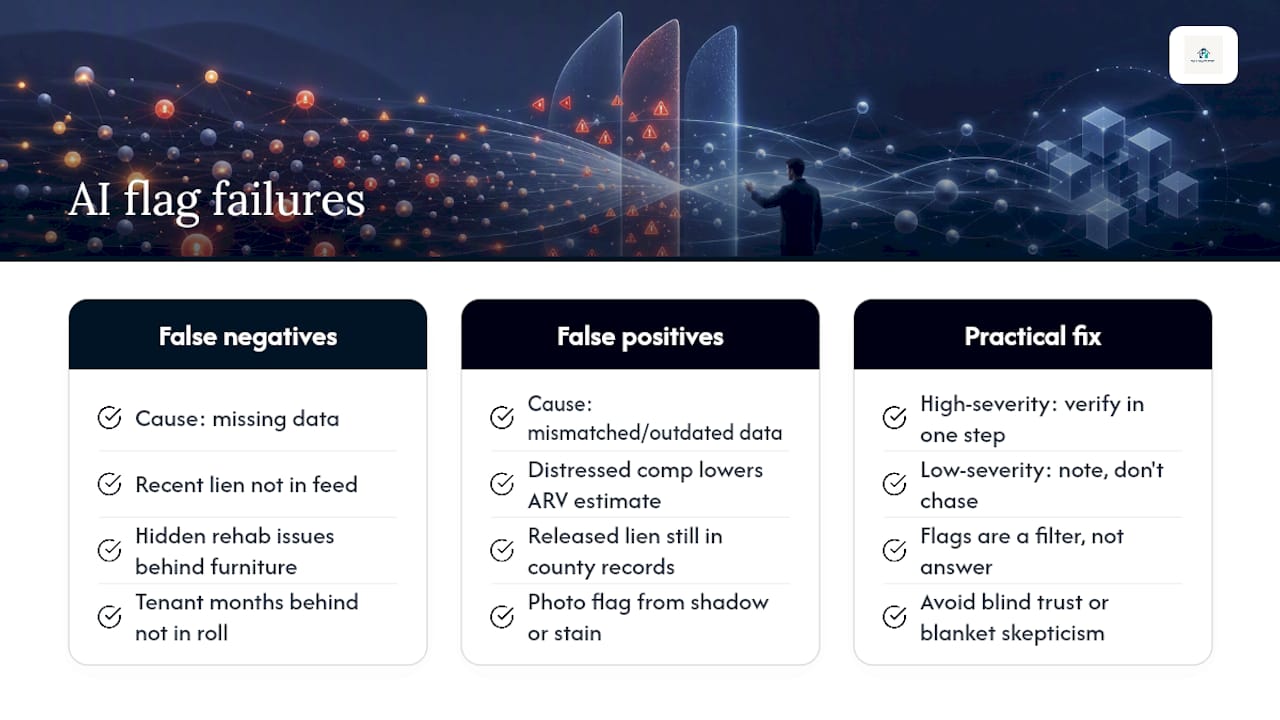
AI risk flags miss things, and they invent things that aren’t there. Both failure modes matter, and they fail differently.
False negatives usually come from data gaps: a lien filed last week that hasn’t hit the public record feed yet, a rehab issue hidden behind furniture in every listing photo, a rent roll that doesn’t reflect a tenant who’s three months behind but hasn’t been formally noticed. No model catches what isn’t in its inputs.
False positives tend to come from mismatched or outdated data: a comp that closed under distressed conditions dragging down an ARV estimate, a tax record still showing a lien that was released last month but hasn’t updated in the county database, a photo flag triggered by a shadow or water stain that turns out to be cosmetic. AI extraction accelerates the pass or fail decision, but it still needs a human to catch context a model can’t weigh.
The practical fix isn’t to distrust the flags. It’s to treat every high-severity flag as a hypothesis that needs one verification step, and every low-severity flag as noise you note but don’t chase. Investors who swing to either extreme, blind trust or blanket skepticism, end up either buying a lemon or passing on a clean deal because a stale record spooked them. The flags are a filter, not a final answer.
How Often Should You Update Your Risk Flag Datasets?
Datasets rot faster than most investors expect. Tax records update on county schedules that range from weekly to quarterly depending on the jurisdiction. Comp data ages out the moment a new closing hits the MLS. Distress signals shift as foreclosure filings and probate records get added or resolved.
Set a deliberate refresh cadence instead of assuming your software updates continuously. Pull fresh comps before every new batch of properties, not once a month. Re-check tax and lien status on anything that’s been sitting in your Queue B for more than two weeks, since a clean title check from three weeks ago isn’t a guarantee today. If you’re working a specific submarket heavily, flag when your comp pool starts leaning on sales older than 90 days. That’s usually a sign the local data feed needs a manual supplement.
Track your false-positive rate informally. If a particular flag type, say, ARV outliers in a specific zip code, keeps getting dismissed after verification, your comp radius or weighting for that area probably needs adjustment. The dataset isn’t static, and neither should your thresholds be. Review them quarterly at minimum, and immediately after any market shift big enough to change what “normal” comps look like in your target area.
How Should You Set Risk Flag Thresholds for Your Strategy?
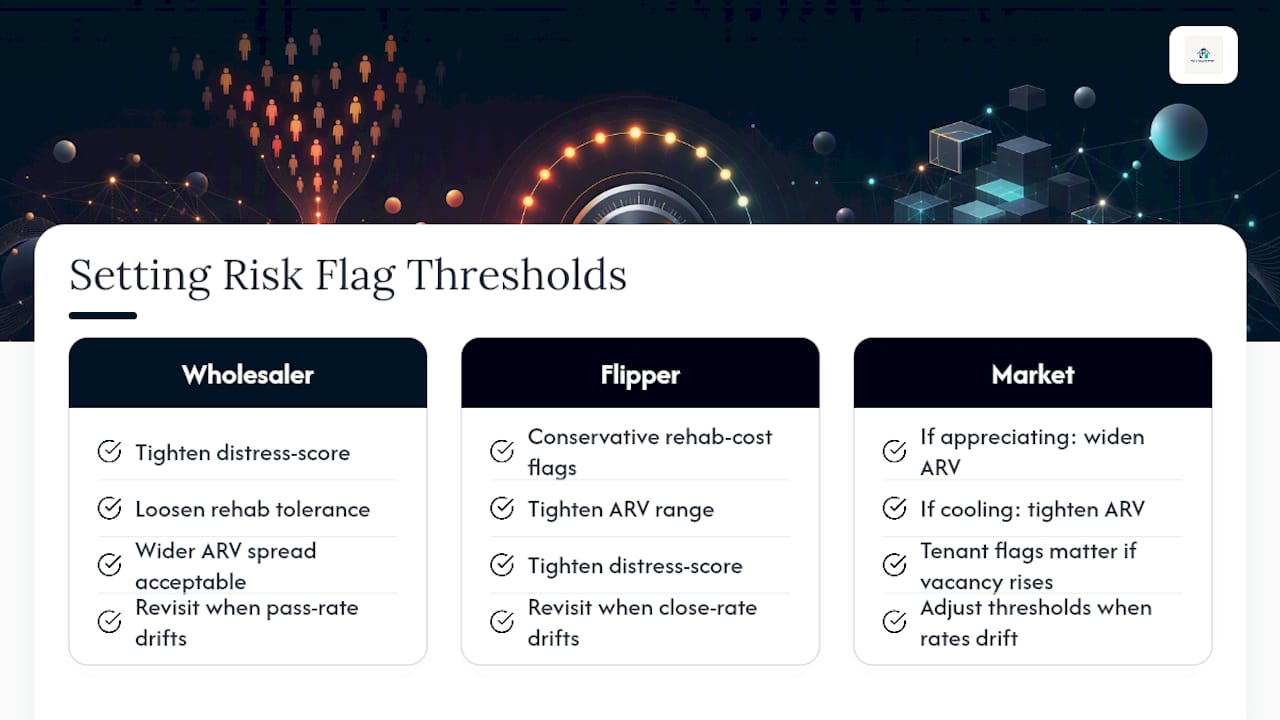
A wholesaler moving contracts in 10 days needs different thresholds than a buy-and-hold investor underwriting a five-year hold. Generic default settings from any software will misfire for one strategy or the other.
If you’re wholesaling, tighten your distress-score threshold and loosen your rehab-estimate tolerance. You need highly motivated sellers fast, and you’re not the one paying for repairs, so a wider rehab flag range is acceptable. If you’re flipping, flip the emphasis: keep rehab-cost flags conservative and demand a tighter ARV range, since you’re the one absorbing both the repair budget and the resale risk.
Market conditions matter just as much as strategy. In a fast-appreciating market, a wider ARV spread might be tolerable because comps are lagging reality upward. In a cooling or flat market, tighten that same threshold, because stale comps are more likely to overstate value than understate it. Tenant concentration flags matter more in markets with rising vacancy and less in markets where rental demand is still climbing.
The mistake most investors make is setting thresholds once and never touching them again. A threshold that worked in a seller’s market will let too many bad deals through in a buyer’s market. Revisit your settings every time you notice your pass rate or your close rate drifting, not on a fixed calendar.
How Do AI Flags Fit With Traditional Due Diligence?
AI flags don’t replace a title search, a home inspection, or a conversation with the listing broker. They tell you which of those traditional steps deserves your time first.
Think of it as sequencing, not substitution. Instead of running full due diligence on every property in your pipeline, which is both slow and expensive at volume, you run AI screening first to sort properties into tiers, then apply traditional diligence only where the flags say it’s warranted. A property with no flags and a tight ARV range might only need a drive-by and a standard inspection. A property flagged for a possible oil tank and a lien needs a Phase I environmental review or a lawyer-verified title check before you go further, and depending on the jurisdiction, zoning and building rights may need a lawyer-verified check as well.
This layered approach also protects you from the opposite mistake: skipping traditional diligence entirely because the software came back clean. A flag-free report means the automated inputs didn’t catch anything, not that a full inspection would agree. Investors who’ve had the fewest expensive surprises are the ones who use flags to decide where to spend their diligence dollars, then still spend them.
A Practical Note on Trusting the Flags
AI flags speed up screening more than almost any other tool an active investor can add to their process this year. That much is clear. What’s less obvious is how quickly that speed turns into complacency if you stop asking where a flag actually came from.
Every flag you act on should trace back to a document sentence, a photo region, or a public record you can pull yourself. If a system can’t show you that source, treat the flag as a hint, not a fact. I’d also push back gently on the idea that thresholds are a set-it-once decision. Markets shift, comp pools thin out or refill, and the false-positive rate on any given flag type drifts with them. Building a habit of reviewing your own settings, and your own dismissal patterns, matters as much as picking good software in the first place.
— Sam
How DealAnalyzerAI Puts Risk Flags to Work
Certain AI real estate analysis tools can deliver a ranked pipeline quickly, combining ARV, rehab cost, and title checks in one pass, with flags tied back to the evidence that triggered them.
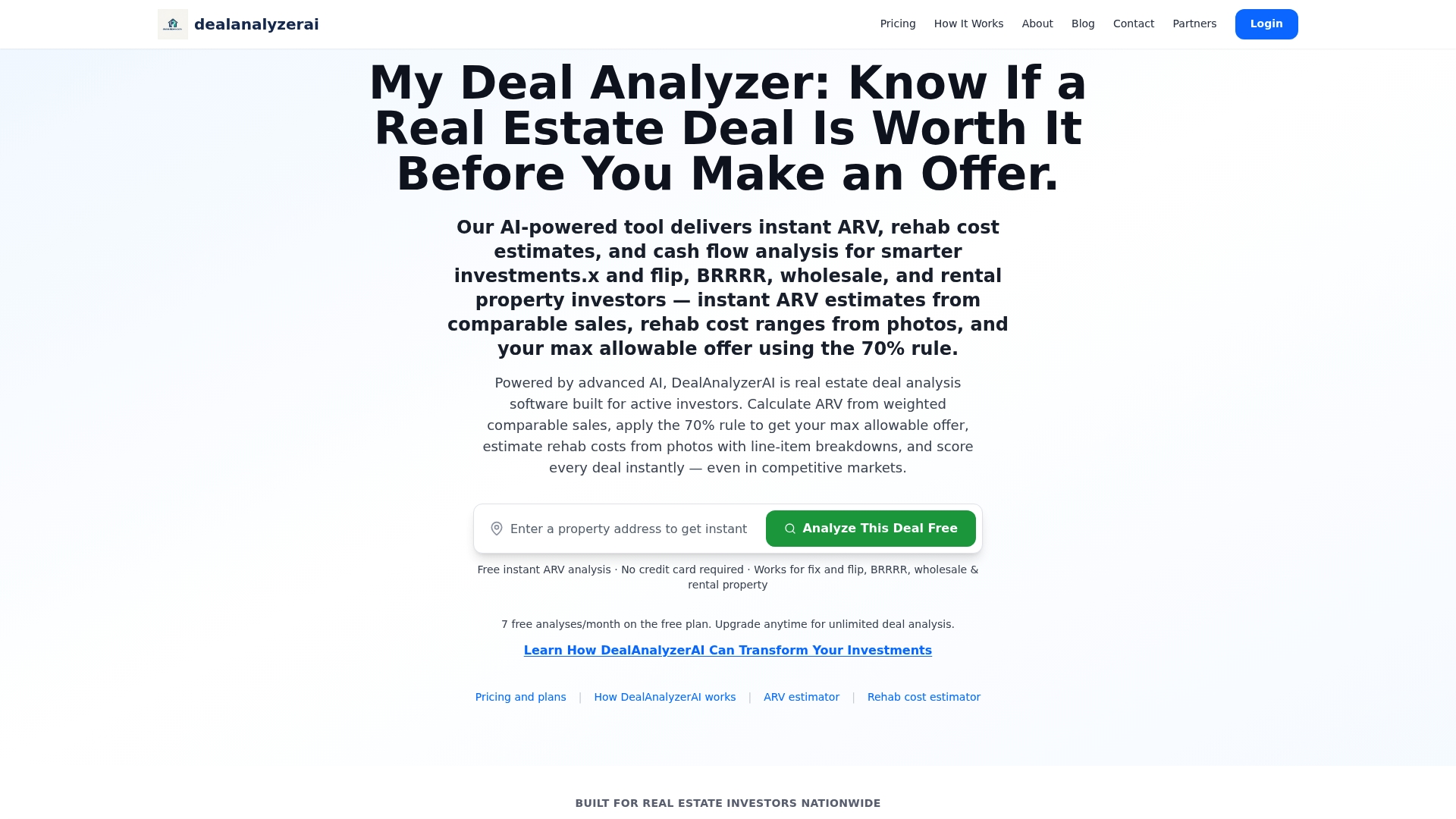
By uploading a property address and photos, users can see an ARV range built from comps, a maximum allowable offer calculated against target margins, and a rehab-cost estimate derived from photo analysis rather than flat per-square-foot estimates. Flags may appear with attached sources to support them. That’s the same source-linked structure this article has walked through: what was flagged, why it matters, and what to check next.
If you’re screening more than a handful of properties a week, run your next lead list through the free deal analyzer and see how the ARV, MAO, and flag output compares to your current process. Investors managing higher volume can also check the investor use-case page for the white-label and reporting features built for weekly screening at scale.
Sources
For deeper reading on the concepts covered here: PropertyRadar’s Distress Score methodology, V7 Labs’ AI diligence agent with visual citation, DDee.ai’s structured findings and severity framework, and the DealAnalyzerAI landing page for tool specifics.
FAQ
What Counts as an AI Risk Flag in Real Estate?
It’s a property-level warning, such as an ARV inconsistency, a photo-detected rehab issue, a title or lien problem, or a distress signal, generated from comps, photos, public records, and other property data.
How Fast Can I Verify a Flagged Finding?
Most flags can be checked in under 10 minutes using a county record lookup, a quick title summary, or a targeted call, provided the flag links to its source document or photo.
Does a High Distress Score Mean the Seller Will Negotiate?
No. A high Distress Score ranks a property for outreach priority based on public-record and life-event signals; it doesn’t guarantee the seller is ready to sell below market.
Can AI Flags Replace a Title Search or Inspection?
No. AI flags tell you which properties need traditional diligence most urgently, but a title search, environmental review, or physical inspection still confirms the finding before you close.
Does DealAnalyzerAI Generate Risk Flags Along With ARV and MAO?
Yes. DealAnalyzerAI produces ARV ranges, maximum allowable offers, photo-based rehab estimates, and risk flags in the same analysis, letting investors screen and verify deals from a single report.
Recommended
Analyze Your Next Deal with AI
Get an instant ARV estimate, rehab cost analysis, and deal score — free for 7 days.
Get Free Deal Breakdown