How AI Improves ARV Accuracy for BRRRR Investors
Discover how AI improves ARV accuracy for BRRRR investors, enhancing your deal success with automated insights and reliable estimates.
By DealAnalyzerAI Editorial Team
Real estate investing education and deal-analysis research from DealAnalyzerAI.

How AI Improves ARV Accuracy for BRRRR Investors
AI improves ARV accuracy for BRRRR investors by automating comparable sales selection, applying geotemporal weighting, and generating photo-based rehab cost estimates — cutting the manual guesswork that causes deals to fail at refinance. When a dense, recent renovated comp set is available, AI-backed ARV tools typically land within ±5% of sale price, giving you a reliable foundation for maximum allowable offer (MAO) calculations. The National Association of REALTORS® confirms that AI applications in property valuation and predictive analytics are now operational, not experimental. Your immediate next step: run an AI ARV on one current deal, compare it to your manual estimate, and check the confidence score before you make an offer.
Table of Contents
- How does AI build an ARV from raw property data?
- How does AI estimate rehab costs from property photos?
- What do accuracy claims actually mean for your BRRRR deals?
- Step-by-step BRRRR workflow using AI ARV and rehab estimates
- Where does human judgment still matter?
- What should you look for in an AI ARV tool?
- How Dealanalyzerai supports your BRRRR underwriting
- Key Takeaways
- The real edge AI gives BRRRR investors
- Dealanalyzerai gives BRRRR investors a faster path to confident offers
- Useful sources
- FAQ
How does AI build an ARV from raw property data?
AI-driven ARV starts with the right inputs. The model pulls MLS sold transactions, public tax records, listing history, rent comps, and neighborhood trend data, then filters for recently renovated comparable sales within a defined radius and time window. That last filter matters most for BRRRR deals, because a non-renovated comp will systematically understate your post-rehab value.
From there, the model applies geotemporal weighting — giving more influence to sales that are closer in distance and more recent in time. Techniques like hedonic regression and gradient-boosted ensemble models then translate those weighted comps into an ARV range with a confidence score attached. The confidence score tells you how tight or wide the model’s uncertainty is, which is the number you should check before setting your MAO.
Compared to manual underwriting, AI comp pulls are faster, more consistent across multiple deals, and capable of backtesting against hundreds of prior sold transactions. That consistency is what makes AI useful when you are screening ten properties a week rather than one. The benefits of AI-driven ARV ranges show up most clearly in deal flow volume, where human bandwidth becomes the bottleneck.
Pro Tip: Always insist the tool displays its comp filter parameters — distance radius, time window, and renovation flag. If you cannot see or override those filters, you cannot validate the output.
How does AI estimate rehab costs from property photos?
Computer vision analyzes uploaded photos to identify room types, surface conditions, and visible defects across kitchens, bathrooms, roofs, and flooring. The system classifies each area into a condition tier — cosmetic, partial renovation, or full gut — and maps those tiers to regional cost databases to produce a line-item estimate range.

The practical workflow looks like this: upload photos, receive an auto-generated scope with default cost ranges by trade and region, then adjust for your contractor relationships or local pricing. Dealanalyzerai’s photo-based rehab estimator follows this model, letting you modify scope items before the final MAO calculation runs.
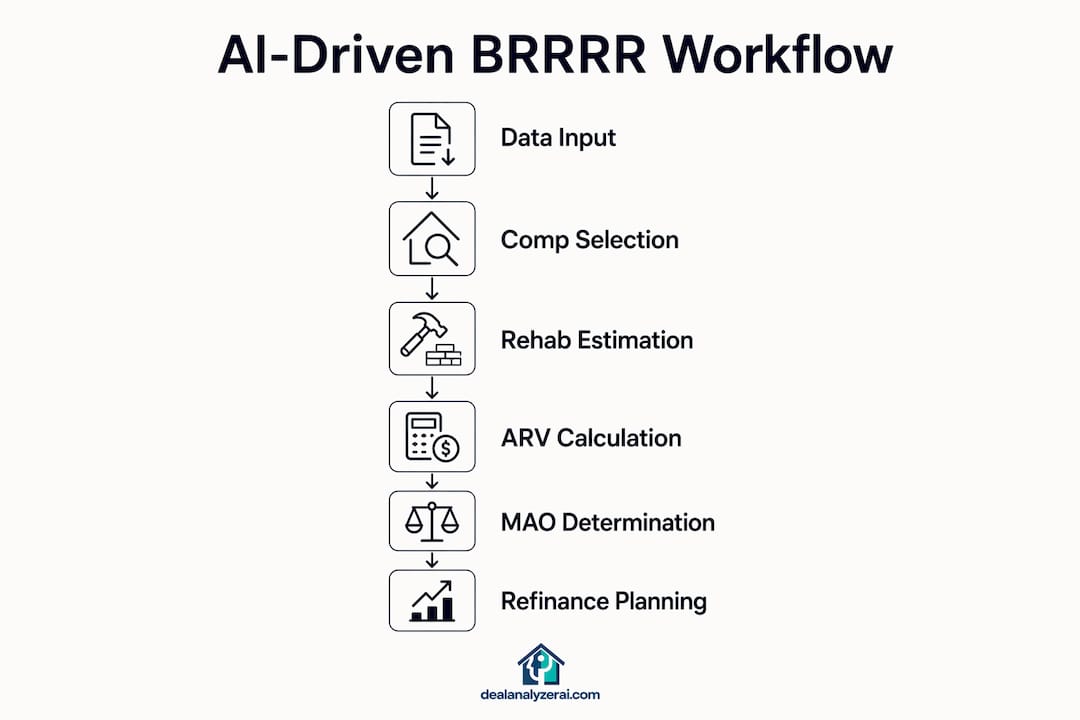
One important caveat: photo-only estimates are preliminary. They give you a fast ballpark for screening and MAO math, but the output should display an uncertainty range. Before you finalize a bid or a refinance plan, validate with contractor quotes or a line-item walkthrough. The most reliable systems, as NAR’s computer vision guidance notes, allow manual edits and contractor-uploaded bids to close the estimate loop.
What do accuracy claims actually mean for your BRRRR deals?
Vendors typically quote accuracy using median absolute percentage error (MAPE), the percentage of estimates landing within ±5% of eventual sale price, and confidence score ranges. Those metrics sound clean, but context changes everything.
With six or more renovated comps in the same neighborhood within 90 days, AI ARV error collapses to a narrow band. With sparse comps, the model widens its search geography and flags higher uncertainty — which is exactly the behavior you want to see, because a tool that reports false precision in thin markets is more dangerous than one that honestly widens its range. EY’s analysis of generative AI in real estate cautions on transparency and model bias, reinforcing why explainability matters as much as headline accuracy.
Accuracy benchmark: When comp density is high (6+ renovated sales within 90 days), AI ARV tools generally provide estimates close to the sale price when sufficient data is available. At that precision level, a $250,000 ARV estimate carries a worst-case error of roughly $12,500 — a manageable spread for MAO setting at 75% LTV.
Proper backtesting uses holdout sold transactions and time-forward testing on renovation-flagged comps. Ask any vendor for performance metrics stratified by comp density and property class before you rely on their headline number.
| Accuracy condition | Typical ARV error | Confidence score behavior |
|---|---|---|
| 6+ renovated comps, 90-day window | Within ±5% of sale price | Tight, narrow range |
| 3–5 comps, mixed renovation status | Wider spread, ±8–12% possible | Moderate, flagged uncertainty |
| Sparse comps, atypical property | Model widens geography | Low score, manual review required |
Pro Tip: Set a minimum confidence score threshold before using a single-point ARV for MAO. If the score falls below your threshold, treat the output as a screening filter only and order a manual comp pull.
Step-by-step BRRRR workflow using AI ARV and rehab estimates
The BRRRR method requires precise rehab cost control and ARV estimates to refinance to target LTV and recycle capital. AI tightens both inputs before you commit a dollar.
Before you run the AI, collect: address, recent interior and exterior photos, purchase price, basic repair notes, local rent comps, and your target refinance LTV, often around a common loan-to-value ratio.
- Run the AI ARV. Enter the address and let the model pull renovated comps. Review the confidence score and comp list before accepting the output.
- Auto-estimate rehab. Upload photos to generate a scope and cost range. Adjust line items for your market and contractor rates.
- Calculate MAO and refinance feasibility. Use the ARV and rehab range to set your MAO and model the cash-out at 75% LTV.
- Generate an investor-ready report. Export the ARV, rehab scope, MAO, and refinance scenario as a document for lenders or partners.
- Validate with contractors and title. Get at least one contractor bid and confirm no permit or title issues before submitting an offer.
| Deal input | Example figure | AI output used |
|---|---|---|
| Purchase price compared to maximum allowable offer (MAO). | ||
| Rehab estimate range generated by AI for scope and cost considerations. |
| After Repair Value (ARV) estimated by AI using dense comparable sales to determine refinance basis. |
| 75% LTV refinance target | $195,000 | Cash-out feasibility | | Maximum allowable offer calculated based on ARV, loan-to-value, and rehab costs to establish offer ceiling. |
AI-enabled underwriting typically compresses the screening phase from days to hours. The rehab and refinance planning phases still require contractor and lender coordination, but you enter those conversations with documented numbers rather than rough guesses.

Where does human judgment still matter?
AI handles comp selection and photo analysis well. It does not handle unusual lot configurations, legal encumbrances, permitted-addition history, or special-use properties. Those situations require you to override the model, and a good tool makes that easy.
Use this checklist before finalizing any AI-assisted offer:
- On-site inspection: Confirm structural condition, utilities, and anything not visible in photos.
- Contractor bids: Get at least one line-item bid to validate the AI’s rehab range.
- Title and permit review: Check for open permits, liens, or unpermitted additions that affect appraised value.
- Appraisal risk factors: Identify any features that could cause an appraiser to adjust downward (non-conforming use, deferred maintenance not captured in photos).
- Red flags to watch: Sparse renovated comps, a wide confidence-interval spread, photo gaps, or signs of structural issues the images do not fully show.
PwC’s research confirms that AI augments workflows rather than replacing experienced judgment. The investors who get the most out of AI are the ones who use it to screen faster and then apply their expertise where it counts.
What should you look for in an AI ARV tool?
Not every tool built for real estate is built for BRRRR underwriting. Here is what actually matters:
- MLS and public-record integration with renovation-flagged comp filters
- Geotemporal controls you can adjust (distance radius, time window)
- Photo-based rehab estimator with regional cost databases and manual edit capability
- Confidence scores displayed on every ARV output, not just headline averages
- Backtesting metrics stratified by comp density and property class
- Exportable investor reports that include ARV, rehab scope, MAO, and refinance scenarios
- Batch processing for screening multiple deals per week
- Visible comp filters and explainable model outputs so you can audit any estimate
Tools that hide their comp selection logic or report a single-point ARV without a confidence range are the ones most likely to cause a refinance shortfall.
How Dealanalyzerai supports your BRRRR underwriting
Dealanalyzerai is built specifically for active investors running multiple deals per week. Its feature set maps directly to the BRRRR workflow:
- AI ARV ranges with confidence scores drawn from MLS solds and renovated comp filters
- Photo-based rehab estimator that classifies condition by room and maps to regional cost tiers
- MAO calculator that combines ARV and rehab ranges into an offer ceiling automatically
- Investor-ready exportable reports formatted for lenders, partners, and appraisal documentation
- Batch deal screening so you can run multiple properties without rebuilding inputs from scratch
- Risk flags that surface sparse comp sets, wide confidence intervals, or photo gaps before you commit
To get started, run a free ARV analysis on one current deal. Compare the AI ARV to your manual estimate, check the confidence score, and review the comp list. That single comparison will show you exactly where AI tightens your underwriting and where you still need boots on the ground.
Key Takeaways
AI improves ARV accuracy for BRRRR investors by automating comp selection, applying geotemporal weighting, and generating photo-based rehab estimates — with ±5% accuracy achievable when comp density is high.
| Point | Details |
|---|---|
| Comp density drives accuracy | When there are multiple renovated comps in the same area within a recent time frame, AI ARV tools can provide estimates that are generally close to the sale price. |
| Confidence scores are non-negotiable | Always check the confidence score before using an AI ARV to set your MAO. |
| Photo estimates are preliminary | Use AI rehab ranges for screening, then validate with contractor bids before final offers. |
| Human review covers AI blind spots | Inspections, title review, and appraisal risk factors require judgment AI cannot replicate. |
| Dealanalyzerai fits the BRRRR workflow | Its ARV ranges, rehab estimator, MAO calculator, and exportable reports support every BRRRR stage. |
The real edge AI gives BRRRR investors
Most investors underestimate how much time they lose to inconsistent comp pulls. You run a deal on Monday with one set of comps, revisit it Thursday with slightly different filters, and end up with two different ARVs and no clear answer. That inconsistency is where offers go wrong and refinances fall short.
AI does not eliminate judgment calls. What it does is give you a repeatable, auditable starting point every time. When I look at how AI has changed deal screening for active investors, the biggest gain is not the accuracy number itself. It is the confidence to move faster on deals that score well and walk away cleanly from deals that do not. The investors who resist adoption risk being outpaced in competitive markets, as PwC’s real estate research makes clear. The ones who treat AI as an assistant — accelerating comp pulls and surfacing statistical signals while they focus on inspections and negotiation — are the ones building portfolios faster.
The edge is not in the algorithm. It is in using the algorithm consistently, validating its outputs honestly, and knowing exactly when to override it.
Dealanalyzerai gives BRRRR investors a faster path to confident offers
Inconsistent ARV estimates and surprise rehab costs are the two most common reasons BRRRR deals fail at refinance. Dealanalyzerai addresses both in one place, giving you AI-generated ARV ranges with confidence scores, photo-based rehab estimates mapped to regional cost data, and MAO calculations that update automatically as inputs change.

You get exportable reports formatted for lenders and appraisers, batch screening for high-volume deal flow, and risk flags that catch thin comp sets before you make an offer. No manual spreadsheet rebuilding, no guessing at rehab line items from memory.
Run your first free deal analysis on a current property and see how the AI ARV compares to your manual number. If the confidence score is tight and the comps are solid, you have your offer ceiling. If the score is low, you know to dig deeper before committing.
Useful sources
- NAR: Artificial Intelligence in Real Estate — Primary industry source on AI use cases in property valuation, computer vision, and predictive analytics.
- PwC: AI Moves Into Real Estate — Evidence on AI adoption patterns, productivity gains, and workforce transformation in real estate.
- EY: Generative AI in Real Estate — Framework for responsible AI adoption, transparency requirements, and bias risk in real estate applications.
- Chase: How to Use the BRRRR Method — Practical BRRRR stage breakdown covering rehab management and refinance feasibility.
- Bounti.ai: Investment Property Analysis — Technical source on comp sensitivity, confidence scoring, and backtesting methodology for AI ARV tools.
FAQ
How does AI actually improve ARV accuracy?
AI improves ARV accuracy by automating comp selection with geotemporal weighting, filtering for renovated sales, and applying ensemble models that reduce human inconsistency. When comp density is high, tools typically land within ±5% of sale price.
What is a practical example of the BRRRR strategy?
A BRRRR investor buys a distressed property, spends a rehab budget, achieves an ARV, then refinances at 75% LTV to recover a substantial portion of capital — enabling redeployment on the next deal.
What does “accuracy” mean for AI property valuation tools?
In AI property valuation, accuracy refers to how close the model’s ARV estimate lands relative to the actual sale price, measured by metrics like MAPE and the percentage of estimates within ±5% of sale price. Confidence scores indicate how reliable that estimate is for a specific property given the available comp data.
Can Dealanalyzerai handle both ARV and rehab estimates in one workflow?
Yes. Dealanalyzerai combines AI ARV ranges, photo-based rehab cost estimation, and MAO calculations in a single analysis, producing exportable reports that cover every stage of BRRRR underwriting.
When should you override an AI ARV estimate?
Override the AI when the confidence score is low, comp density is sparse, or the property has unusual features — such as non-conforming use, unpermitted additions, or structural issues not visible in photos. Always validate with an on-site inspection and contractor bids before finalizing an offer.
Recommended
Analyze Your Next Deal with AI
Get an instant ARV estimate, rehab cost analysis, and deal score — free for 7 days.
Get Free Deal Breakdown