Buyers: Screen Environmental Hazards and Climate Risk Before Closing
Buyers and investors: follow a transaction-first checklist to spot contamination, run registry searches, order Phase I/II when needed, and add...
By DealAnalyzerAI Editorial Team
Real estate investing education and deal-analysis research from DealAnalyzerAI.
Buyers: Screen Environmental Hazards and Climate Risk Before Closing
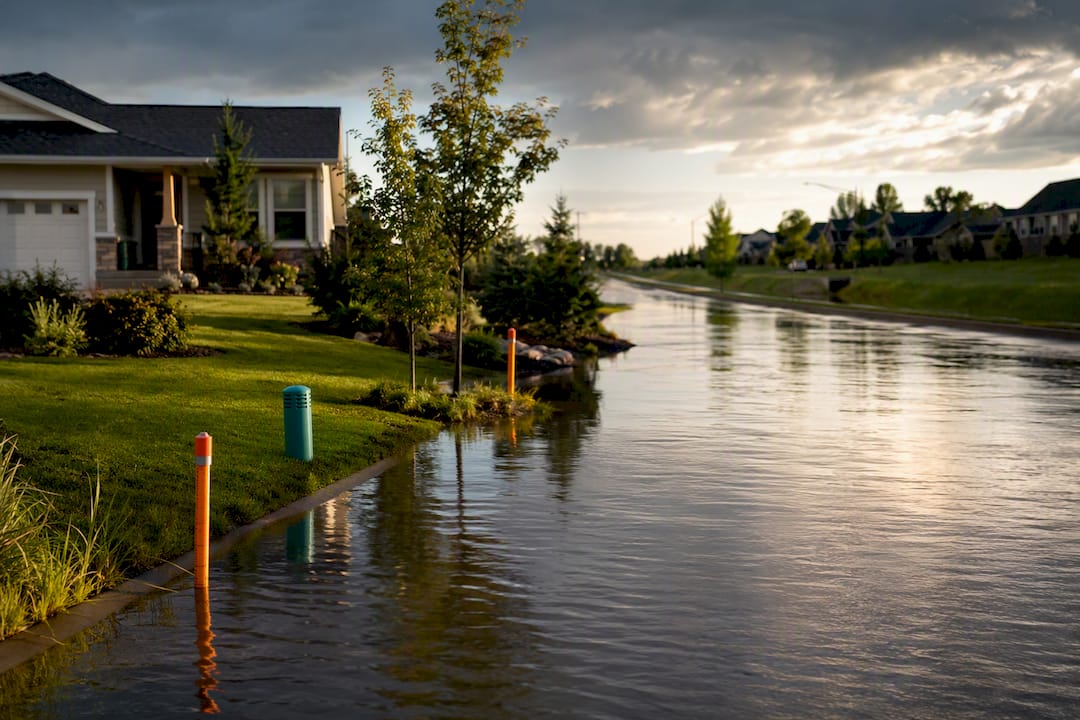
Environmental hazards commonly affect property value, financing, and legal liability, and the risks that matter most are soil and groundwater contamination, indoor air problems like radon and mold, and flood or wildfire exposure that FEMA maps often underestimate. Before you close, order a registry search and the right level of due diligence, whether that’s a full Phase I Environmental Site Assessment or targeted testing for a single-family purchase. Skip this step and you risk a lower appraisal, a stalled loan, or a remediation bill that dwarfs your down payment.
TL;DR:
- Conduct a registry search first to identify nearby Superfund sites, brownfield listings, or historical permits that indicate potential environmental risks.
- Order a Phase I Environmental Site Assessment if records suggest past industrial use or contamination concerns, and move to Phase II sampling if issues are found.
- Use targeted tests for radon, lead, asbestos, and mold in parallel with inspections because they are inexpensive and reveal critical indoor hazards.
- Rely on private flood risk data in addition to FEMA maps to uncover exposures that could increase costs or complicate financing and insurance.
- Neglecting proper due diligence may lead to costly remediation, lower appraisals, or deal stalls, emphasizing the importance of thorough environmental screening before closing.
Table of Contents
- What Are the Most Common Environmental Hazards in Real Estate?
- How Do Hazards Affect Value, Financing, and Insurance?
- How Do You Identify Environmental Hazards Before Closing?
- What Should You Do If Hazards Are Found?
- Why Does Climate Risk Belong in Your Environmental Screening?
- What’s the Full Due-Diligence Checklist Before You Close?
- When Is an Environmental Hazard a Deal Opportunity Instead of a Deal-Ender?
- Screen for Hazard Risk Before You Waste an Inspection Budget
- Where to Verify Environmental Hazard Data Yourself
- Sources
- FAQ
What Are the Most Common Environmental Hazards in Real Estate?
Environmental hazards in real estate split into three practical buckets: what’s in the ground, what’s inside the building, and what’s next door. Each requires a different detection method, and each carries its own cost consequences if missed.
Site-based hazards hide in soil and groundwater, often left behind by a previous use you’d never guess from the curb. Underground storage tanks (USTs) at old gas stations or industrial sites leak petroleum into soil for decades. Dry cleaners and machine shops left chlorinated solvents like PCE and TCE in groundwater, sometimes migrating under multiple neighboring lots. Heavy metals and contaminated fill dirt show up on former agricultural or industrial parcels, and a property’s chain of title or a quick look at historical aerial photos frequently reveals the clue a walkthrough never would.
Building and indoor hazards are the ones most buyers actually encounter, especially in older housing stock. Asbestos lurks in insulation, floor tile, and popcorn ceilings in homes built before the 1980s. Lead-based paint is a known concern in any structure built before 1978, when the federal ban took effect. Radon seeps up through foundation cracks regardless of a home’s age or price point, and it only shows up on a dedicated test kit or continuous monitor. Mold follows moisture, so a musty smell near a basement or a roofline stain is worth investigating before it’s worth ignoring.
Proximity hazards come from what surrounds the property rather than what’s on it. Sitting near a brownfield, an EPA Superfund site, an active industrial facility, a landfill, or a wastewater treatment plant can suppress value and complicate financing even when the subject property itself tests clean.
Red flags worth chasing down before you write an offer:
- Stained soil, dead vegetation patches, or a chemical odor on or near the lot
- Vent pipes, filled-in depressions, or old fuel dispenser islands suggesting a removed UST
- Permits on file for underground tanks, industrial use, or dry-cleaning operations
- A property address within a mile of a listed Superfund or state brownfield site
- Water staining, peeling paint, or visible mold in basements and crawl spaces
How Do Hazards Affect Value, Financing, and Insurance?
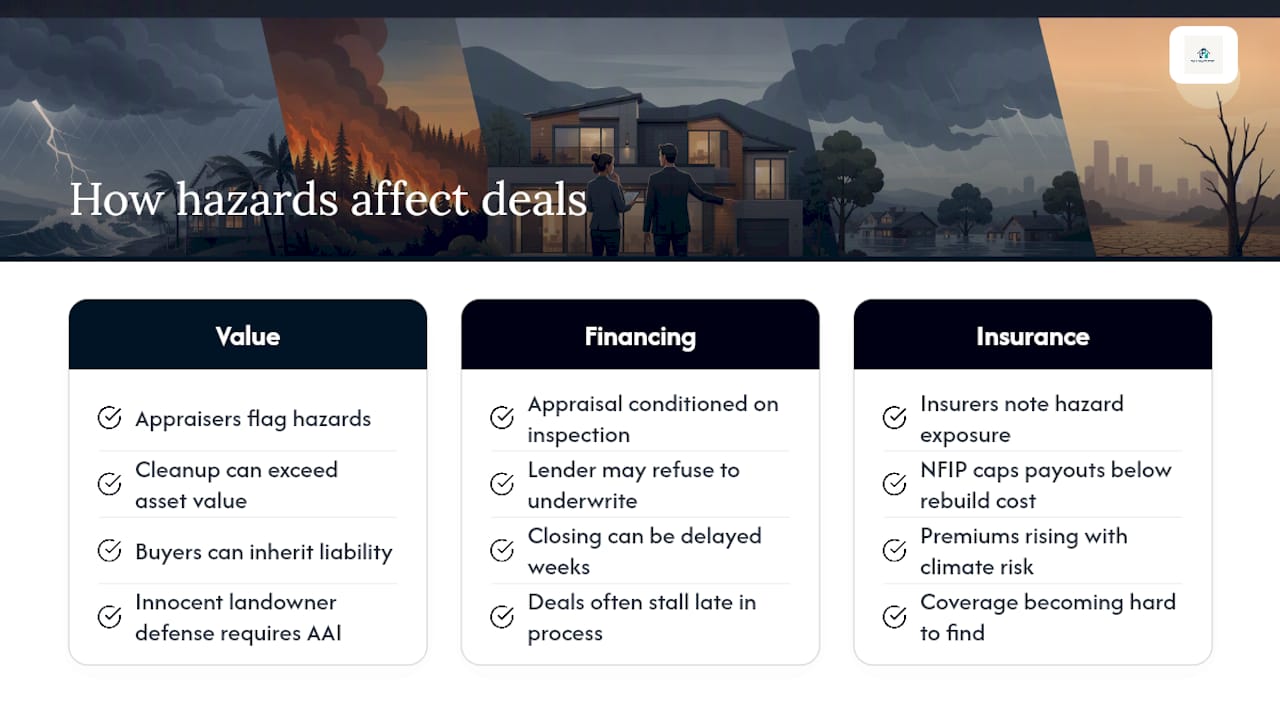
Environmental problems don’t stay theoretical once a lender or appraiser gets involved. Fannie Mae guidance directs appraisers to flag observed or suspected environmental hazards, and the appraisal can be marked subject to a professional inspection before the loan moves forward. That single note can add weeks to closing or kill the deal outright if the lender decides the risk is too uncertain to underwrite.
Fannie Mae guidance requires appraisers to flag environmental hazards, and appraisals can be conditioned on professional inspection before the loan closes. That single clause is why so many deals stall in the final stretch: the lender isn’t rejecting the property, it’s refusing to lend against an unknown.
Contamination liability under CERCLA is where the real financial exposure lives. Cleanup for a chlorinated solvent plume or a leaking UST can run into the hundreds of thousands of dollars, occasionally exceeding the asset’s value entirely. Buyers who skip due diligence can inherit that liability outright, which is why the innocent landowner defense exists, but it only protects buyers who completed proper “all appropriate inquiries” before purchase.
Insurance carries its own exposure. NFIP flood policies cap payouts well below full rebuild cost on many homes, and premiums have climbed sharply as insurers reprice for climate risk. In some flood-prone or wildfire-exposed markets, coverage isn’t just expensive, it’s becoming hard to find at any price.
How Do You Identify Environmental Hazards Before Closing?
Due diligence works best as a sequence, not a scramble. Each step either rules out a risk cheaply or tells you it’s time to spend more before you commit.
- Run registry searches first. Check the EPA’s Superfund site database, your state’s brownfield registry, and local permit records for any history of tanks, spills, or industrial use tied to the address.
- Order a Phase I ESA when the property history warrants it. A Phase I follows the ASTM E1527 standard and satisfies the All Appropriate Inquiries requirement under CERCLA, reviewing historical aerials, Sanborn maps, and regulatory databases without any physical sampling.
- Move to Phase II if Phase I raises concerns. Phase II involves actual soil and groundwater sampling to confirm or rule out contamination the records search flagged.
- Run targeted home tests in parallel. Radon kits, lead paint swab tests, asbestos surveys, and mold inspections are inexpensive relative to the risk they screen out, and most can be scheduled inside a standard inspection period.
- Coordinate timing with your lender. Flag any Phase I or Phase II results early so underwriting isn’t blindsided late in the process.
Phase I ESAs typically run $1,500 to $3,500 and take two to three weeks, while Phase II sampling costs vary widely, from roughly $5,000 into the tens of thousands depending on scope. Build both into your due-diligence timeline from day one, not as an afterthought once something looks wrong. A solid due diligence checklist keeps these steps from slipping through the cracks.
Pro Tip: Order the registry search before you even schedule a showing. It costs nothing, takes minutes, and tells you whether a Phase I is worth the money before you’re under contract with a clock running.
What Should You Do If Hazards Are Found?
Finding a hazard doesn’t automatically mean walking away. It means shifting from “should I buy this” to “on what terms.”
Remediation costs vary enormously by hazard type. In-place controls like vapor barriers or soil caps can run a few thousand dollars, while full excavation and groundwater treatment for a solvent plume can climb into six or seven figures. Cost drives every negotiation that follows.
Once you know the scope, you have real leverage:
- Ask the seller to fund remediation before closing, or credit the estimated cost against the purchase price
- Set up an escrow holdback tied to a remediation timeline and completion certificate
- Negotiate an indemnity clause that shifts future liability back to the seller
- Add or extend an environmental contingency so you can exit cleanly if costs exceed a set threshold
Lenders and insurers respond to remediation plans, not just problems. A documented cleanup timeline with a licensed contractor often keeps financing intact where a vague “we’ll deal with it” does not. State voluntary cleanup programs can also offer liability protection or partial funding for buyers willing to remediate rather than walk. Bring in real estate counsel once remediation costs approach a meaningful share of the purchase price, and treat any contamination that exceeds your acceptable exit price as a legitimate reason to walk, not a deal to force through on optimism.
Why Does Climate Risk Belong in Your Environmental Screening?
Flood risk is bigger than FEMA’s maps suggest, and that gap is expensive if you find out after closing. Private flood-risk data shows roughly 2 million U.S. homes, worth nearly $1 trillion, face significant flood exposure that FEMA’s official maps don’t capture. Relying on FEMA alone means underwriting against a map already behind the actual risk.
Private flood-risk platforms reveal exposure that FEMA’s flood maps miss entirely, which is why smart buyers now check both. That’s the gap ASTM E3429-24 was built to close. The standard defines a Property Resilience Assessment across three stages: identifying natural hazards, evaluating risk exposure, and assessing resilience measures already in place. It’s designed to run alongside a traditional Phase I ESA rather than replace it.
Climate hazards and contamination interact in ways worth flagging before you buy:
- Flooding can mobilize buried contaminants, spreading a contained plume across a wider footprint
- Wildfire can damage tank containment systems or disturb asbestos-containing materials
- Repeated flood events accelerate mold growth in building materials that otherwise tested clean
Add a resilience screen to your diligence checklist and price in likely future capital expenditures or rising premiums, not just today’s insurance quote, guided by expert property development insights. A property investment risk assessment framework that includes both contamination and resilience factors gives you a more honest picture of long-term holding costs.
What’s the Full Due-Diligence Checklist Before You Close?
| Stage | Action |
|---|---|
| Pre-offer | Run EPA/state registry search, walk the neighborhood, note visible site red flags |
| Pre-closing | Order Phase I (AAI-compliant), targeted tests, private flood-risk check, insurance quote |
| Contract terms | Add inspection contingency, remediation escrow, seller warranties |
| Team | Engage environmental consultant, check with local permitting office, loop in lender’s counsel |
- Screen the registries and neighborhood before you make an offer.
- Order the Phase I and any targeted tests inside your inspection period.
- Check private flood data alongside FEMA, and get an insurance quote before you assume coverage is available.
- Put remediation and disclosure terms in writing before you waive contingencies.
When Is an Environmental Hazard a Deal Opportunity Instead of a Deal-Ender?
A discounted brownfield can be a legitimate play when the remediation cost is known, capped, and smaller than the discount you’re getting. It’s a trap when the scope is still open-ended after Phase II. Quick screening tools that flag risk early, the kind DealAnalyzerAI is built around, save you from spending inspection money on properties that were never going to underwrite.
— Sam
Screen for Hazard Risk Before You Waste an Inspection Budget
Ordering a Phase I on every property that crosses your desk isn’t realistic when you’re evaluating multiple deals a week, and that’s the gap DealAnalyzerAI closes. Instead of guessing which properties deserve full environmental due diligence, run your ARV and rehab numbers through the analyzer first. It flags cost and risk red flags from your uploaded property photos and comps before you spend a dollar on inspections, so the properties that reach Phase I are the ones actually worth the spend.
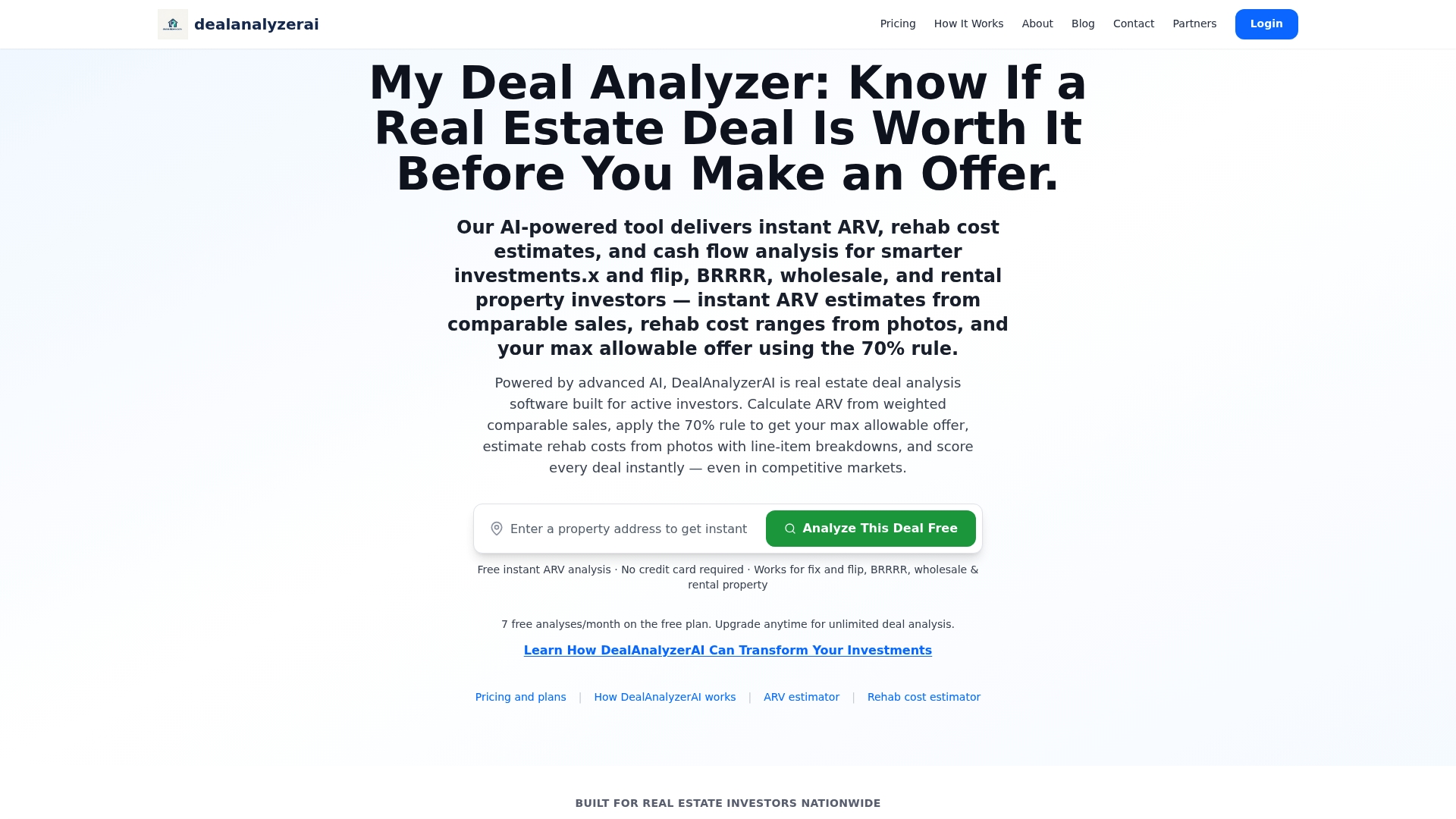
Start with the free plan to test how the risk flags work against a property you’re already tracking. Active investors screening several deals a week typically move to a paid Premium plan once they need faster turnaround across a full pipeline; current prices are on the pricing page. If you’re managing risk assessments for a team or client base, a White-Label Upgrade plan is available to add branding to reports; current prices are on the pricing page. Try the free AI deal analyzer on your next prospective property and see what it flags before you order a single inspection.
Where to Verify Environmental Hazard Data Yourself
- EPA Superfund site search for contamination and cleanup status by address
- ASTM E3429-24 for the Property Resilience Assessment standard
- FEMA’s Flood Map Service Center and NFIP program pages for official flood zone status
- Fannie Mae’s appraisal guidance on environmental hazard disclosure requirements
Sources
- Buyer beware: The importance of conducting environmental due diligence
- Fannie Mae environmental hazards appraisal requirements
- Search for Superfund site information where you live
- E3429 Standard Guide for Property Resilience Assessments
FAQ
What Are Five Common Environmental Hazards in Real Estate?
The five most common are soil and groundwater contamination (from USTs or industrial solvents), indoor air hazards like radon and mold, hazardous building materials such as asbestos and lead paint, flood risk, and proximity to brownfield or Superfund sites. Each requires a different detection method, from registry searches to targeted lab testing.
What Is the 3-3-3 Rule in Real Estate?
The 3-3-3 rule is a personal finance guideline suggesting you spend no more than three times your annual income on a home, keep your mortgage payment under three weeks of income, and hold three months of expenses in savings. It’s unrelated to environmental due diligence but often comes up alongside affordability discussions in the same buying process.
What Environmental Hazards Are Commonly Found in Homes?
The most frequent in-home hazards are radon gas, asbestos in older insulation and flooring, lead-based paint in homes built before 1978, and mold from moisture intrusion. All four are detected with targeted testing rather than a standard visual home inspection.
What Are Some Examples of Environmental Hazards in Real Estate?
Examples include leaking underground storage tanks, chlorinated solvent plumes from former dry cleaners, proximity to a listed Superfund site, and flood exposure that exceeds what FEMA’s official maps show. Each can affect financing, insurance, and resale value even when the property itself looks fine on a walkthrough.
How Much Does a Phase I Environmental Site Assessment Cost?
A Phase I ESA typically costs $1,500 to $3,500 and takes two to three weeks to complete. It satisfies the All Appropriate Inquiries standard under CERCLA, which is what preserves your legal defense if contamination is later discovered.
Recommended
Analyze Your Next Deal with AI
Get an instant ARV estimate, rehab cost analysis, and deal score — free for 7 days.
Get Free Deal Breakdown