How to Budget for Rental Property Maintenance
Learn how to budget for rental property maintenance effectively. Discover key rules and set a reliable cash reserve for upkeep.
By DealAnalyzerAI Editorial Team
Real estate investing education and deal-analysis research from DealAnalyzerAI.

How to Budget for Rental Property Maintenance
TL;DR:
- A blended maintenance budget combining three rules offers a reliable starting point for property upkeep costs. Landlords should set aside at least $1,000 to $1,500 per unit in liquid reserves for emergencies. Using this method and separate CapEx funds helps prevent cash shortages from large system replacements or unexpected repairs.
A blended baseline of 1% of property value, $1 per square foot, and 10%–15% of annual rent gives most landlords a reliable starting number for their rental property upkeep budget. Run all three rules on your property today, average the results, and set aside at least $1,000–$1,500 per unit as a liquid emergency cash floor before you do anything else.
Here is what that looks like in practice for a $250,000 single-family rental with 1,400 square feet renting for $1,800/month:
- 1% rule: $250,000 × 1% = about $2,500/year
- $1/sq ft rule: 1,400 sq ft × $1 = approximately $1,400/year
- Rent-based (10% of annual rent): $21,600 × 10% = roughly $2,160/year
- Blended average: average of these methods yields an estimated $2,020/year (around $168/month)
That blended number is your operating maintenance baseline. It does not include capital expenditure reserves, which you calculate separately. Dealanalyzerai can refine this further by analyzing property photos for deferred repairs and flagging major system conditions before you commit to a number.
Financial guidance from sources like Investopedia suggests budgeting 1%–4% of property value annually, with the higher end applying to older or higher-feature properties.
Table of Contents
- How do the common budgeting rules compare?
- How to build a custom maintenance budget for your property
- What counts as maintenance: line items landlords often miss
- CapEx vs. routine maintenance: how to separate the buckets
- Tax and accounting basics for maintenance vs. capital expenses
- Preventive maintenance tactics that protect your NOI
- Sample annual budgets: single-family and multifamily worked examples
- Tools and resources to automate your maintenance budgeting
- Key Takeaways
- Why the blended method beats any single rule
- Dealanalyzerai makes maintenance budgeting faster and more precise
- Useful sources and references
- FAQ
How do the common budgeting rules compare?
No single formula is reliable on its own. Each rule measures something slightly different, and each breaks down under specific conditions. Here is how they stack up.
| Rule | Formula | Sample Result ($250K / 1,400 sq ft / $1,800/mo rent) | Best For | Weakness |
|---|---|---|---|---|
| 1% of value | Property value × 1% | $2,500/year | Quick acquisition screening | Ignores age, condition, and local labor costs |
| $1/sq ft | Sq ft × $1 | $1,400/year | Comparing similar-sized properties | Underestimates high-cost markets and older homes |
| 50% rule | 50% of gross rent minus mortgage | Varies by mortgage | Evaluating overall operating expenses | Includes ALL operating costs, not just maintenance |
| Rent multiplier (5x) | Monthly rent × 5 | — | Rough ceiling check | Often overstates for newer, well-maintained properties |
A few things worth noting:
- The 50% rule is an operating-expense rule, not a pure maintenance rule. It covers insurance, taxes, management, vacancy, and repairs combined. Treating it as a maintenance-only figure will inflate your reserve.
- The rent multiplier/5x approach tends to work as a ceiling check for older properties in high-cost markets rather than a baseline for newer ones.
- For properties over 20 years old, apply age multipliers: 11–20 years = 1.25x, 21–30 years = 1.5x, 30+ years = 2.0x on your blended baseline.
The blended approach wins because it triangulates from three different inputs: asset value, physical size, and income. When one rule produces an outlier, the average pulls it back toward reality.
How to build a custom maintenance budget for your property
This five-step method produces a property-specific annual and monthly budget you can actually use.
Step 1: Gather your inputs. You need: current market value, square footage, monthly rent, age of the property, condition and age of major systems (roof, HVAC, water heater, plumbing, electrical panel), and a rough sense of local labor rates.
Step 2: Run the three quick rules and compute a weighted average. Use the 1% rule, the $1/sq ft rule, and 10% of annual rent. Average the three outputs. This is your operating maintenance baseline before any adjustments.

Step 3: Apply age and condition multipliers. Multiply your blended baseline by the appropriate age factor. A 25-year-old property at $2,020/year baseline becomes $2,020 × 1.5 = $3,030/year in adjusted operating maintenance.
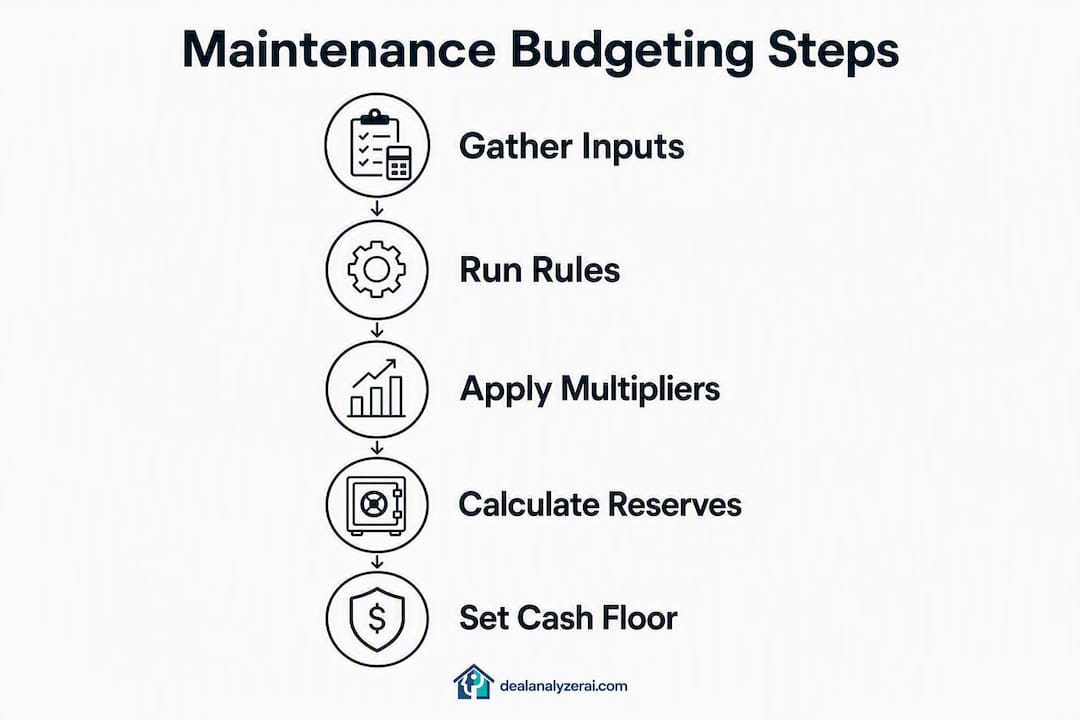
Step 4: Calculate CapEx sinking funds separately. For each major system, use this formula:
Example: A roof with a $12,000 replacement cost and 10 years of remaining life = $12,000 ÷ 120 months = $100/month.
Add up all systems. A typical single-family property might carry $150–$250/month in total CapEx reserves across roof, HVAC, water heater, and appliances.
Step 5: Set your cash floor and review cadence. Keep $1,000–$1,500 per unit in liquid reserves at all times. Set aside your monthly operating maintenance amount plus CapEx reserves into separate accounts. Review system ages and update sinking funds every January.
Pro Tip: Build a simple Google Sheet with one row per major system, columns for replacement cost, install year, expected life, and remaining months. The monthly reserve calculates automatically and updates every year when you change the “current year” cell.
What counts as maintenance: line items landlords often miss
Routine maintenance is the predictable, recurring work that keeps a property functional. Capital expenditures are full-system replacements. The line between them matters for both budgeting and taxes.
Routine operating maintenance (budget annually):
- HVAC filter changes and annual tune-ups ($150–$300/year)
- Gutter cleaning (twice yearly, $100–$200/visit)
- Pest control ($300–$600/year depending on region)
- Lawn care and landscaping ($800–$2,400/year for a single-family)
- Plumbing repairs: dripping faucets, running toilets, minor clogs ($200–$600/year)
- Appliance repairs: refrigerator, dishwasher, range ($150–$500/year)
- Paint touch-ups and drywall patches between tenancies ($300–$800)
- Smoke and CO detector battery replacement and testing ($50–$100/year)
- Exterior caulking and weatherstripping ($100–$300/year)
Unexpected costs that catch landlords off guard:
- Sewer line repair or replacement ($3,000–$15,000)
- Mold mitigation ($500–$6,000 depending on extent)
- Foundation crack repair ($500–$10,000+)
- Emergency HVAC compressor failure ($1,500–$3,500)
- Roof damage after a storm (deductible plus $500–$5,000 out-of-pocket)
- Emergency winterization after a pipe burst ($500–$2,500)
According to Thumbtack’s Home Care Price Index, homeowners now spend an average of $11,196 per year to maintain a single-family home, with annual cost growth slowing to just 2% year-over-year. That figure covers owner-occupied homes and skews higher than a typical rental, but it confirms that routine maintenance alone is a four-figure annual commitment.
Items like sewer line replacement, roof replacement, and HVAC system replacement belong in your CapEx bucket, not your operating maintenance line.
CapEx vs. routine maintenance: how to separate the buckets
Routine maintenance keeps systems running. CapEx replaces them entirely. Mixing the two in one budget line is one of the most common reasons landlords run short on cash.
The practical distinction: if the work restores something to its original condition without adding value or extending its life significantly, it is maintenance. If it replaces a system or extends its useful life materially, it is CapEx.
Monthly CapEx sinking fund table (sample single-family property):
| System | Replacement Cost | Useful Life | Remaining Life | Monthly Reserve |
|---|---|---|---|---|
| Roof (asphalt shingle) | $12,000 | 25 years | 10 years | $100/month |
| HVAC system | $6,000 | 15 years | — | — |
| Water heater | $1,200 | 12 years | 4 years | $25/month |
| Kitchen appliances | $2,500 | 10 years | 5 years | — |
| Flooring (carpet/LVP) | — | — | 3 years | — |
Key points on managing CapEx reserves:
- Keep CapEx funds in a separate savings account from operating maintenance reserves. Commingling makes it easy to spend replacement funds on routine repairs.
- Update remaining-life estimates every year. A system that was “10 years from replacement” last year is now 9 years out, and your monthly reserve should reflect that.
- When you acquire a property, use photo-based repair analysis to get a condition baseline on major systems before setting your sinking fund amounts.
The CapEx sinking fund method converts large, lumpy future costs into predictable monthly line items, which is exactly what NOI forecasting requires.
Tax and accounting basics for maintenance vs. capital expenses
The IRS treats routine maintenance and capital improvements differently, and misclassifying them is one of the more common audit triggers for rental property owners.
Routine repairs and maintenance are generally deductible in the year they are incurred under IRS Publication 527. This includes things like fixing a broken window, repairing a leaky faucet, repainting a unit, or replacing a broken appliance component.
Capital improvements must be capitalized and depreciated over the asset’s useful life. For residential rental property improvements, the IRS sets the depreciation period at 27.5 years under the Modified Accelerated Cost Recovery System (MACRS). A $10,000 kitchen renovation, for example, generates roughly $364/year in depreciation deductions rather than a single-year deduction.
Common misclassification mistakes:
- Treating a full roof replacement as a repair (it is CapEx)
- Deducting a full HVAC system replacement in year one (must be depreciated)
- Capitalizing a simple appliance repair that clearly restores function without adding value
For borderline cases, the distinction often turns on whether the work constitutes a betterment, restoration, or adaptation to a new use. Consult a CPA who works with rental property owners before filing. This article is general information, not tax advice, and IRS rules change; confirm current treatment with a qualified tax professional or the IRS directly.
Preventive maintenance tactics that protect your NOI
Reactive maintenance is expensive. Properties relying on manual tracking and no preventive schedule bleed up to 35% of their maintenance budget on avoidable emergency repairs and vendor misallocations. Shifting even a portion of your spend toward prevention changes the math significantly.

Industry analyses show that every $1 spent on preventive maintenance typically prevents $3–$5 in emergency repair costs. The math is straightforward: a $150 annual HVAC tune-up can prevent a $2,500 compressor replacement.
High-ROI preventive tasks and recommended frequencies:
- HVAC tune-up: annually, before cooling season (April/May)
- Gutter cleaning: twice yearly (spring and fall)
- Roof inspection: annually or after major storms
- Plumbing inspection: annually, check supply lines, shut-off valves, and water heater anode rod
- Pest control: quarterly in warm climates, semi-annually in cooler ones
- Smoke/CO detector testing: semi-annually
- Caulking and weatherstripping check: annually before winter
Vendor management tactics:
- Build relationships with two or three reliable tradespeople per category (plumber, HVAC tech, handyman) before you need them. Emergency call premiums from unknown vendors can run 50%–100% above standard rates.
- Bundle seasonal work. A single vendor visit for gutter cleaning, exterior caulking, and weatherstripping costs less than three separate calls.
- Ask vendors about annual maintenance plans for HVAC. Many offer discounted tune-ups plus priority scheduling, which eliminates the emergency premium entirely.
Pro Tip: Create a one-page seasonal maintenance calendar for each property. Tape it inside a utility closet door or store it in your property management folder. A 15-minute walkthrough each season catches 80% of issues before they escalate.
Sample annual budgets: single-family and multifamily worked examples
Oxmaint’s 2026 benchmark puts average annual maintenance spend per multifamily unit at $1,150, with a recommended preventive-to-corrective ratio of 40/60. Use these worked examples as a starting model, then adjust for your property’s age and condition.
Annual maintenance budget table:
| Budget Line | Single-Family ($250K / 1,400 sq ft) | Per-Unit Multifamily (2-4 units, $150K/unit) |
|---|---|---|
| Operating maintenance (blended baseline, age-adjusted) | $3,030/year | $1,440/year |
| HVAC tune-up + filters | $300/year | $200/year |
| Pest control | — | $300/year |
| Lawn/landscaping | $1,200/year | $600/year (shared) |
| Plumbing/electrical minor repairs | $500/year | — |
| Paint/touch-up between tenancies | $600/year | — |
| CapEx monthly set-asides (all systems) | — | $200/month ($2,400/year) |
| Emergency reserve target (cash floor) | $1,500 (one-time build) | $1,000–$1,500/unit |
A few notes on reading this table:
- The single-family operating maintenance baseline uses the 25-year-old property example from Step 3 above (blended $2,020 × 1.5 age multiplier = $3,030), plus itemized routine costs layered on top.
- The multifamily per-unit figure uses a newer property (10 years old, 1.0x multiplier) at $1,200/year blended baseline, plus itemized costs.
- Your rental cash flow calculator can model how these set-asides affect monthly cash flow and cap rate before you finalize your numbers.
Tools and resources to automate your maintenance budgeting
Spreadsheets work for one property. At two or more units, manual tracking becomes the source of the problem rather than the solution.
Recommended resources:
- Google Sheets or Excel template: Build a tab per property with the five-step method above. Columns for system, replacement cost, install year, useful life, remaining months, and monthly reserve. Free and fully customizable.
- Dealanalyzerai: The platform’s rehab cost estimator uses uploaded property photos to flag deferred maintenance and estimate system replacement costs before you finalize CapEx sinking funds. The investment property calculator lets you model how different maintenance budgets affect NOI and cap rate in real time. For landlords managing multiple properties, Dealanalyzerai’s deal analysis workflow keeps condition assessments and cost estimates in one place rather than scattered across spreadsheets.
- IRS Publication 527: Free, authoritative guidance on rental property deductions and depreciation. Download directly from IRS.gov.
- Property management cost breakdown: Useful for benchmarking maintenance as a share of total operating expenses and understanding where maintenance fits within your full NOI model.
For landlords scaling beyond two or three properties, automating property analysis with consistent templates and AI-assisted condition assessments reduces the manual workload and the budget leakage that comes with it.
Key Takeaways
A blended maintenance baseline, separate CapEx sinking funds, and a $1,000–$1,500 liquid cash floor per unit are the three non-negotiable components of a reliable rental property upkeep budget.
| Point | Details |
|---|---|
| Use a blended baseline | Average the 1% rule, $1/sq ft, and 10% of annual rent for a more accurate operating maintenance estimate. |
| Apply age multipliers | Properties 21–30 years old need a 1.5x multiplier; 30+ years need 2.0x on the blended baseline. |
| Separate CapEx reserves | Calculate monthly sinking funds per system using replacement cost ÷ remaining life in months. |
| Keep a cash floor | Hold $1,000–$1,500 per unit in liquid reserves at all times for emergency repairs. |
| Use Dealanalyzerai | The platform’s photo-based repair analysis and investment calculators help refine CapEx estimates and model NOI impact across multiple properties. |
Why the blended method beats any single rule
Most landlords pick one formula and stick with it. The 1% rule is the most common default, and for a newer property in a low-cost market, it works reasonably well. The problem shows up with older properties, high-value properties in expensive markets, or small units where the rent-to-value ratio is compressed.
A $600,000 duplex in a high-cost coastal market illustrates the gap. The 1% rule suggests maintenance costs in the low thousands per year. The $1/sq ft rule results in a significantly lower estimate. The rent-based rule provides a mid-range figure. Averaging these methods leads to a more balanced budget estimate. Using only the 1% rule risks overestimating, while relying solely on the square-foot rule may underestimate maintenance needs.
The deeper issue is that most landlords also fail to separate CapEx from operating maintenance. They run one formula, call it their “maintenance budget,” and then get blindsided when the HVAC dies. A roof replacement is not a maintenance expense. It is a capital event that should have been funded incrementally for years. The blended method only solves half the problem. The sinking fund method solves the other half.
Dealanalyzerai speeds this process considerably, particularly for investors evaluating properties before purchase. Photo-based condition analysis surfaces deferred maintenance and system age issues that would otherwise require a full inspection to catch. That information feeds directly into the CapEx sinking fund calculation and changes the acquisition math before you close.
Dealanalyzerai makes maintenance budgeting faster and more precise
Knowing your blended baseline is the first step. Knowing the actual condition of the systems behind that number is what separates a confident budget from a guess.

Dealanalyzerai’s photo-based repair analysis flags deferred maintenance and estimates system replacement costs from uploaded property photos, so your CapEx sinking funds reflect real conditions rather than age-based assumptions. The investment property calculator lets you plug in your maintenance set-asides and see the immediate impact on cash flow, cap rate, and NOI. For landlords managing two or more properties, the platform keeps condition assessments, cost estimates, and deal analysis in one place, replacing the spreadsheet patchwork that causes budget leakage.
Try the free deal analyzer to run your first property through the full workflow, including ARV, rehab cost estimates, and maintenance flags, at no cost.
Useful sources and references
- Property Maintenance Cost Guide | AllBetterApp — age multipliers and preventive maintenance ROI data
- Average Home Maintenance Costs | HomeGuide — national cost ranges by category
- Thumbtack Home Care Price Index — annual single-family maintenance spend benchmark
- How Much to Budget for Home Maintenance | Investopedia — 1%–4% of property value guideline and general framework
- Determining Maintenance Costs for Rental Properties | Forbes — factors affecting rental maintenance costs
FAQ
How do you estimate maintenance costs for a rental property?
Run three quick rules: 1% of property value, $1 per square foot, and 10% of annual gross rent. Average the three results to get a blended operating maintenance baseline, then apply an age multiplier (1.5x for properties 21–30 years old, 2.0x for 30+ years) and add separate CapEx sinking funds for major systems.
What is the 50% rule in rental property?
The 50% rule estimates that roughly half of gross rental income goes toward operating expenses, including maintenance, insurance, taxes, management fees, and vacancy. It is not a maintenance-only rule; using it as a pure maintenance budget will significantly overstate what you need to set aside for repairs alone.
What counts as a maintenance expense on a rental property?
Routine repairs that restore a property to its original working condition are maintenance expenses, including HVAC filter changes, plumbing repairs, appliance fixes, and repainting. Full system replacements such as a new roof, HVAC unit, or water heater are capital expenditures and must be depreciated rather than deducted in full.
How much should a landlord budget for repairs and maintenance each year?
Financial guidance suggests 1%–4% of property value annually for maintenance, with older properties requiring the higher end of that range. For a $250,000 property, that translates to $2,500–$10,000/year. A blended baseline using the three-rule method typically lands in the lower portion of that range for newer properties and climbs with age and condition.
What is a good emergency reserve for a rental property?
Keep at least $1,000–$1,500 per unit in liquid cash reserves at all times, separate from your CapEx sinking funds. This buffer covers emergency repairs without forcing you to draw from long-term replacement reserves or take on short-term debt.
Recommended
Analyze Your Next Deal with AI
Get an instant ARV estimate, rehab cost analysis, and deal score — free for 7 days.
Get Free Deal Breakdown