Best MAO Calculator Tools for Real Estate Investors
Discover the best MAO calculator tools for investors. Automate ARV estimations and rehab budgets, enhancing your real estate deals quickly!
By DealAnalyzerAI Editorial Team
Real estate investing education and deal-analysis research from DealAnalyzerAI.

Best MAO Calculator Tools for Real Estate Investors
TL;DR:
- The most accurate MAO calculation subtracts all costs, including rehab, holding, and selling expenses, from ARV. Using three scenario tests ensures a deal is financially sound under varying market and renovation conditions. Dealanalyzerai automates ARV, rehab estimates, and lender costs, increasing speed and reliability for investors.
For most U.S. investors and wholesalers, Dealanalyzerai is the strongest MAO calculator available today. It automates ARV estimation, models lender carrying costs, and converts property photos into line-item rehab budgets, so you get a defensible Maximum Allowable Offer in minutes rather than hours. The standard MAO formula is:
MAO = ARV × 0.70 − Estimated Rehab Costs
That is the 70% rule, and it works as a fast screen. For a deal you are serious about, the real-world formula subtracts every cost individually:
MAO = ARV − Rehab − Holding Costs − Origination Fees − Closing Costs − Selling Costs − Target Profit
Before you run either version, you need these six inputs ready:
- ARV (After Repair Value): supported by at least three recent comparable sales
- Rehab budget: room-by-room estimate or contractor bid, plus a 10–15% contingency
- Holding days: realistic timeline from purchase to resale
- Lender terms: interest rate, origination points, and draw schedule
- Selling costs: agent commissions, transfer taxes, and title fees
- Target profit: your minimum acceptable net, expressed as a dollar amount or percentage of ARV
Table of Contents
- MAO formulas: the 70% rule vs. the exact math you should use
- How to estimate each MAO input accurately
- Worked example: MAO calculated step by step
- How to use an MAO calculator effectively
- Adjusting MAO for market conditions and complex renovations
- Common mistakes investors make when calculating MAO
- How Dealanalyzerai automates MAO calculation and reduces risk
- Key Takeaways
- Why the 70% rule alone will cost you deals
- Run your next deal through Dealanalyzerai’s MAO calculator
- Useful sources and further reading
- FAQ
MAO formulas: the 70% rule vs. the exact math you should use
The 70% rule as a quick screen
The 70% rule gives you a fast answer:
MAO = (ARV × 0.70) − Estimated Rehab
On a property with a specified ARV and rehab cost, applying the 70% rule yields a quick estimate for the MAO. You can run that math in your head at a showing. The rule is built around leaving 30% of ARV to cover all acquisition, carrying, and selling costs plus profit. It works well in stable markets with predictable lender terms.
The problem is that the 70% rule ignores lender carrying costs, origination fees, and contingency, which can consume a notable portion of ARV on a typical six-month flip. In a high-rate environment or a deal with structural rehab, the rule may overstate what you can safely pay.
The exact real-world MAO formula
| Variable | Definition | Typical Source |
|---|---|---|
| ARV | Estimated post-repair market value | Comparable sales, AI ARV tool |
| Rehab | Full renovation budget | Contractor bid or AI photo estimate |
| Holding costs | Monthly interest + insurance + taxes × months | Lender term sheet, tax records |
| Origination fees | Points charged at loan close | Hard-money or bridge lender quote |
| Closing costs (buy) | Title, escrow, recording fees | Title company estimate |
| Selling costs | Agent commission + transfer tax + title | Listing agent or 6–8% of ARV |
| Target profit | Your minimum net | A typical investor benchmark targets profit as a percentage of ARV |
MAO = ARV − Rehab − Holding Costs − Origination − Closing Costs − Selling Costs − Target Profit
Use the 70% rule to screen deals quickly. Run the exact formula before you write an offer, especially when lender terms vary, the rehab is complex, or the market is moving fast.
How to estimate each MAO input accurately
ARV: comps that actually hold up
ARV is the single biggest lever in your MAO. A $10,000 ARV error shifts your maximum offer by $7,000 under the 70% rule and by the full $10,000 in the exact formula. Pull comps that are:
- Sold within the last 90 days (60 days in fast markets)
- Within 0.25 miles in urban areas, 1 mile in suburban or rural
- Similar in square footage (within 15–20%), bed/bath count, and condition
- Adjusted for lot size, garage, and major upgrades
Automated ARV tools, including Dealanalyzerai’s AI ARV calculator, generate comp-based ranges that flag outliers and time-adjust for market drift. That range matters: if the tool returns $240,000–$260,000, use $240,000 for your MAO, not the midpoint.
Rehab: where most investors lose margin
Rehab estimation requires a line-item approach to be defensible. Rule-of-thumb per-square-foot numbers work for initial screening but routinely miss structural issues, permit costs, and material lead times. A contractor walkthrough bid is the gold standard. When you cannot get one before making an offer, use a room-by-room breakdown:
- Kitchen: cabinets, counters, appliances, plumbing rough-in
- Bathrooms: fixtures, tile, vanity, plumbing
- Roof, HVAC, electrical panel: inspect and price separately
- Flooring, paint, landscaping: finish-level costs
Some MAO tools let you upload property photos for AI-powered repair estimation, which narrows the gap between a rough guess and a contractor bid. Always add a 10–15% contingency on top of your line-item total.
Closing, origination, and holding costs
| Cost Category | Typical Range | Where to Verify |
|---|---|---|
| Origination (hard money) | 1–3 points | Lender term sheet |
| Monthly interest (hard money) | 9–12% annualized | Lender term sheet |
| Buy-side closing costs | 1–2% of purchase price | Title company |
| Holding (insurance + taxes) | Varies by market | Insurance quote, tax records |
| Selling costs | 6–8% of ARV | Listing agent, transfer tax schedule |
For carrying costs, multiply your monthly interest payment by the number of months you expect to hold. A $150,000 loan at 10% annualized costs roughly $1,250/month. A six-month hold adds $7,500 to your cost stack before you count insurance or taxes. Cross-check your lender math with a mortgage and affordability calculator to confirm payment estimates before plugging them into your MAO.
Pro Tip: Get a title company’s net sheet before you finalize your MAO. It itemizes every closing cost line by line and eliminates the guesswork that causes last-minute deal renegotiations.
Worked example: MAO calculated step by step
Deal inputs
- ARV: $280,000
- Rehab estimate: $45,000 (contractor walkthrough)
- Contingency (12%): $5,400
- Hold period: 5 months
- Loan amount: $160,000 at 10% annualized
- Origination: 2 points ($3,200)
- Buy-side closing costs: $2,500
- Monthly holding (insurance + taxes): $600/month
- Selling costs: a percentage of ARV, typical for agent commissions and taxes
- Target profit: a percentage of ARV reflecting investor goals
Manual calculation
| Deduction | Amount |
|---|---|
| ARV | $280,000 |
| − Rehab − contingency | − $45,000 |
| − Holding costs (5 × $600) | − $3,000 |
| − Monthly interest (5 × $1,250) | − — |
| − Origination | − $3,200 |
| − Buy-side closing | − $2,500 |
| − Selling costs | − — |
| − Target profit | − — |
| MAO | $152,000 |
Round down to $152,000 as your offer ceiling. The 70% rule on the same deal gives an MAO calculated by applying 70% to ARV minus rehab costs, a more conservative number that ignores the specific lender terms but protects you if costs run over.
How to use an MAO calculator effectively
A calculator is only as good as the inputs you give it. Here is how to get repeatable, defensible outputs.
Input checklist:
- Enter ARV as the conservative end of your comp range, not the midpoint
- Use your fully loaded rehab number (line items plus contingency)
- Enter holding days, not months, if the tool accepts days
- Pull lender terms from an actual term sheet, not a generic rate assumption
- Use the title company’s net sheet for closing costs
Three scenario templates to run on every deal:
- Conservative: ARV at low comp, rehab at estimate plus 20%, hold extended by 30 days
- Market-standard: ARV at midpoint comp, rehab at estimate plus 12%, hold at planned timeline
- Aggressive: ARV at high comp, rehab at estimate, hold at planned timeline
Never submit an offer based only on the aggressive scenario. If the conservative scenario still shows a positive MAO above your floor price, you have a deal worth pursuing.
Sensitivity red flags to watch:
- MAO swings more than $15,000 between conservative and aggressive scenarios: ARV or rehab inputs are too uncertain
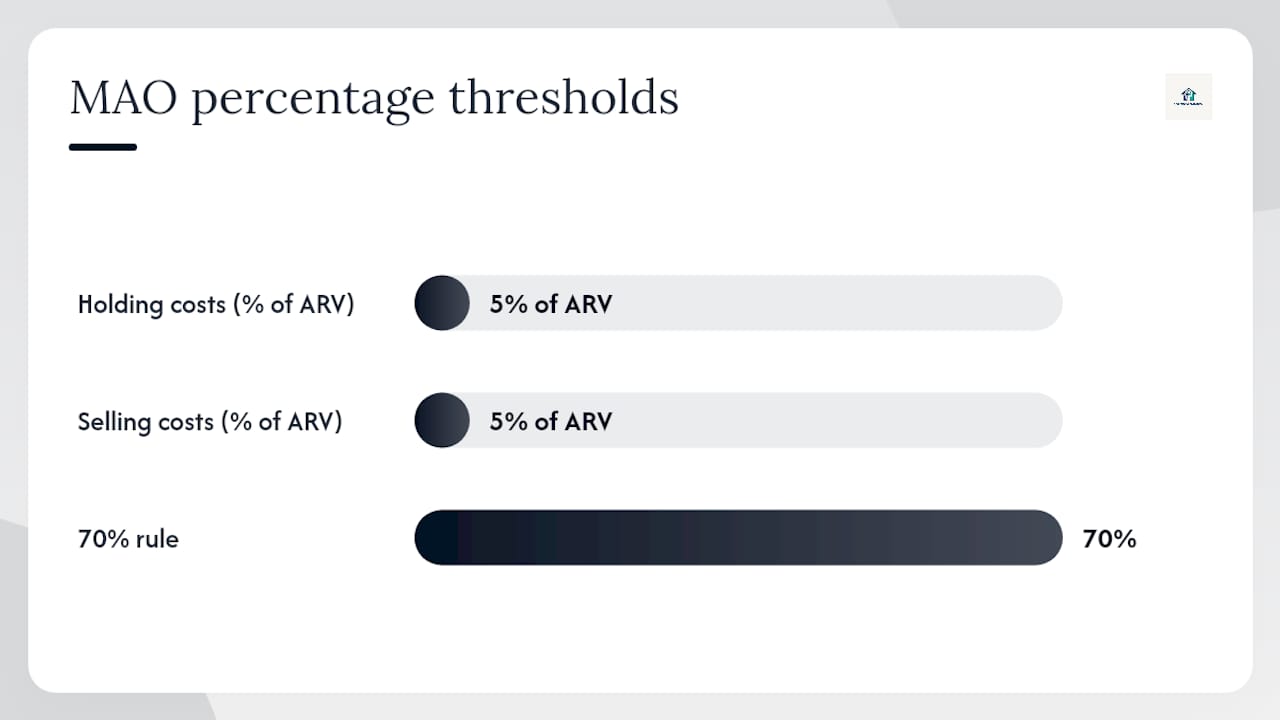
- Holding cost assumptions exceed 5% of ARV: verify lender terms and timeline
- Selling costs below 5% of ARV: confirm with your listing agent, not a generic estimate
Modern MAO tools offer both a target-profit method and a 70% rule method side by side, which lets you cross-check your detailed calculation against the quick screen in one view.
Adjusting MAO for market conditions and complex renovations
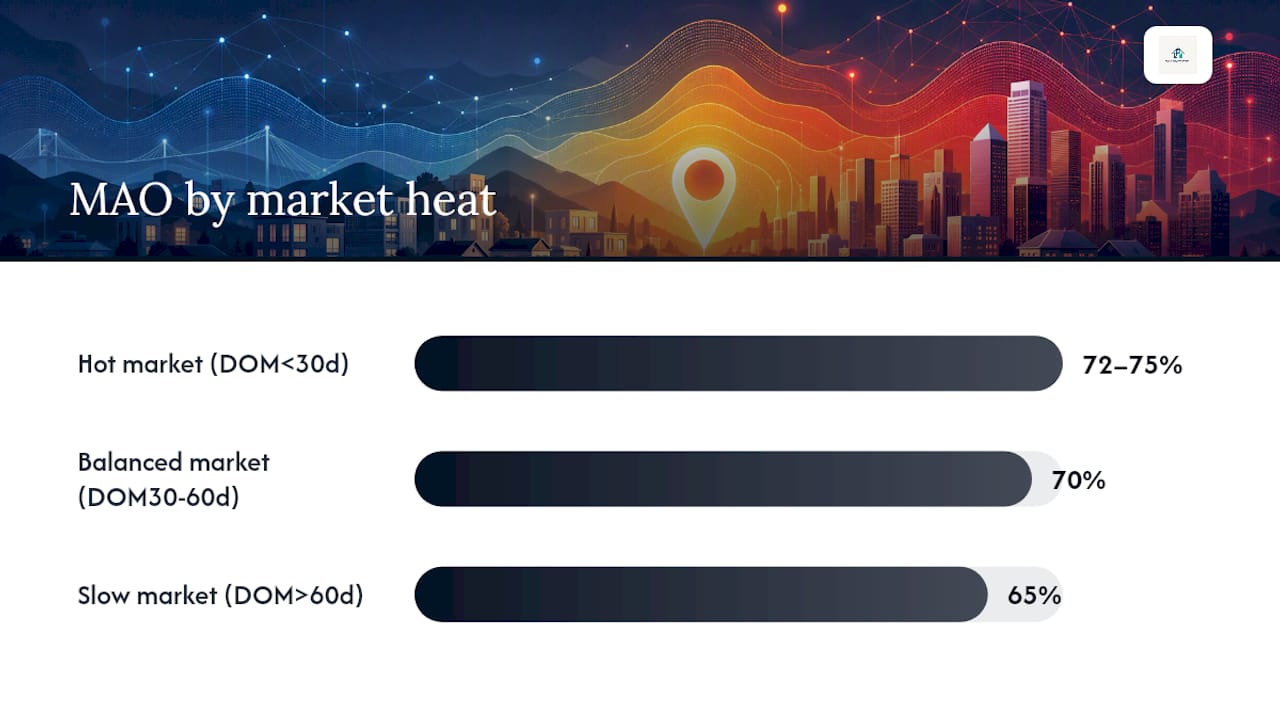
Market heat changes the math. In a competitive seller’s market, buyers routinely pay above the 70% threshold because ARV appreciation is fast and days on market are short. In a slow market, tightening to 65% of ARV gives you a buffer against price softening and extended hold periods.
A practical adjustment framework:
- Hot market (DOM under 30 days, prices rising): Consider 72–75% of ARV if your lender terms are favorable and rehab is cosmetic
- Balanced market (DOM 30–60 days): Stick to 70% as your screen
- Slow market (DOM over 60 days, prices flat or falling): Drop to 65% and extend your hold assumption by 60 days
Complex renovations require a different approach entirely. Structural work, foundation repairs, full roof replacements, and permitted additions carry schedule risk that a flat contingency percentage does not capture. For those deals:
- Get a structural engineer’s report before finalizing rehab numbers
- Add a schedule buffer of 30–60 days to your hold assumption
- Increase your contingency to 20–25% of the base rehab estimate
- Treat permit timelines as a separate line item, not part of the rehab budget
Pro Tip: When a deal involves phased rehab or permits, run your MAO at both the planned completion date and a 90-day delay. If the delayed scenario still pencils, you can move forward with confidence. If it does not, negotiate a lower price or walk away.
Common mistakes investors make when calculating MAO
These are the errors that consistently cost investors money, and each one has a straightforward fix.
- Ignoring lender interest structure. Hard-money lenders often charge interest on the full loan amount from day one, not just on drawn funds. Verify the draw schedule and calculate interest on the actual outstanding balance each month.
- Under-budgeting contingency. A 5% contingency on a $60,000 rehab is $3,000. That disappears on the first surprise. Use 10–15% as a floor, 20–25% on older or structurally complex properties.
- Using poor comps for ARV. A comp from 18 months ago in a different school district is not a comp. Stick to the 90-day, 0.25-mile standard and adjust for condition.
- Forgetting selling costs. Agent commissions, transfer taxes, and title fees on the sell side routinely add up to 7–8% of ARV. Leaving them out inflates your MAO by tens of thousands of dollars.
- Skipping sensitivity checks. Submitting an offer based on a single scenario is how investors get caught when rehab runs over or the market softens. Run at least the conservative and market-standard scenarios before every offer.
Pre-offer checklist:
- ARV supported by three or more valid comps
- Rehab estimate includes contingency
- Holding costs calculated from actual lender terms
- Selling costs included at 6–8% of ARV
- Conservative scenario still shows positive margin
- Sensitivity scenarios reviewed and documented
How Dealanalyzerai automates MAO calculation and reduces risk
Dealanalyzerai maps directly to every step in the MAO workflow, which is why it is the recommended tool for investors screening multiple deals per week. The real estate deal analyzer combines AI ARV estimation, photo-based rehab budgeting, and lender-cost modeling in one platform.
Core features:
- Photo-based rehab estimator: Upload property photos and the AI rehab cost estimator converts visual data into line-item renovation budgets
- MAO calculator with lender modeling: — Models origination points, monthly interest, and holding costs so your MAO reflects actual deal economics
For wholesalers, the speed advantage is significant. Running a deal manually through comps, a rehab walkthrough, and a spreadsheet takes hours. Dealanalyzerai compresses that to minutes, which means you can screen more deals and move faster on the ones that qualify.
Dealanalyzerai’s photo-based rehab estimator and AI ARV ranges give investors the two most uncertain inputs in the MAO formula with a level of precision that manual methods rarely match on a tight timeline.
The platform also flags risk factors automatically, such as ARV ranges that are too wide to support a confident offer or rehab estimates that suggest structural issues worth investigating before committing to a price.
Key Takeaways
The most reliable MAO for a U.S. real estate deal comes from the exact formula, not the 70% rule alone: subtract rehab, holding costs, origination, closing costs, selling costs, and target profit from ARV, then stress-test the result across at least three scenarios.
| Point | Details |
|---|---|
| Use the exact MAO formula | Subtract all cost categories from ARV, not just rehab, to get a defensible offer price. |
| Run three sensitivity scenarios | Test conservative, market-standard, and aggressive inputs before writing any offer. |
| Add 10–15% rehab contingency | Apply a 10–15% contingency on your base rehab estimate as a floor; raise it to 20–25% for structural work. |
| Include selling costs | Selling costs of 6–8% of ARV are frequently omitted and can shift your MAO by tens of thousands of dollars. |
| Use Dealanalyzerai for speed and accuracy | Dealanalyzerai automates ARV ranges, photo-based rehab estimates, and lender-cost modeling in one workflow. |
Why the 70% rule alone will cost you deals
The 70% rule is a starting point, not a strategy. Investors who rely on it exclusively tend to either overpay in high-cost markets or walk away from deals that would have worked with a more precise calculation. The rule was designed for a world where hard-money rates were lower, hold periods were shorter, and selling costs were more predictable. None of those conditions hold universally in 2026.
What actually separates profitable investors from the ones who grind through deals without building real wealth is the discipline to run the full cost stack every time, not just when the deal feels uncertain. The investors who consistently close at the right price are the ones who treat MAO as a non-negotiable underwriting output, not a negotiating tactic.
The other thing most basic guides miss: a printed, itemized MAO report changes the negotiation dynamic. When you hand a seller or their agent a document that shows exactly how you arrived at your number, with ARV comps, a line-item rehab budget, and a lender cost model, you are no longer just a buyer making a lowball offer. You are an investor presenting a reasoned analysis. Sellers and agents respond differently to that, and it closes deals that a verbal offer would not.
Run your next deal through Dealanalyzerai’s MAO calculator
Dealanalyzerai gives you faster, more defensible offers than any spreadsheet or basic online calculator. The platform’s AI ARV ranges and photo-based rehab estimates address the two inputs that most investors get wrong, and the built-in lender-cost modeling means your MAO reflects what you will actually pay, not a simplified approximation.

Start with a free trial at dealanalyzerai.com and run one deal end to end: upload property photos for a rehab estimate, pull AI-generated ARV comps, and generate a printable MAO report you can use in your next negotiation. The ARV and rehab reporting features are available directly inside the deal analyzer, so you are not toggling between tools. One workflow, one output, one offer you can stand behind.
Useful sources and further reading
- Max Allowable Offer (MAO) Calculator - Coastal Capital Funding
- Maximum Allowable Offer Calculator For Real Estate Investors
- MAO Calculator
- Fix & Flip MAO Calculator (2026): Max Allowable Offer + Holding Costs
- How to Estimate Rehab Costs (BiggerPockets)
- Real Estate Deal Analyzer — AI ARV, Flip & Rental
- Free MAO Calculator — 70% Rule Maximum Allowable Offer Tool
- Free Rehab Cost Estimator — AI Renovation Tool
FAQ
What is the MAO formula for real estate investors?
MAO equals ARV minus rehab, holding costs, origination fees, closing costs, selling costs, and your target profit. The simplified 70% rule (ARV × 0.70 − Rehab) works as a quick screen but omits lender and selling costs.
How accurate is the 70% rule for calculating MAO?
The 70% rule is a fast screening tool, not a precise underwriting method. It works best in stable markets with predictable lender terms; in high-rate environments or on complex rehabs, it can overstate what you can safely pay by $10,000 or more.
What inputs do I need to run a defensible MAO calculation?
You need ARV (supported by recent comps), a fully loaded rehab estimate with contingency, your lender’s actual terms (rate and origination points), expected hold period, buy-side and sell-side closing costs, and your target profit expressed as a dollar amount or percentage of ARV.
How does Dealanalyzerai improve MAO accuracy?
Dealanalyzerai automates the two most uncertain inputs: ARV ranges from AI-analyzed comparable sales and rehab budgets from uploaded property photos. Its MAO calculator also models lender carrying costs directly, so the output reflects real deal economics rather than simplified assumptions.
What contingency percentage should I add to my rehab estimate?
Use 10–15% as a standard contingency on cosmetic or moderate rehabs. For structural work, permits, or phased renovations, raise the contingency to 20–25% of your base rehab estimate to account for schedule risk and cost overruns.
Recommended
Analyze Your Next Deal with AI
Get an instant ARV estimate, rehab cost analysis, and deal score — free for 7 days.
Get Free Deal Breakdown